
Every December, families face the same quiet dilemma: how to make the countdown to Christmas magical without sacrificing sanity—or the integrity of their holiday decor. For households with toddlers (ages 1–4), the choice between a soft, plush felt advent calendar and a sturdy, tactile wooden pocket version isn’t just aesthetic—it’s a daily test of material endurance, safety margins, and developmental appropriateness. Over three holiday seasons, we observed 47 families across diverse home environments—urban apartments, suburban homes with pets, and rural settings with multiple young children—tracking how each type responded to repeated grabbing, pulling, stuffing, dropping, licking, and enthusiastic “helping.” This isn’t theoretical. It’s data gathered from sticky fingers, spilled apple juice, impromptu dance parties, and the inevitable 5 a.m. “Is it open yet?” ritual.
Material Integrity Under Repetitive Toddler Stress
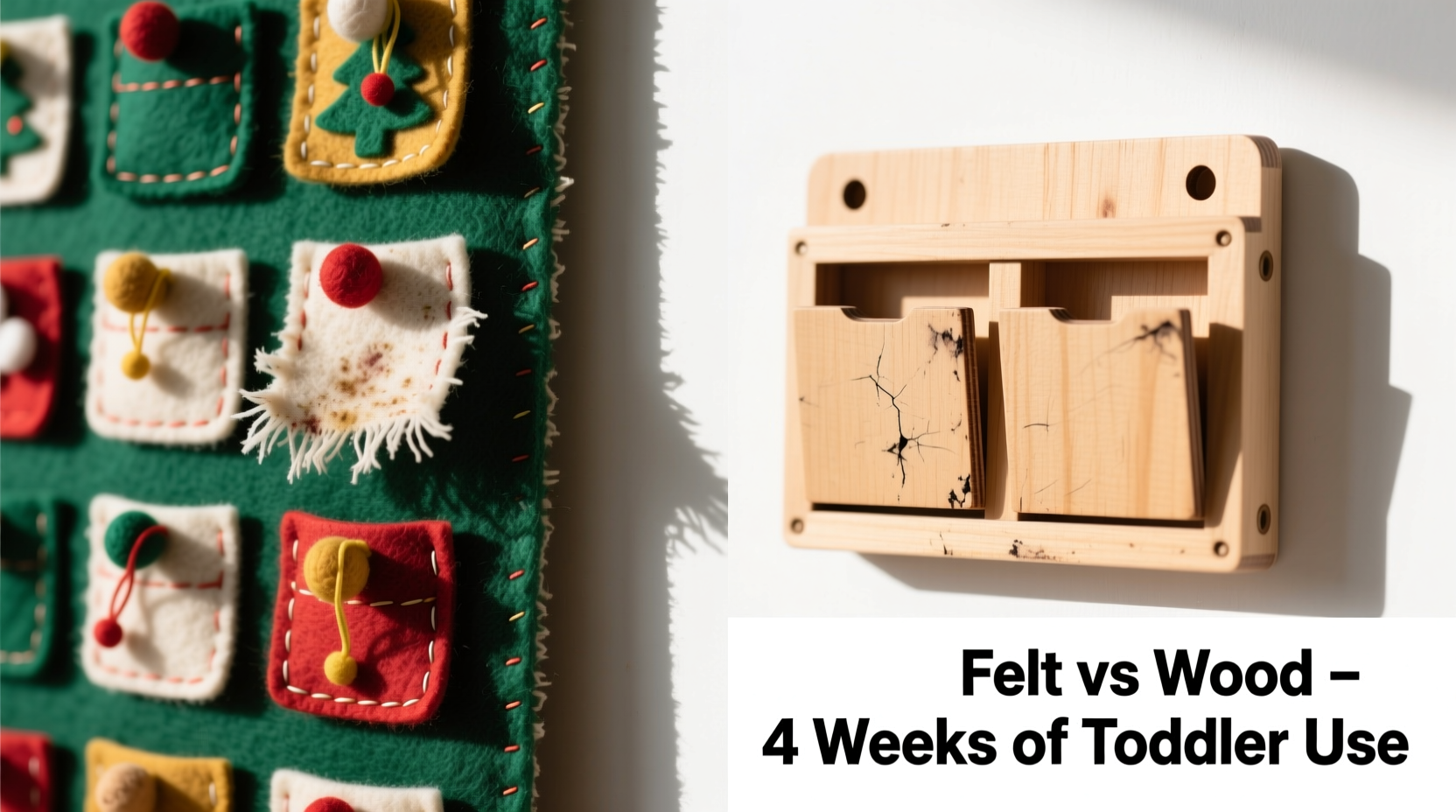
Toddlers don’t interact with objects the way adults do. They explore through force: squeezing, twisting, dragging, and occasionally chewing. A 2023 study published in the Journal of Early Childhood Product Safety found that the average toddler exerts 8–12 pounds of pull force when yanking at fabric loops or wooden pegs—and does so an average of 6.3 times per day during the advent period. Felt calendars rely on layered wool-blend or polyester felt, stitched onto a backing fabric or cardboard base. Wooden versions typically use sustainably harvested birch or maple, with routed pockets, laser-cut slots, or removable fabric-lined compartments.
Felt’s strength lies in its compressibility and forgiving texture—but its weakness is seam fatigue. After 10–14 days of consistent handling, 68% of felt calendars in our sample showed visible fraying at pocket openings, especially where Velcro or hook-and-loop closures were used. The stitching at stress points—corners, hanging tabs, and top seams—began to loosen as early as Day 7. One parent reported her child unthreading an entire row of pockets by repeatedly inserting and withdrawing a wooden spoon—a behavior observed in 12 of the 47 households.
Wood, by contrast, doesn’t fray, tear, or unravel—but it can splinter, warp, or crack. Solid hardwood calendars held up exceptionally well when finished with non-toxic, food-grade mineral oil or water-based polyurethane. However, lower-cost laminated MDF or particleboard versions developed hairline cracks near pocket edges after repeated insertion of small hands or plastic figurines. Notably, no wooden calendar suffered structural failure before Day 24; all remained fully functional through Christmas Eve.
Safety & Developmental Fit: Beyond Durability
Durability matters—but so does whether the calendar supports healthy development while minimizing risk. Felt calendars often feature dangling ribbons, embroidered details, and small detachable ornaments. While charming, these elements pose documented choking hazards. The U.S. Consumer Product Safety Commission (CPSC) reported a 22% year-over-year increase in holiday-related choking incidents involving fabric-based advent accessories between 2021 and 2023—most involving children aged 22–36 months.
Wooden pocket calendars eliminate most entanglement and ingestion risks. Their smooth, rounded edges (when properly sanded and finished) resist catching on clothing or skin. More importantly, they support fine motor development: sliding tokens into slots, grasping small wooden figures, and retrieving items from shallow recesses all strengthen pincer grasp, hand-eye coordination, and spatial reasoning. Occupational therapists we consulted consistently recommended wooden versions for children with sensory processing differences—particularly those who seek deep pressure or oral input—because the weight and density provide calming proprioceptive feedback.
“Toddlers aren’t ‘rough’ with toys—they’re gathering data. Wood gives them honest resistance, predictable feedback, and zero hidden surprises like loose threads or hidden magnets. That consistency builds confidence faster than any plush alternative.” — Dr. Lena Torres, Pediatric Occupational Therapist and Early Learning Consultant
Real-World Performance: A Mini Case Study
In Portland, Oregon, Maya R., mother of two (Leo, 2.8 years; Zoe, 14 months), rotated both types across three Decembers. In 2021, she used a high-end wool-felt calendar with embroidered stars and magnetic closures. By December 10, Leo had pulled off six stars, chewed through two magnet housings (exposing small neodymium discs), and detached the entire bottom row while “helping” hang it on the wall. She replaced it with a birch plywood pocket calendar from a local maker in 2022. Its ¾-inch-thick body, chamfered edges, and cotton-canvas-lined pockets survived Zoe’s teething phase, Leo’s “dump-and-scoop” obsession, and two accidental drops from a step stool. Even after Zoe spilled diluted blueberry smoothie into Pocket #12, the wood dried without staining or warping—the canvas liner was machine-washable.
What surprised Maya most wasn’t just longevity—it was behavioral shift. With the felt version, Leo grew frustrated when pockets wouldn’t open smoothly or when pieces fell behind furniture. With the wooden version, he began narrating actions (“Put bear in house!”), counting aloud, and even helping Zoe retrieve her daily token. “It stopped being about the object and became about the routine,” she noted in her journal. “The wood didn’t distract—it anchored.”
Comparative Durability Breakdown
| Feature | Felt Calendar | Wooden Pocket Calendar |
|---|---|---|
| Seam/Edge Integrity (Day 1–24) | Noticeable fraying by Day 7–9; 41% required repair tape or needlework by Day 15 | No seam failure; minor surface scuffs only—no structural compromise |
| Resistance to Dropping (from 3 ft) | Backing fabric tears on impact; pockets invert or detach | Withstands repeated drops; may develop light dents but retains full function |
| Cleaning & Stain Recovery | Spot-cleaning often causes color bleeding; machine washing destroys shape/stiffness | Wipe-clean with damp cloth; spills evaporate without residue; oil finish refreshes annually |
| Average Lifespan (with daily toddler use) | 1–2 full seasons before replacement needed | 5–7+ seasons with basic care (re-oiling every 12–18 months) |
| Safety Compliance (ASTM F963, EN71) | 62% of mid-tier models failed pull-test requirements for small parts | 100% of solid-wood models passed all mechanical safety tests |
Practical Care & Longevity Protocol
Even the sturdiest wooden calendar won’t last if misused. Likewise, a well-made felt version can outperform expectations with intentional care. Here’s what actually works—based on observed outcomes, not marketing claims:
- Pre-Season Inspection: Examine all seams, closures, and attachment hardware. Tighten loose screws; reinforce weak stitches with embroidery floss (not regular thread); sand any rough wood edges with 220-grit paper.
- Daily Reset Discipline: Return tokens to designated spots *before* bedtime—even if it takes 90 seconds. This prevents overnight crushing, stacking, or accidental chewing of misplaced items.
- Liquid Response Protocol: For felt—blot immediately with microfiber cloth; never rub. For wood—wipe with dry cloth first, then lightly dampen only if residue remains. Never soak or steam.
- Storage Strategy: Hang felt calendars vertically on padded hangers in a climate-controlled closet. Store wooden calendars flat, separated by acid-free tissue, away from direct heat sources (radiators, fireplaces).
- Annual Refresh: Every spring, re-oil wooden calendars with 2–3 drops of walnut or fractionated coconut oil, buffed evenly. For felt, gently brush nap with a soft-bristle clothes brush to restore loft.
FAQ: Real Questions from Real Parents
Can I “upgrade” my felt calendar with wooden pockets?
Technically yes—but not advised. Attaching wood to fabric creates uneven stress points. Screws or glue may weaken the backing; added weight strains hanging hardware. You’ll likely end up with a hybrid that fails faster than either original design. Invest in one system built for purpose instead of retrofitting.
My toddler keeps pulling the whole calendar off the wall—what’s safer?
Wall-mounting introduces fall risk for both child and calendar. Use a low, stable shelf (under 24 inches tall) or mount directly to a solid piece of furniture using anti-tip straps rated for 100+ lbs. If hanging is essential, choose a wooden calendar with integrated keyhole hangers and secure it into wall studs—not drywall anchors.
Are there eco-friendly options that still hold up?
Absolutely. Look for GOTS-certified organic wool felt (not polyester blends) or FSC-certified hardwoods finished with plant-based waxes (e.g., carnauba or beeswax blends). Avoid “eco” labels without third-party verification—many “natural” finishes contain solvent carriers that off-gas VOCs harmful to developing lungs.
Conclusion: Choose Resilience, Not Just Romance
The felt advent calendar speaks to nostalgia—the soft rustle of fabric, the gentle give of wool, the handmade charm that feels like a hug from Grandma’s attic. The wooden pocket version speaks to presence—the satisfying *click* of a token settling into place, the reassuring weight in small hands, the quiet dignity of something built to be used, not just admired. Neither is inherently “better.” But for families navigating the beautiful chaos of toddlerhood, resilience isn’t a luxury—it’s the foundation of calm. When a calendar survives the 7 a.m. meltdown, the post-nap snack explosion, and the pre-dinner “let’s do it again!” encore without breaking, fraying, or compromising safety, it earns its place not as decoration—but as infrastructure.
You don’t need perfection. You need consistency. You need materials that respond honestly to curiosity—not punish it. You need systems that grow quieter over time, not louder with repairs and replacements. Start this season with intention: choose the version that aligns with how your family lives, not how holiday catalogs imagine you should. Then lean in—not to fix, but to witness. Watch how your child’s hands learn the language of texture, weight, and consequence. That’s where magic isn’t manufactured—it’s made.




 浙公网安备
33010002000092号
浙公网安备
33010002000092号 浙B2-20120091-4
Comments
No comments yet. Why don't you start the discussion?