
The Fender Esquire and Telecaster are two of the most iconic electric guitars in music history. Both born from Leo Fender’s pioneering designs in the early 1950s, they share a similar body shape, construction, and unmistakable twang. Yet, one key difference stands out: the Esquire has a single pickup, while the Telecaster features two. But does that extra pickup truly make a difference in tone, playability, and musical application? The answer isn’t as simple as “more pickups equal more versatility.” To understand what’s at stake, we need to dive into their origins, circuitry, tonal characteristics, and how players have used them across genres.
A Tale of Two Guitars: Origins and Evolution
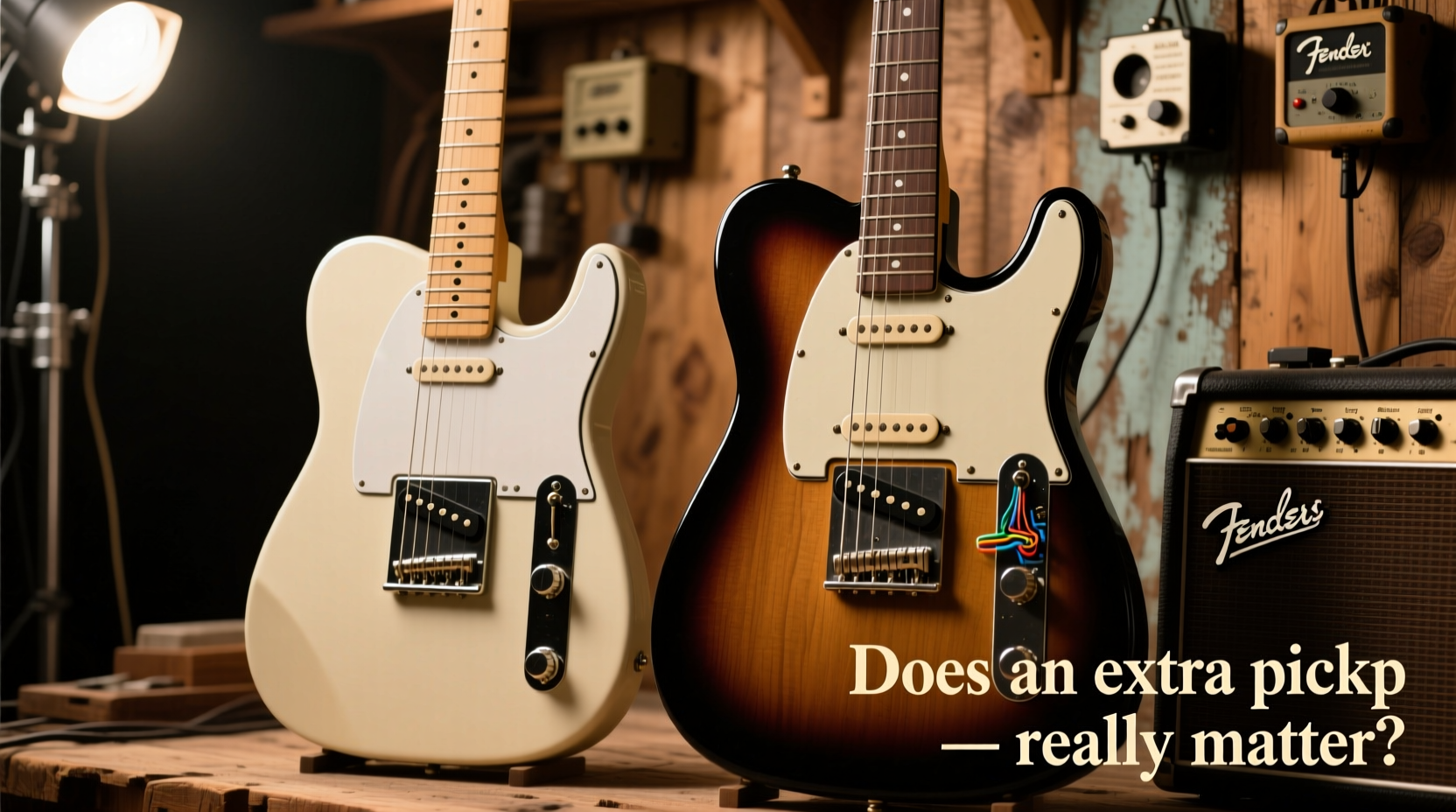
When Leo Fender introduced the Esquire in 1950, it was marketed as an affordable, no-frills electric guitar with a single bridge pickup. It was meant for working musicians who needed durability and clarity. However, customer demand for greater tonal flexibility led Fender to add a neck pickup and rename the dual-pickup model the “Broadcaster.” After a trademark conflict with Gretsch, the name evolved into “Telecaster” by 1951.
The original Esquire didn’t stay single-pickup for long. By late 1950, many Esquires were factory-equipped with a second pickup in the neck position—effectively making them Telecasters. Yet, Fender continued producing the Esquire designation for guitars with only one pickup, often wiring them with a switch that allowed access to multiple tones via coil splitting or resistor networks—even with just one physical pickup.
“Leo Fender wasn’t chasing complexity—he was solving problems. The Esquire was his prototype for simplicity; the Telecaster, his answer to player demand.” — Richard Smith, Fender Archivist and Historian
Tonal Differences: One Pickup vs. Two
At first glance, the Telecaster appears superior in versatility: two pickups mean more tonal combinations. The standard three-way switch offers:
- Position 1: Bridge pickup (bright, cutting, twangy)
- Position 2: Bridge + Neck (a blended, slightly scooped midrange tone)
- Position 3: Neck pickup (warm, round, bluesy)
The Esquire, with only one pickup, seems limited. But here’s where things get interesting: many vintage and modern Esquires use a unique switching configuration. With just the bridge pickup installed, players can still access three distinct sounds through internal resistor and tap switching:
- Full bridge pickup output
- Bridge pickup with a resistor, creating a softer, warmer tone
- Neck-position tone simulated via a partial ground circuit (often called the “tone simulator”)
This clever design gives the Esquire unexpected flexibility despite its minimalist hardware. In practice, the “third” tone mimics a neck pickup’s warmth, though it lacks the full magnetic response of a dedicated coil.
Performance Comparison: When Simplicity Wins
In real-world playing scenarios, the choice between Esquire and Telecaster often comes down to intent. The Telecaster excels in situations requiring quick tonal shifts—think country pedal steel bends in the neck position followed by stinging bridge licks. Studio musicians appreciate its range; session players like Danny Gatton and Albert Lee leveraged both pickups to cover multiple styles in one take.
Conversely, the Esquire appeals to players who value focus and immediacy. Its single pickup forces a commitment to a specific sonic identity: bright, aggressive, and direct. Artists like Tom Morello and John Lennon (who famously played a ’58 Esquire) embraced this limitation as a creative tool. Morello used his Esquire with Rage Against the Machine to craft searing riffs and effects-laden solos, relying on technique and external processing rather than pickup switching.
Moreover, the Esquire’s lighter weight and balanced output contribute to a responsive feel under the fingers. With fewer electronics, there’s less signal degradation and a more direct connection between string vibration and amplifier.
Feature Comparison: Esquire vs. Telecaster
| Feature | Fender Esquire | Fender Telecaster |
|---|---|---|
| Pickups | 1 (bridge only) | 2 (bridge + neck) |
| Switching Options | 3 positions (via resistor/tap circuitry) | 3 positions (standard selector) |
| Tonal Range | Narrower, focused on bridge character | Broad: bright bridge to warm neck |
| Weight | Slightly lighter (less hardware) | Standard (~7–8 lbs) |
| Best For | Rock, punk, garage, experimental | Country, rock, jazz, studio work |
| Player Examples | Tom Morello, John Lennon, Roy Buchanan | Keith Richards, Bruce Springsteen, James Burton |
Mini Case Study: The Garage Rock Revival
In the early 2000s, bands like The White Stripes and The Hives reignited interest in stripped-down rock aesthetics. Jack White of The White Stripes famously played a modified 1950s Esquire through cranked tube amps and analog effects. With no neck pickup to rely on, he developed a playing style centered around dynamics, palm muting, and aggressive picking—all amplified by the Esquire’s inherent brightness and sustain.
During live performances, White would often engage the Esquire’s second switch position (resistor mode), dialing in a spongy, almost vocal midrange dip that cut through without overpowering the mix. This setup became a signature part of The White Stripes’ sound on tracks like “Seven Nation Army” and “Icky Thump.”
The case illustrates a crucial point: limitations breed innovation. Had White been using a Telecaster, he might have defaulted to the neck pickup for warmer tones. Instead, the Esquire pushed him toward developing a unique voice within a constrained palette.
Expert Tips for Choosing Between Them
Selecting between an Esquire and a Telecaster isn’t just about specs—it’s about philosophy. Ask yourself the following before deciding:
Checklist: Which Guitar Fits Your Style?
- Do you frequently switch between bright and warm tones during a set? → Lean toward Telecaster.
- Do you rely heavily on effects pedals or amp overdrive? → Esquire’s clarity can enhance pedal response.
- Are you looking for studio versatility? → Telecaster offers broader recording options.
- Do you prefer a raw, unfiltered connection to your amp? → Esquire delivers minimal signal loss.
- Is stage weight or balance an issue? → Esquire is slightly lighter and more compact.
FAQ
Can I modify an Esquire to sound like a Telecaster?
Yes, but not without significant work. You’d need to route the body for a neck pickup, install new electronics, and modify the pickguard. Many players instead choose a Telecaster and disable the neck pickup when desired, preserving originality.
Is the Esquire more affordable than the Telecaster?
Not necessarily. Due to its rarity and cult status, vintage and reissue Esquires often command higher prices than standard Telecasters. Limited production runs also increase collector demand.
Does the Esquire’s third tone really mimic a neck pickup?
It simulates the warmth but doesn’t replicate the magnetic response. It’s best described as a “voiced” bridge tone—softer and fuller, yet still rooted in the bridge position’s attack and clarity.
Conclusion: Does the Extra Pickup Matter?
The extra pickup on a Telecaster undeniably expands tonal possibilities. For players navigating diverse genres or needing quick access to contrasting sounds, it’s a practical advantage. But the Esquire proves that limitation isn’t deficiency. Its singular focus fosters a distinctive voice—one prized by innovators who value character over convenience.
In the end, the question isn’t whether the extra pickup matters, but what kind of musician you are. If you thrive on options and adaptability, the Telecaster is your ally. If you seek a raw, unfiltered conduit for expression, the Esquire might be the more powerful tool. Both guitars have shaped music history not because of how many pickups they have, but because of what players have done with them.




 浙公网安备
33010002000092号
浙公网安备
33010002000092号 浙B2-20120091-4
Comments
No comments yet. Why don't you start the discussion?