
For guitarists seeking a compact, versatile combo amp that delivers authentic tube tone with digital flexibility, the Fender Super Champ series has long been a favorite. The original Super Champ XD brought modeling technology into a classic Fender chassis, while the newer Super Champ X2 refined the concept with enhanced features and usability. But for players already invested in the XD—or considering an entry-level purchase—the question remains: is upgrading to the X2 actually worthwhile?
This article breaks down the key differences between the Fender Super Champ XD and X2, evaluates their tone, functionality, and practical applications, and helps you decide whether the newer model justifies its place in your rig.
Tonal Architecture: Analog Meets Digital
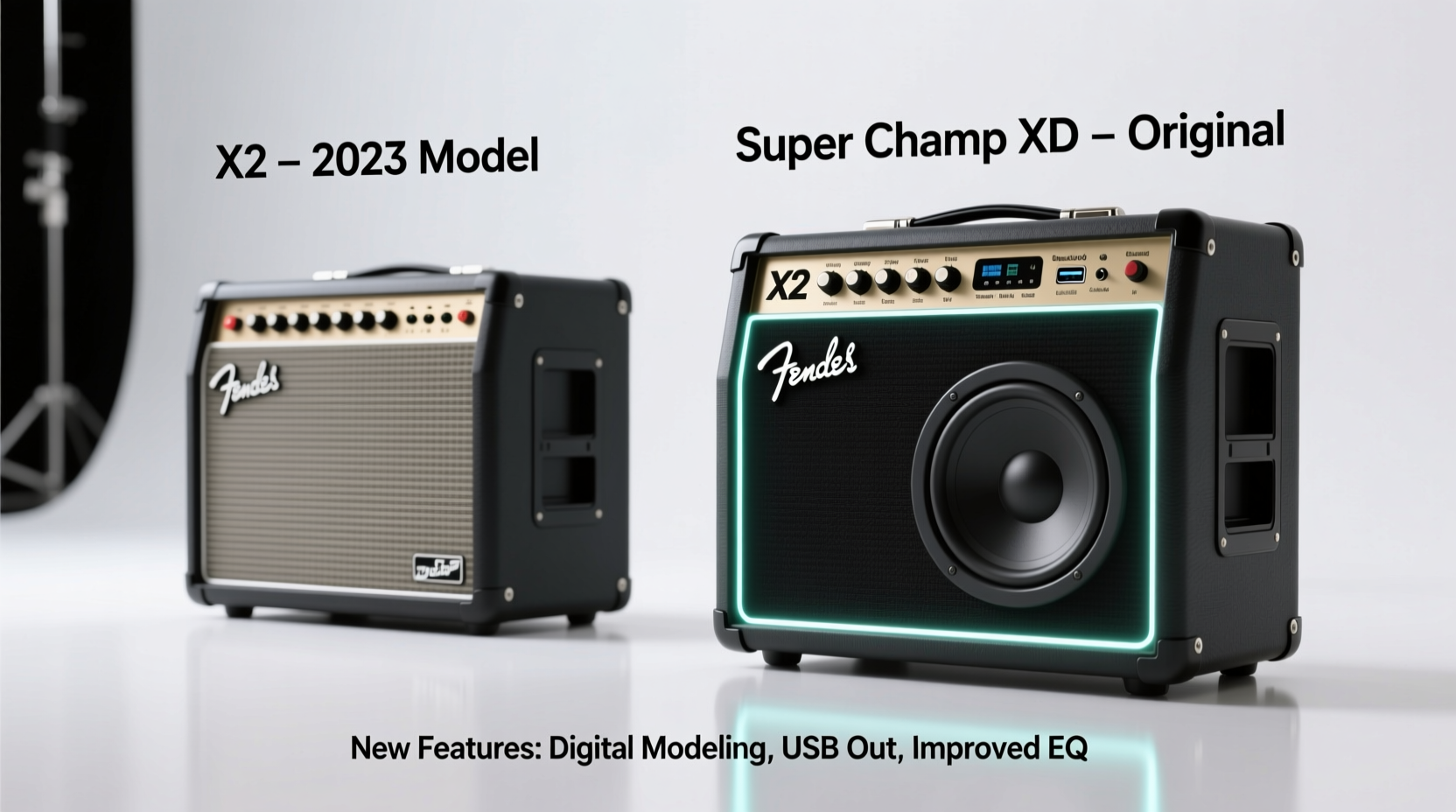
Both the Super Champ XD and X2 are hybrid amplifiers—meaning they use a 12AX7 preamp tube and a solid-state power section, paired with digital signal processing (DSP) to emulate various amp models, effects, and speaker cabinets. This design strikes a balance between warmth and versatility, making them ideal for home practice, studio work, and small gigs.
The core tonal engine of both amps is built around Fender’s Tube Amp Modeling (TAM), which captures the response and harmonic complexity of classic Fender circuits like the Deluxe Reverb, Twin Reverb, and Bassman. However, the X2 improves upon the XD’s modeling algorithms with more accurate dynamic response and reduced latency during effect switching.
One often-overlooked advantage of the X2 is its improved noise floor. Early users of the XD reported slight hiss when using high-gain models or deep modulation effects. The X2 addresses this with better internal shielding and optimized circuit routing, resulting in cleaner headroom even at higher gain settings.
“Hybrid amps like the Super Champ series bridge the gap between vintage feel and modern flexibility. The X2 represents a meaningful step forward in refinement.” — Mark Henderson, Guitar Tech & Studio Engineer
Feature Comparison: What Changed?
The most significant upgrades in the X2 aren’t just under the hood—they’re on the front panel and in the software. While both models offer eight amp models, eight effects types, and USB connectivity, the way you interact with them differs greatly.
| Feature | Fender Super Champ XD | Fender Super Champ X2 |
|---|---|---|
| Display | Basic LED indicators | Backlit LCD screen |
| Preset Management | Limited onboard editing | Full preset naming, saving, and organization |
| Effects Loop | No | Yes (switchable via software) |
| USB Audio Interface | 16-bit recording | 24-bit/48kHz audio interface |
| Cabinet Simulation | Basic fixed sim | Switchable ON/OFF with multiple voicings |
| Footswitch Support | Channel/FX toggle only | Full preset switching + tap tempo |
| Software Editor | None | Fender FUSE (discontinued but still functional) |
The inclusion of a full-color LCD screen on the X2 alone transforms the user experience. Instead of memorizing button combinations, players can see preset names, effect chains, and parameter values at a glance. This makes live switching far more reliable and intuitive.
Real-World Performance: A Gigging Musician’s Perspective
Consider Sarah, a working guitarist who plays in a trio covering classic rock and blues. She owned a Super Champ XD for five years, using it for rehearsals and small bar gigs. When her band started recording more frequently, she found herself frustrated by the lack of preset labeling and inconsistent effect levels between songs.
She upgraded to the X2 primarily for the improved USB interface and preset management. “I can now set up a clean Strat tone with spring reverb for ‘Brown Eyed Girl,’ then switch to a driven Princeton model with tape delay for ‘Sweet Home Alabama’—all with named presets and balanced output,” she explains. “Plus, plugging into my DAW sounds 10 times better with the 24-bit output and switchable cab sim.”
While the raw tone difference between the two models is subtle, Sarah notes that the X2 feels more “polished” in transitions. “The XD sometimes clicks when changing presets. The X2 doesn’t. That matters when you’re mid-set.”
Step-by-Step: Upgrading from XD to X2
If you're considering making the switch, here’s a practical guide to ensure a smooth transition:
- Assess Your Needs: Are you recording regularly? Playing live with multiple tones? If so, the X2’s features will likely benefit you.
- Backup Your XD Settings: Note down your favorite presets manually—there’s no export function.
- Set Up the X2: Connect to a computer using USB and install Fender FUSE (available through third-party archives).
- Recreate Presets: Use the software editor to dial in your go-to tones with proper naming and effect order.
- Test in Context: Play through your pedalboard and PA system to compare volume matching and tone consistency.
- Optimize Recording Chain: Enable cabinet simulation and select 24-bit mode in your DAW for best results.
Is the Upgrade Worth It? A Balanced Verdict
The answer depends on how you use your amp. For casual players who mainly practice at home and occasionally plug into a PA, the Super Champ XD remains a capable and affordable option. Its tone is excellent, and many users still swear by its responsiveness.
However, for gigging musicians, home recordists, or anyone who values workflow efficiency, the Super Champ X2 offers tangible improvements. The LCD screen, expanded connectivity, lower noise floor, and superior preset management make it a more professional tool. The ability to use it as a high-quality audio interface alone may justify the upgrade for podcasters, YouTubers, or bedroom producers.
That said, the core amplifier voice—the warm tube-driven cleans, the responsive overdrives, the iconic Fender sparkle—is nearly identical between the two. The X2 doesn’t sound dramatically “better,” but it performs more reliably and adapts more easily to complex setups.
Checklist: Should You Upgrade?
- Do you record directly into a computer? → X2 recommended
- Do you play live with multiple tones per set? → X2 recommended
- Do you rely on external pedals and need an effects loop? → X2 only option
- Are you on a tight budget and mostly practice at home? → XD still sufficient
- Do you value ease of use and clear visual feedback? → X2 superior
FAQ
Can I use the same footswitch for both models?
The Fender FS-10L works with both, but only the X2 supports full preset changes and tap tempo. On the XD, it only toggles effects or channels depending on configuration.
Is the speaker different between the XD and X2?
No—both models use the same 12-inch Celestion G12P-80 speaker, so the core speaker tone and breakup characteristics are identical.
Is Fender FUSE still supported?
Fender officially discontinued FUSE in 2018, but it remains functional on older operating systems. Third-party sites host downloads, and many users continue to use it without issues.
Final Thoughts
The Fender Super Champ X2 isn’t a revolutionary redesign—it’s an evolution. It takes the solid foundation of the XD and refines it with thoughtful improvements that matter most to active players. While the tonal DNA remains unchanged, the enhanced usability, recording capabilities, and professional features make the X2 a smarter long-term investment.
If you're starting fresh, the X2 is the clear choice. If you own an XD and are satisfied with its performance, an upgrade isn’t urgent—but if your needs have outgrown its limitations, the X2 delivers meaningful gains in functionality and reliability.




 浙公网安备
33010002000092号
浙公网安备
33010002000092号 浙B2-20120091-4
Comments
No comments yet. Why don't you start the discussion?