
Choosing between the Fitbit Charge 6 and the Inspire 3 comes down to a balance of functionality, budget, and personal fitness goals. Both devices come from Fitbit’s latest generation of wearables, promising accurate health tracking, sleek design, and seamless integration with smartphones. But the key differentiator—built-in GPS—raises an important question: is it worth paying nearly double for the Charge 6? For runners, hikers, or outdoor enthusiasts, GPS might be essential. For casual users focused on daily steps and sleep quality, the Inspire 3 could offer more than enough.
This article breaks down every major aspect of both trackers—their design, health sensors, workout capabilities, battery life, and smart features—to help you decide whether the added cost of the Charge 6 is justified by its advanced technology.
Design and Comfort: Subtle Differences, Big Impact
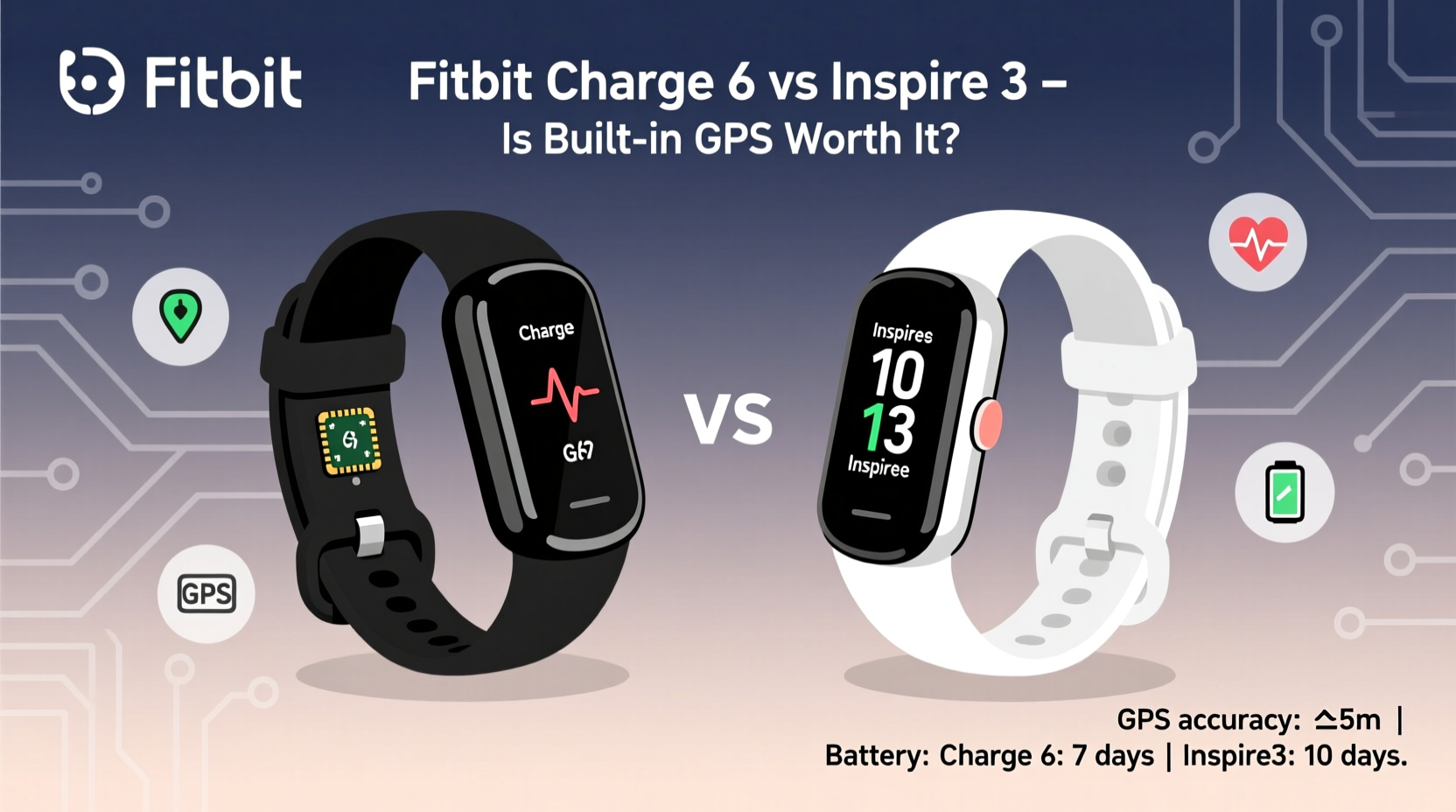
The physical experience of wearing a fitness tracker matters just as much as its features. The Fitbit Charge 6 and Inspire 3 differ significantly in form factor, which influences comfort and usability.
The Charge 6 has a larger, rectangular AMOLED touchscreen (1.04 inches) with a slightly curved edge, offering more screen real estate for data visualization during workouts. It’s designed for active users who want to glance at stats mid-run or review heart rate zones without pulling out their phone. The band is interchangeable and slightly wider, giving it a sportier, more substantial feel on the wrist.
In contrast, the Inspire 3 takes a minimalist approach. Its smaller, oval-shaped display (0.76 inches) is less intrusive and better suited for all-day wear, especially for those with smaller wrists. It’s lighter (just 19 grams) and slimmer, making it ideal for sleep tracking or discreet daily use. While the screen is monochrome OLED, it’s still responsive and legible in sunlight.
Health and Fitness Tracking: Core Features Compared
Both devices offer robust health monitoring, including 24/7 heart rate tracking, sleep staging, SpO2 (blood oxygen) monitoring, stress management tools, and menstrual cycle tracking. They also support Active Zone Minutes, Fitbit’s metric that rewards time spent in elevated heart rate zones during exercise.
However, there are subtle differences in sensor accuracy and functionality. The Charge 6 uses newer optical sensors and includes ECG (electrocardiogram) measurement, allowing users to check for signs of atrial fibrillation—a feature absent in the Inspire 3. While not a medical diagnosis tool, this adds value for users concerned about cardiovascular health.
The Charge 6 also introduces Google integration, such as Google Maps navigation prompts and YouTube Music controls, enhancing its utility beyond pure fitness. The Inspire 3 lacks these smart integrations but still supports basic notifications like calls, texts, and calendar alerts.
“Having continuous heart rate and sleep tracking on both models shows Fitbit’s commitment to holistic health—but the Charge 6 goes further with clinical-grade tools like ECG.” — Dr. Lena Torres, Digital Health Researcher at Stanford Medicine
Built-In GPS: Why It Matters for Outdoor Activity
The most significant hardware difference between the two devices is GPS. The Fitbit Charge 6 includes built-in GPS, enabling it to record pace, distance, elevation, and route mapping during outdoor workouts—without needing a connected smartphone. The Inspire 3 relies entirely on your phone’s GPS, meaning you must carry your device to get accurate location data.
For runners, cyclists, or hikers who train outdoors regularly, this distinction is critical. Imagine going for a trail run: with the Charge 6, you can leave your phone behind, track your exact path, and review split times post-workout. With the Inspire 3, omitting your phone means losing route data and estimated distance—limiting insight into performance trends over time.
Moreover, GPS-enabled workouts on the Charge 6 sync directly to the Fitbit app with full maps and elevation profiles, supporting deeper analysis. This is particularly useful if you're training for races or trying to improve endurance.
But if your workouts are mostly indoor—treadmill runs, gym sessions, yoga, or walking around the neighborhood where approximate step counts suffice—then GPS becomes less essential. In these cases, the Inspire 3 delivers comparable core metrics using accelerometer-based estimates.
Real Example: A Runner's Dilemma
Sarah, a recreational runner training for her first half-marathon, initially bought the Inspire 3 due to its lower price. She quickly realized that her treadmill-mode runs didn’t translate well to outdoor progress because she couldn’t accurately measure her pace or distance when running without her phone. After upgrading to the Charge 6, she began logging consistent outdoor runs with precise feedback, helping her adjust her training plan and avoid overexertion. For Sarah, the GPS wasn’t a luxury—it was a necessity for goal-oriented training.
Detailed Feature Comparison
| Feature | Fitbit Charge 6 | Fitbit Inspire 3 |
|---|---|---|
| Display | 1.04\" AMOLED color touchscreen | 0.76\" monochrome OLED |
| Built-in GPS | Yes | No (relies on phone) |
| Heart Rate Monitoring | Continuous, with improved accuracy | Continuous |
| ECG App | Yes | No |
| Sleep Tracking | Advanced (with Sleep Score & insights) | Basic sleep stages + Sleep Score |
| Battery Life | Up to 7 days (with moderate GPS use) | Up to 10 days |
| Smartphone Notifications | Yes (with Google integration) | Yes (basic alerts only) |
| Water Resistance | Up to 50m (swim-proof) | Up to 50m (swim-proof) |
| Price (MSRP) | $159.95 | $99.95 |
The table highlights that while both devices share foundational health tracking, the Charge 6 pulls ahead in display quality, GPS capability, ECG support, and smart features—all contributing to its higher price point.
Battery Life and Charging: Trade-Offs Between Power and Performance
Battery longevity affects user convenience. The Inspire 3 boasts up to 10 days of battery life under normal usage—ideal for users who dislike frequent charging. The Charge 6, despite its larger battery, lasts about 7 days. However, actual performance depends heavily on usage patterns.
Using GPS regularly reduces the Charge 6’s battery life significantly. A single hour-long run with GPS enabled can consume 15–20% of the charge. Frequent map syncing, notifications, and music controls also drain power faster. Users engaging in multiple outdoor workouts per week may need to charge every 4–5 days.
If uninterrupted battery life is a priority and you don’t mind carrying your phone during exercise, the Inspire 3 offers greater efficiency. But if you value standalone functionality—even at the cost of more frequent charging—the Charge 6 remains a strong contender.
Step-by-Step Guide: How to Decide Which Tracker Fits Your Lifestyle
- Assess your primary activity type: Do you run, bike, or hike outdoors frequently? If yes, GPS is valuable. If most workouts are indoors, it’s less critical.
- Evaluate your health monitoring needs: Are you interested in ECG readings or advanced heart rhythm analysis? Only the Charge 6 provides this.
- Consider daily wear preferences: Do you want a low-profile device for constant wear, including sleep? The Inspire 3 excels here.
- Review your tech ecosystem: Do you use Android phones and appreciate Google integrations? The Charge 6 leverages these better.
- Set a budget: If staying under $100 is important, the Inspire 3 offers excellent baseline tracking. If you’re willing to invest in future-proof features, the Charge 6 delivers more long-term utility.
Frequently Asked Questions
Can the Inspire 3 track outdoor walks without a phone?
It will count steps and estimate distance using motion sensors, but without GPS, it cannot map your route or provide accurate pace/distance data. You’ll see “estimated” markers in the app.
Is the Charge 6 waterproof enough for swimming?
Yes, both devices are rated 50m water-resistant and suitable for pool and open-water swimming. They automatically detect swim workouts and track laps, duration, and calories.
Does the extra cost of the Charge 6 pay off over time?
For active users who rely on GPS and advanced health insights, yes. The added features enhance training accuracy and long-term health awareness. For general wellness tracking, the Inspire 3 offers strong value at a lower entry point.
Final Verdict: Is Built-In GPS Worth the Extra Cost?
The answer hinges on how you use your fitness tracker. If your routine involves regular outdoor exercise where precise distance, pace, and route history matter, then the built-in GPS of the Fitbit Charge 6 is absolutely worth the $60 premium. Combined with ECG, a brighter display, and smarter integrations, it functions as a comprehensive fitness companion.
However, if your focus is on general wellness—monitoring sleep, daily movement, heart rate trends, and receiving basic notifications—the Inspire 3 delivers exceptional performance at a compelling price. It’s one of the best entry-level trackers on the market, especially for beginners or those transitioning from no wearable at all.
Ultimately, think of the Charge 6 as a performance upgrade tailored for athletes and health-conscious individuals seeking detailed analytics. The Inspire 3 serves as an elegant gateway into consistent health tracking without overwhelming complexity.
“The right fitness tracker isn’t the one with the most features—it’s the one you’ll actually wear and trust.” — Mark Reynolds, Wearable Technology Analyst, TechInsight Weekly
Take Action Today
Your fitness journey deserves tools that align with your habits and goals. Whether you choose the streamlined simplicity of the Inspire 3 or the advanced capabilities of the Charge 6, what matters most is consistency. Track your progress, listen to your body, and let data guide improvement—not obsession.




 浙公网安备
33010002000092号
浙公网安备
33010002000092号 浙B2-20120091-4
Comments
No comments yet. Why don't you start the discussion?