
Sleep is no longer just a passive state—it's a metric. As wearable technology evolves, consumers are increasingly focused on understanding the quality of their rest, recovery, and overall physiological patterns. Two dominant devices have emerged in this space: fitness trackers with advanced sleep analysis and smart rings designed specifically for holistic health monitoring. While both claim to deliver actionable insights, they differ significantly in design, data collection methods, and user experience. Choosing between them isn’t just about preference—it’s about aligning device capabilities with your personal health goals.
How Sleep Tracking Works: The Science Behind the Data
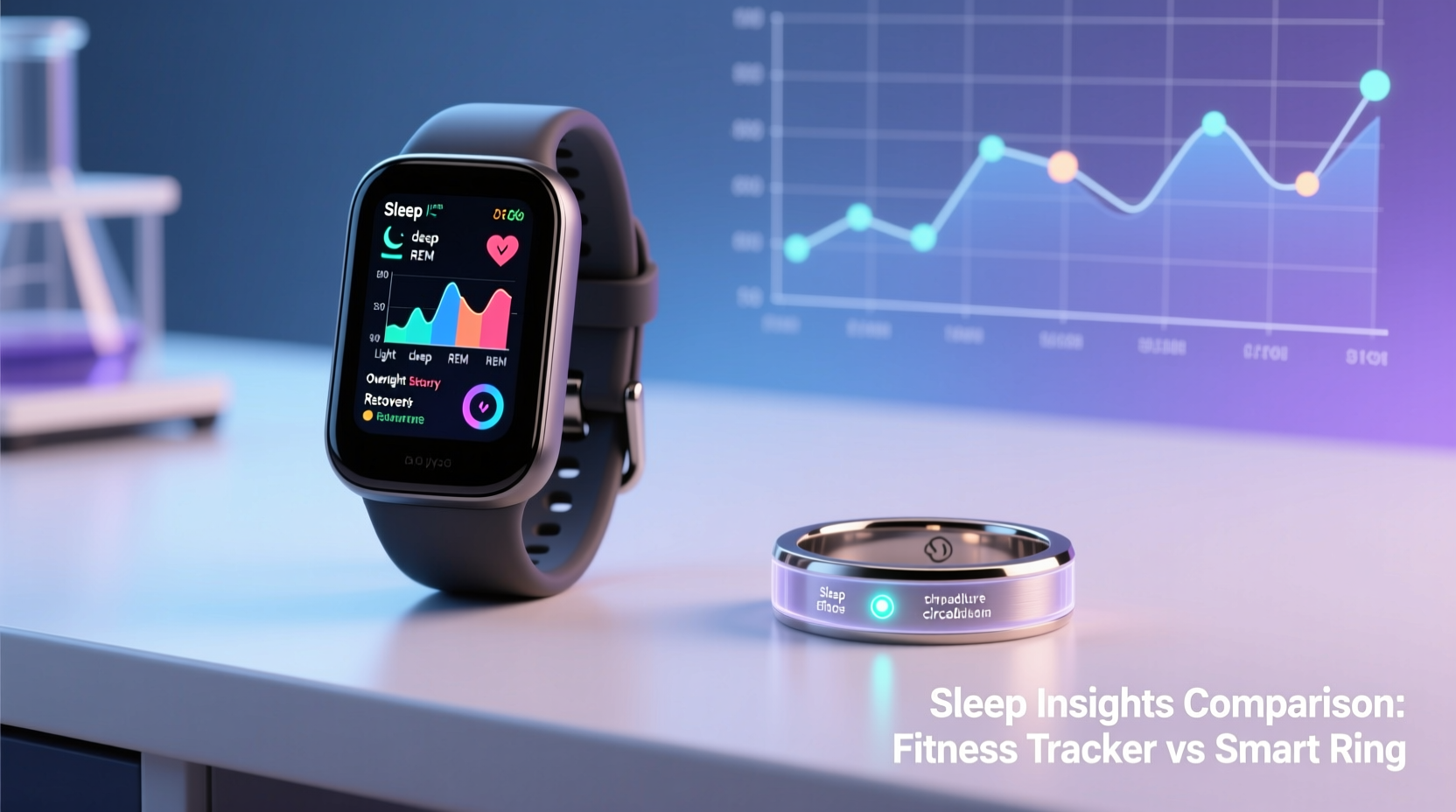
At its core, sleep tracking relies on a combination of sensors: accelerometers detect movement, optical heart rate monitors (PPG) track heart rate variability (HRV), and some devices incorporate skin temperature, blood oxygen (SpO2), and respiratory rate sensors. These inputs feed into algorithms that estimate sleep stages—light, deep, and REM—as well as total sleep duration and disturbances.
Fitness trackers typically use wrist-based photoplethysmography (PPG), where green or red light measures blood flow changes beneath the skin. This method can be affected by motion artifacts, inconsistent wear tightness, and skin tone variations. Smart rings, worn on the finger, benefit from higher capillary density and reduced motion during sleep, potentially offering more stable readings.
“Finger-based PPG shows less motion noise and more consistent perfusion than wrist sensors during nocturnal monitoring.” — Dr. Lena Torres, Biomedical Engineer, Stanford Sleep Research Lab
The location of the sensor matters. The fingertip has a rich vascular network, making it easier to capture clean pulse signals even at low perfusion levels. This anatomical advantage allows smart rings to collect more reliable baseline metrics, especially HRV and resting heart rate, which are critical for assessing recovery and autonomic nervous system balance.
Accuracy Comparison: Sleep Stages, Heart Rate, and Recovery Metrics
When comparing devices, clinical validation is key. Several studies have evaluated consumer wearables against polysomnography (PSG), the gold standard for sleep analysis. While no consumer device matches PSG accuracy, some come closer than others.
Fitness trackers like the Fitbit Charge 6, Garmin Venu 3, and Whoop 4.0 use proprietary algorithms trained on large datasets to infer sleep architecture. They perform reasonably well in detecting wakefulness and distinguishing light from deep sleep but often overestimate REM sleep and struggle with micro-awakenings.
Smart rings such as the Oura Ring Gen3 and Ultrahuman Ring Air leverage multi-point temperature sensing, dual-frequency PPG, and advanced machine learning models. Independent research published in *npj Digital Medicine* found the Oura Ring demonstrated 90% agreement with PSG for total sleep time and was superior in estimating sleep efficiency and onset latency.
Key Accuracy Differences
- Fitness Trackers: Better for activity-to-sleep transition detection; may miss subtle awakenings due to motion filtering.
- Smart Rings: Excel in continuous nighttime HRV and temperature trends; less prone to signal dropout during still periods.
- Both: Struggle with precise REM identification, though newer models are improving through AI-driven recalibration.
Comfort and Wearability: Does Design Impact Compliance?
No amount of data is useful if the device isn’t worn consistently. Comfort plays a decisive role in long-term adherence.
Fitness trackers are bulkier, often featuring screens and buttons. While modern versions are slimmer, many users report discomfort when sleeping on their side or experiencing pressure points. Adjustable bands help, but skin irritation and \"watch roll\" (device rotating during sleep) remain common complaints.
Smart rings, by contrast, are minimalist. Designed to resemble jewelry, they weigh under 5 grams and conform closely to the finger. Most users report forgetting they’re wearing one. However, fit is crucial—too loose and data degrades; too tight and circulation may be affected. Sizing kits are recommended before purchase.
“I switched from a fitness band to a smart ring after three months of inconsistent data. The ring stays put, doesn’t dig into my wrist, and I actually wear it 24/7 now.” — Marcus R., biohacker and data analyst
Wearability Checklist
- Test multiple band types (silicone, nylon, metal) for skin sensitivity
- Avoid wearing on dominant hand if you type frequently
- Ensure snug but non-restrictive fit—should allow slight rotation
- Remove during water immersion unless rated for swimming
- Charge strategically to avoid overnight gaps (e.g., charge during morning shower)
Data Depth and Insights: Beyond Basic Sleep Scores
Modern wearables don’t just track sleep—they interpret it. The value lies not in raw data, but in how it’s contextualized.
Fitness trackers emphasize integration with daily activity. They correlate steps, workouts, and screen time with sleep quality, offering feedback like “Your intense evening workout delayed deep sleep by 40 minutes.” Brands like Garmin and Apple provide detailed breakdowns of sleep stages, breathing rate, and blood oxygen trends, often visualized through intuitive dashboards.
Smart rings go further in physiological insight. The Oura Ring, for example, calculates a daily “Readiness Score” combining sleep performance, HRV balance, body temperature deviation, and previous day’s exertion. This predictive modeling helps users decide whether to push hard or prioritize recovery.
Ultrahuman Ring Air introduces glucose metabolism estimates using thermal flux and HRV patterns—an experimental but promising approach for metabolic health monitoring. Meanwhile, circular.fitness offers open API access, appealing to developers and quantified self-enthusiasts.
| Feature | Fitness Tracker | Smart Ring |
|---|---|---|
| Sleep Stage Accuracy | Moderate (75–85% vs PSG) | High (85–90% vs PSG) |
| HRV Consistency | Variable (motion-sensitive) | High (stable perfusion) |
| Body Temperature Trends | Limited (ambient only) | Detailed (proximal + distal sensors) |
| Battery Life | 4–7 days | 5–8 days |
| Recovery Scoring | Basic (sleep + activity) | Advanced (multi-parameter AI model) |
| Daytime Wear Comfort | Good (visible, functional) | Excellent (discreet, lightweight) |
Real-World Use Case: Optimizing Sleep for Shift Workers
Sophia, a 34-year-old ER nurse working rotating shifts, struggled with insomnia and daytime fatigue. She tried a Fitbit Sense 2 first, appreciating its ECG and stress tracking, but found her sleep scores fluctuated wildly despite similar rest patterns. After syncing data with her doctor, she realized the device frequently misclassified naps as fragmented nighttime sleep.
She switched to an Oura Ring Gen3. Within two weeks, her clinician noted clearer circadian rhythm markers via elevated body temperature prior to waking—a pattern previously obscured by wrist motion noise. Using the ring’s “Cycle Sync” feature, Sophia began timing caffeine intake and light exposure based on predicted alertness dips. Over six weeks, her subjective sleep quality improved by 40%, and her resting heart rate dropped from 72 to 63 bpm.
This case illustrates a broader trend: individuals with irregular schedules benefit more from devices that accurately detect subtle physiological shifts rather than relying solely on movement-based algorithms.
Step-by-Step Guide to Choosing Your Device
Selecting the right tool depends on your priorities. Follow this decision framework:
- Define Your Primary Goal: Is it general wellness, athletic recovery, medical insight, or behavioral change?
- Evaluate Wear Tolerance: Try wearing a ring versus a watch for 24 hours. Note any discomfort or interference with routine tasks.
- Check Data Export Options: Do you want to integrate with Apple Health, Google Fit, or third-party apps like Cronometer or TrainingPeaks?
- Assess Battery & Charging Needs: Can you charge daily, or do you need multi-day endurance without interruption?
- Review Long-Term Costs: Some rings require subscription fees for full analytics (e.g., Oura $5.99/month). Trackers usually offer free basic access.
- Validate Against Known Patterns: Compare device-reported sleep to your perceived energy levels and mood over 14 days.
- Consult Healthcare Providers: If managing conditions like sleep apnea or arrhythmias, confirm the device complements—not replaces—clinical tools.
Frequently Asked Questions
Can a smart ring replace a sleep study?
No. While smart rings provide valuable longitudinal trends, they cannot diagnose sleep disorders like apnea or narcolepsy. Polysomnography remains the diagnostic standard. However, rings can help identify patterns worth discussing with a sleep specialist.
Do fitness trackers overestimate sleep quality?
Sometimes. Due to algorithmic smoothing, many trackers classify quiet wakefulness (e.g., reading in bed) as light sleep. This leads to inflated total sleep time estimates. Smart rings are slightly better at detecting true wake episodes due to higher signal fidelity.
Which is better for women’s health tracking?
Smart rings currently lead in menstrual cycle prediction accuracy. By combining temperature baselines, HRV dips, and sleep fragmentation patterns, devices like Oura report ovulation within ±1 day in 89% of cycles, outperforming most wrist-worn trackers reliant on self-reported symptoms.
Final Recommendation: Match the Tool to Your Lifestyle
If you're an athlete seeking granular recovery metrics, a shift worker navigating circadian disruption, or someone prioritizing unobtrusive all-day wear, a smart ring likely provides superior insights. Its anatomical advantage, combined with refined algorithms for HRV and temperature, enables deeper physiological profiling.
If you value screen-based notifications, GPS for outdoor workouts, and seamless smartphone integration, a high-end fitness tracker remains a powerful all-in-one solution. Modern models have closed the gap in sleep accuracy and offer robust ecosystems for fitness logging and goal setting.
Ultimately, the best device is the one you wear consistently and act upon. Whether it's a sleek ring or a feature-rich tracker, the goal is not perfect data—but meaningful insight that leads to better choices. Sleep isn’t just about duration; it’s about restoration. Choose the tool that helps you understand—and improve—your body’s nightly journey toward recovery.




 浙公网安备
33010002000092号
浙公网安备
33010002000092号 浙B2-20120091-4
Comments
No comments yet. Why don't you start the discussion?