
When temperatures plummet below freezing, staying warm isn’t just about comfort—it’s about health and safety. For many people, especially those who commute on foot, bike, or work outdoors, leg insulation becomes a critical concern. Two popular options dominate cold-weather lower-body layering: fleece-lined tights and layered leggings. But which actually keeps you warmer? The answer isn't as simple as thickness or fabric weight. It depends on heat retention, moisture management, mobility, and how the garments perform under real winter conditions.
This article breaks down the science and practical use of both options, compares their thermal efficiency, and helps you make an informed decision based on your lifestyle, activity level, and climate.
The Science of Warmth: How Legs Stay Warm in Cold Weather
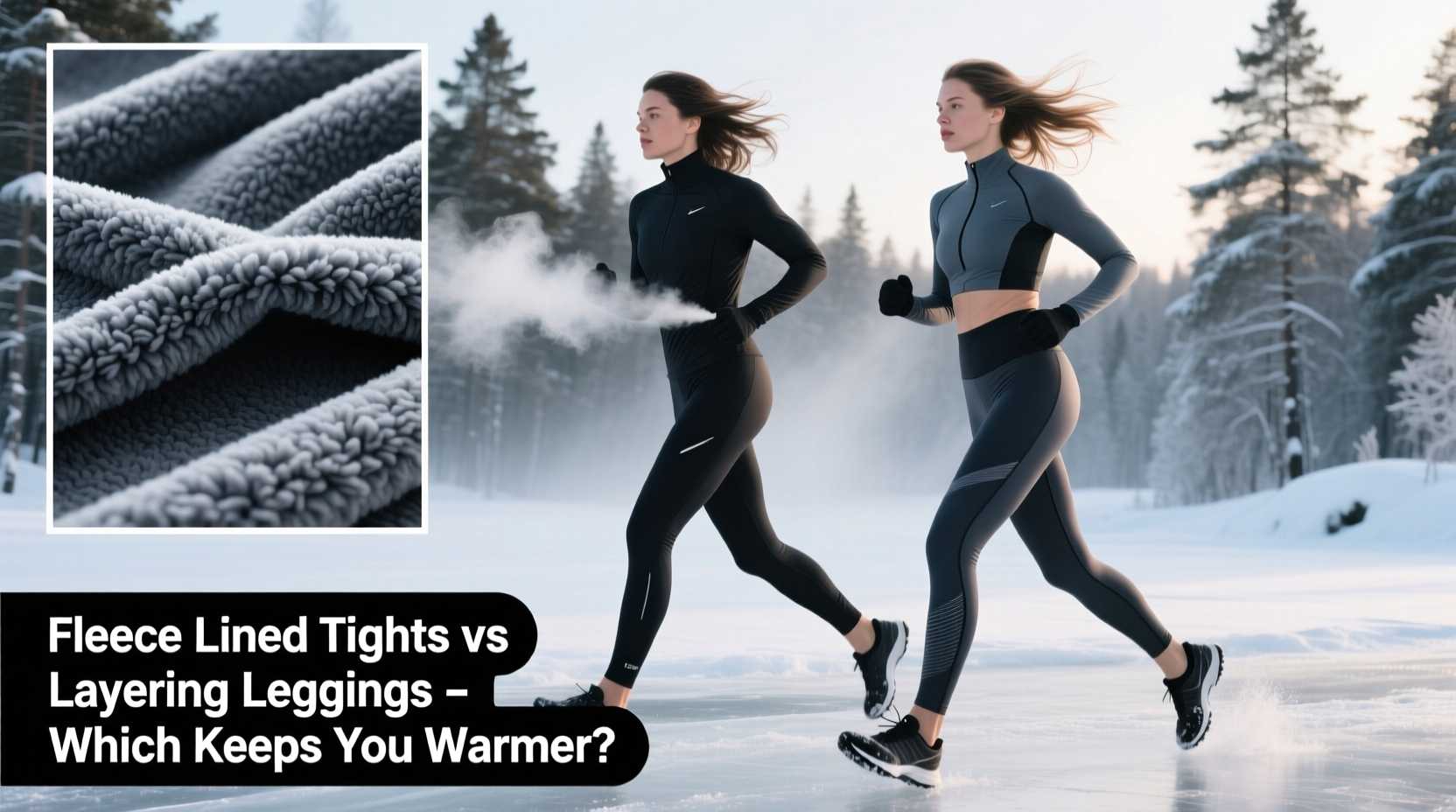
Human legs lose heat quickly because they contain large muscle groups with significant blood flow and relatively thin skin coverage compared to the torso. In freezing conditions (below 32°F / 0°C), exposed or poorly insulated legs can lead to discomfort, reduced circulation, and even early signs of frostnip—especially during prolonged outdoor exposure.
Warmth is not solely determined by fabric thickness. Three key factors influence how well clothing insulates:
- Trapped air: Insulation works by trapping body-warmed air close to the skin. More trapped air means better warmth.
- Moisture wicking: Sweat cools the body rapidly when it evaporates. Fabrics that retain moisture reduce thermal efficiency.
- Layering synergy: Multiple layers create microclimates of warm air between them, enhancing insulation more effectively than a single thick layer.
Fleece-lined tights rely on a single integrated layer of brushed polyester (fleece) bonded to a nylon-spandex outer shell. Layered leggings involve wearing two separate garments—typically a thin base layer (like compression tights) beneath a thicker, often brushed or thermal, legging.
While both aim to solve the same problem, their design philosophies differ significantly.
Comparative Analysis: Fleece-Lined Tights vs Layered Leggings
| Feature | Fleece-Lined Tights | Layered Leggings |
|---|---|---|
| Insulation Type | Single integrated fleece lining | Air gap between two separate layers + individual fabric insulation |
| Warmth Efficiency | Moderate; limited by single-layer construction | High; dual-layer system traps more warm air |
| Breathability | Lower; moisture can get trapped between skin and fleece | Higher; base layer wicks sweat, outer layer allows vapor escape |
| Mobility & Fit | Tighter fit, less bulk, ideal under pants or skirts | Bulkier, may restrict movement if layers are tight |
| Durability | Fleece can pill over time; outer shell may wear thin | Individual layers last longer; replace only what's worn |
| Temperature Range | Best for 20–40°F (-7 to 4°C) | Effective from 0°F (-18°C) upward with proper outerwear |
The table reveals a clear distinction: while fleece-lined tights offer convenience and slim profiles, layered leggings provide superior thermal protection through strategic air trapping and functional separation of roles (wicking vs. insulation).
Real-World Performance: A Winter Commuter Case Study
Sarah, a nurse in Minneapolis, walks 15 minutes each way to her hospital shift year-round. During a particularly harsh January with average highs near 10°F (-12°C) and wind chills dropping to -20°F (-29°C), she tested both systems over two weeks.
First week: She wore fleece-lined tights under jeans. By mid-morning, her thighs felt damp from light perspiration during her brisk walk. Although initially warm, the trapped moisture made her feel colder once inside the hospital after sweating stopped. Her calves remained chilly throughout the day.
Second week: She switched to a base layer of merino-blend tights under thick thermal leggings. Despite the same commute, she reported consistent warmth, no clamminess, and greater comfort during long shifts on cold tile floors. The layered system allowed her body to regulate temperature more effectively.
“I didn’t realize how much moisture was affecting my warmth until I tried layering,” Sarah said. “Now I never go back to just fleece-lined.”
This case illustrates a broader principle: in active scenarios involving walking, cycling, or physical labor, breathability and moisture control are as important as insulation.
Expert Insight: What Thermoregulation Specialists Say
“Layering works because it mimics natural insulation strategies seen in animals like arctic foxes—their fur creates multiple air-trapping zones. Humans achieve similar results with fabrics. One thick garment compresses under outerwear, reducing its insulating power. Multiple thinner layers maintain loft and airflow.” — Dr. Lena Patel, Bioclimatologist at Northern Climate Research Institute
Dr. Patel emphasizes that compression is a hidden enemy of warmth. Fleece-lined tights, when worn under tight jeans or snow pants, often lose up to 40% of their effective insulation because the fleece gets flattened, eliminating the tiny air pockets essential for heat retention.
In contrast, layered leggings allow the space between garments to remain uncompressed, preserving thermal volume. Even a 1mm air gap can increase insulation by 15–20%, according to textile studies from the American Society for Testing and Materials (ASTM).
Step-by-Step Guide to Optimizing Leg Warmth in Freezing Temperatures
Whether you’re hiking, commuting, or simply enduring a brutal winter morning, follow this sequence to maximize warmth without sacrificing mobility:
- Start with a wicking base layer: Choose a snug-fitting tights made of merino wool or synthetic blend (e.g., polyester-spandex). This pulls sweat away from the skin.
- Add a mid-layer for insulation: Wear a loose-fitting thermal legging over the base. Look for brushed interiors or grid fleece textures that trap air.
- Ensure proper outerwear compatibility: Your pants or snow pants should be roomy enough not to compress the layers underneath. Avoid skinny jeans or tight ski shells unless designed for layering.
- Seal heat leaks: Use gaiters or boot cuffs to prevent cold air from entering at the ankle. Consider tall socks that cover the legging seam.
- Monitor moisture: If you start sweating heavily, consider venting (e.g., unzipping outer pants slightly) to avoid dampness buildup.
- Wash and care properly: Fabric degradation reduces insulation. Wash in cold water, avoid fabric softeners (they coat fibers), and air dry to preserve elasticity and thermal properties.
This system outperforms any single-layer solution—including high-end fleece-lined tights—because it adapts to changing activity levels and environmental conditions.
When Fleece-Lined Tights Make Sense
Despite their limitations in extreme cold, fleece-lined tights have legitimate uses:
- Mild winter days: Between 30–45°F (-1 to 7°C), they provide adequate warmth with minimal bulk.
- Under skirts or dresses: Their sleek profile makes them ideal for professional or formal settings where layering isn’t practical.
- Low-activity environments: For office workers or shoppers who spend little time outdoors, overheating is more likely than freezing, so lighter insulation suffices.
- Fashion-first needs: Available in sheer-to-opaque varieties, they offer versatility that layered leggings lack.
They are also easier to put on and require less coordination than managing two separate leg layers. For urban dwellers with short exposures to cold, they remain a popular and reasonable choice.
Checklist: Choosing the Right Option for Your Needs
Use this checklist to decide whether to go with fleece-lined tights or layered leggings:
- ✅ Will you be outside for more than 20 minutes in sub-freezing temps? → Choose layered leggings.
- ✅ Are you physically active (walking fast, biking, shoveling)? → Choose layered leggings.
- ✅ Do you wear tight pants or skirts? → Fleece-lined tights may be your only option.
- ✅ Is breathability a concern due to sweating? → Layered leggings win.
- ✅ Do you want maximum warmth-to-weight ratio? → Layered leggings provide better return.
- ✅ Are you dressing for appearance over performance? → Fleece-lined tights offer more styling flexibility.
No single solution fits all situations. The smartest approach is having both in your winter wardrobe and choosing based on daily conditions.
Frequently Asked Questions
Can I wear fleece-lined tights under leggings for extra warmth?
Yes, but be cautious. Combining fleece-lined tights with another tight legging can cause excessive compression, reducing airflow and increasing sweat retention. A better combination is a thin, non-fleece base layer under a loose thermal legging. If you do layer fleece-lined tights, ensure the outer layer is cut generously to avoid squeezing the inner fabric flat.
Do thicker leggings always mean more warmth?
Not necessarily. Thickness contributes to warmth, but only if the fabric maintains loft and doesn’t compress. A thin, well-engineered base layer paired with a puffy thermal legging will often outperform a single thick but dense legging. Material composition (wool, synthetic blends) and air-trapping structure matter more than raw thickness.
Are there hybrid products that combine the best of both worlds?
Yes. Some brands now offer “thermal tights” with a detachable liner or double-knit construction that mimics layering in a single garment. However, these can be harder to regulate and may still suffer from moisture buildup. True layering remains more adaptable.
Conclusion: Prioritize Function Over Form in Extreme Cold
In freezing temperatures, survival instinct should override fashion sense. While fleece-lined tights offer convenience and a smooth silhouette, they fall short in sustained cold, especially when movement generates sweat. Layered leggings, by leveraging the principles of air entrapment and moisture management, deliver superior warmth, comfort, and adaptability.
The human body evolved to stay warm through layered insulation—think fur, feathers, or traditional Inuit garments made of multiple skins. Modern fabric technology lets us replicate that wisdom with precision. Don’t rely on a single garment to do all the work. Build a system that responds to your environment.




 浙公网安备
33010002000092号
浙公网安备
33010002000092号 浙B2-20120091-4
Comments
No comments yet. Why don't you start the discussion?