
In a 320-square-foot studio apartment in Portland, Maya rearranged her holiday setup three times before Thanksgiving—each attempt sacrificing either walkway clearance, storage access, or visual calm. Her breakthrough wasn’t a new tree—it was swapping her 48-inch floor-standing artificial pine for a vertically anchored, wall-mounted “tree display” built into a floating oak shelf system. She reclaimed 9.6 square feet of floor space—the equivalent of a full yoga mat—and gained vertical storage for ornaments, lights, and even spare batteries. This isn’t just about Christmas decor. It’s about how spatial intelligence transforms living in under 400 square feet. For tiny-home dwellers, every inch carries functional, emotional, and logistical weight. The choice between a floating shelf tree display and a traditional floor model isn’t aesthetic preference—it’s a strategic decision with measurable impact on circulation, safety, adaptability, and long-term livability.
How Space Savings Actually Break Down (Beyond the Obvious)
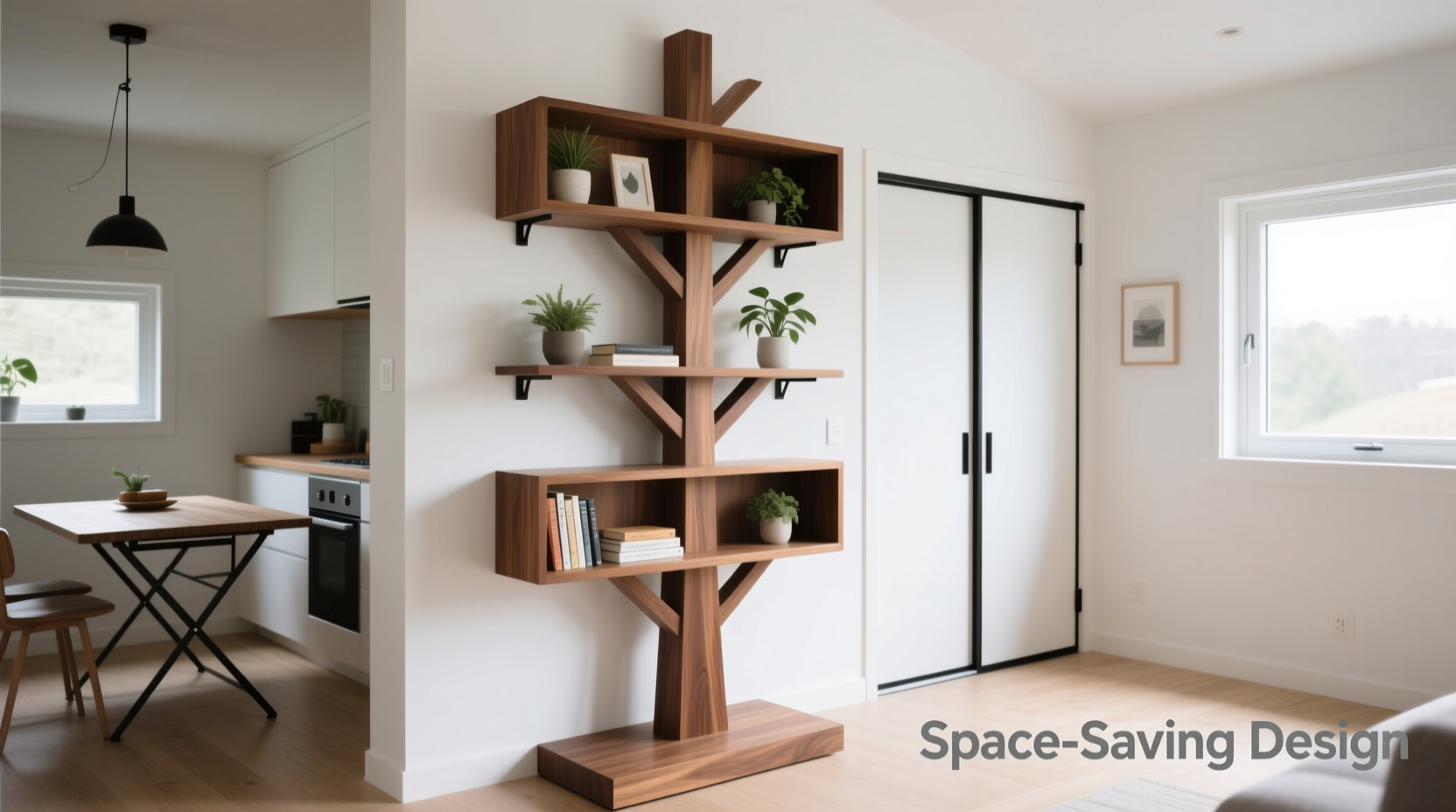
Most comparisons stop at “floor model takes up floor space; shelf model doesn’t.” That oversimplifies reality. A true spatial analysis accounts for three dimensions: footprint, vertical occupancy, and functional adjacency.
A standard 5-foot pre-lit artificial floor tree occupies roughly 24–30 inches in diameter at its base—translating to 3.1 to 4.9 square feet of non-negotiable floor real estate. But that’s only the starting point. Add the required clearance: 18 inches minimum around all sides for safe passage, ornament access, and fire-code compliance. That expands the effective footprint to 7.1–10.2 square feet. In a micro-kitchenette or loft bedroom, that’s the difference between fitting a narrow desk or not—or between walking comfortably beside your bed versus sidestepping it.
A floating shelf tree display—typically built as a 12- to 18-inch-deep horizontal ledge with integrated vertical supports (often angled or stepped)—occupies zero floor area. Its spatial cost is purely vertical: 60–72 inches tall and 12–24 inches wide. Crucially, it *shares* wall surface already designated for storage or display—no new wall “dedication” required. And because it’s mounted high (usually 48–72 inches from floor), it avoids conflict with doors, windows, outlets, and furniture placement.
Structural Realities: Weight, Wall Integrity, and Installation Limits
Weight distribution is where many tiny-home residents underestimate risk. A 6-foot floor tree—even lightweight PVC—weighs 12–25 lbs. Add 2–4 lbs of lights, 3–8 lbs of ornaments, and a 1.5-lb stand, and you’re at 18–38 lbs resting stably on the floor. No structural concerns.
A floating shelf tree display shifts that load to your wall—and not just any wall. Stud placement, drywall thickness, anchor type, and shelf material determine viability. Most residential walls use 16-inch-on-center wood studs. A properly installed 24-inch oak shelf (1.25\" thick, 8\" deep) anchored into two studs with 3.5\" lag screws can safely hold 85–110 lbs—more than enough for a 5-foot tree display plus accessories. But a shelf anchored only into drywall with toggle bolts? Max safe load drops to 30–45 lbs—and repeated vibration from footsteps or HVAC cycling degrades that over time.
Crucially, shelf trees aren’t “lighter”—they’re *concentrated*. A 20-lb tree distributed across a 24-inch shelf exerts ~0.83 lbs per linear inch of mounting rail. That same weight hanging from a single bracket risks shear failure. Professional installers always specify multi-point anchoring: at least two wall brackets per shelf tier, with primary support directly into studs—not just drywall anchors.
“The biggest misconception is that ‘floating’ means ‘low-load.’ In reality, a well-engineered shelf display transfers more dynamic stress to wall framing than a floor tree ever could. One improperly placed screw in a plasterboard wall can compromise an entire display—and your insurance coverage.” — Rafael Mendez, Tiny Home Structural Consultant & Certified ICF Builder
Practical Comparison: Floating Shelf Tree Display vs Floor Model
| Feature | Floating Shelf Tree Display | Floor Model |
|---|---|---|
| Floor Space Used | 0 sq ft (wall-mounted only) | 3.1–10.2 sq ft (including clearance) |
| Vertical Clearance Required | 60–72\" height; minimal headroom impact | 60–84\" height + 18\" overhead safety buffer |
| Installation Complexity | Moderate–High (requires stud-finding, leveling, anchoring) | Low (unbox, assemble stand, plug in) |
| Adaptability | High (can be repurposed year-round as bookshelf or display ledge) | Low (seasonal, single-use, often stored in bins or closets) |
| Safety in High-Traffic Zones | Excellent (no tripping hazard; out of reach of pets/children) | Moderate–Poor (base instability, cord exposure, tipping risk) |
| Storage When Not in Use | Negligible (shelf remains; tree disassembles to 1–2 flat panels) | Significant (requires 2–3 cubic ft of closet/basement space) |
| Lifespan of Core System | 10–25+ years (solid wood/metal shelf; reusable annually) | 3–8 years (plastic stands degrade; light wires fatigue) |
Real-World Case Study: The Brooklyn Loft Conversion
When Leo converted his 380-sq-ft industrial loft into a live-work space, he kept the original exposed brick wall—but needed to maximize floor utility for both client meetings and sleeping. His initial solution: a compact 4.5-foot floor tree in the corner. It worked until he added a fold-down Murphy desk. Suddenly, the tree blocked the desk’s 27-inch swing radius. Moving it meant crowding his twin mattress platform. He consulted a local carpenter who proposed a hybrid solution: a 30-inch-wide, 12-inch-deep blackened steel shelf mounted at 54 inches off the floor, with three integrated vertical dowels (angled at 15°) to hold branch tiers. The tree itself became modular—three interlocking birch plywood “branches” with embedded LED strips, nesting flat when stored.
Result: Total floor space saved = 8.7 sq ft. That allowed him to add a 24-inch rolling cart (for coffee gear and client samples) without narrowing his main pathway. More importantly, the shelf doubled as a display for architectural models and held his Bluetooth speaker—making it a year-round asset, not seasonal clutter. “It stopped being ‘the Christmas thing’ and became part of the room’s architecture,” he notes. “I don’t take it down—I just swap the branches for framed sketches in January.”
Actionable Implementation Guide: Installing a Shelf Tree Display in 5 Steps
- Assess Your Wall Structure: Use a stud finder to map stud locations. Confirm wall type (drywall over wood studs is ideal; concrete or metal studs require specialized anchors). Avoid mounting near electrical boxes or plumbing chases.
- Design for Load & Proportion: Calculate total weight (tree + lights + ornaments). Choose shelf depth (12\" minimum for stability) and width (24–36\" optimal for visual balance). Ensure vertical supports are spaced no more than 16\" apart and land directly over studs.
- Select Hardware & Materials: Use 3.5\" x 1/4\" lag screws with washers for wood studs; sleeve anchors rated for 75+ lbs each for masonry. Shelf material: 1.25\" thick hardwood (oak, maple) or 14-gauge powder-coated steel. Avoid particleboard or MDF—they flex under load and fail unpredictably.
- Mount with Precision: Level the shelf *before* drilling. Drill pilot holes slightly smaller than screw diameter. Tighten screws gradually, alternating sides to prevent warping. Test load with 2x expected weight (e.g., 40 lbs for a 20-lb tree) for 24 hours before final assembly.
- Integrate Thoughtfully: Route cords through discreet wall channels or raceways. Use magnetic or clip-on ornament hangers to avoid drilling into branches. Store disassembled components in labeled, flat-stack bins under the bed or in a closet—taking <1 sq ft of space.
Key Considerations You Can’t Overlook
Not all tiny homes are created equal—and neither are their constraints. Before choosing, evaluate these non-negotiables:
- Lease Restrictions: Many urban micro-apartments prohibit wall modifications. Verify your lease terms or HOA rules before drilling. Some landlords approve “renter-friendly” systems using heavy-duty adhesive anchors (e.g., 3M Command Strips rated for 75 lbs)—though these are best for trees under 15 lbs and require flawless surface prep.
- Fire Safety Compliance: UL-listed LED lights are mandatory. Avoid incandescent strings—they generate heat that can warp shelves or ignite nearby paper decorations. Keep all cords at least 3 inches from shelf edges to prevent accidental yanking.
- Acoustic Impact: In thin-walled units, vibrations from footsteps travel through studs. A poorly damped shelf tree may transmit low-frequency hums during evening use. Mitigate with rubber grommets between shelf brackets and wall, or cork backing on the shelf underside.
- Long-Term Flexibility: Will your next home have the same wall configuration? Shelf displays built into custom cabinetry lose portability. Opt for bolt-on systems with removable brackets if mobility matters.
FAQ
Can I convert my existing floor tree into a shelf display?
Only if it’s designed for modular mounting. Most retail floor trees use proprietary plastic hubs and flexible PVC branches incompatible with rigid shelf mounting. Attempting to retrofit risks branch breakage, uneven weight distribution, and electrical hazards. Instead, invest in a purpose-built shelf tree kit—or build a custom frame using 1x2 poplar and brass pipe fittings, which accepts standard branch adapters.
How much does a professional shelf tree installation cost?
For a single-tier, 30-inch shelf with three dowel mounts: $220–$380 (includes materials, labor, and stud verification). DIY kits with hardware and templates start at $149. Factor in $75–$120 for a certified electrician if you need concealed wiring routed to an outlet—especially critical in older buildings with outdated circuits.
Won’t a shelf tree look “flat” or less festive than a floor tree?
Depth perception is solved with layering. Use staggered shelf heights (e.g., 3 tiers at 52\", 58\", and 64\") and branch angles (10°, 20°, 30°) to create dimensional volume. Add string lights behind the shelf to cast upward shadows, or mount mirrored tiles beneath the lowest tier to reflect light and amplify presence. Festivity comes from light, texture, and rhythm—not just mass.
Conclusion: Reclaiming Space Is Just the First Victory
Choosing between a floating shelf tree display and a floor model in a tiny home isn’t about decoration—it’s about declaring what kind of life you intend to live in limited square footage. A floor tree says, “This season requires sacrifice: of floor space, of flexibility, of year-round utility.” A thoughtfully engineered shelf display says, “My space serves me constantly—not just December through January.” It’s the difference between enduring constraints and designing within them. The most successful tiny-home dwellers don’t just downsize objects; they upgrade intentionality. They ask not “What fits?” but “What serves multiple purposes, enhances daily function, and reflects how I want to move through my home?”
If you’ve been wrestling with cramped corners, tripping hazards, or seasonal storage despair—start small. Measure one wall. Identify two adjacent studs. Sketch a 24-inch shelf at eye level. Then ask: What else could live there in January? A row of cookbooks? A set of framed city maps? Your favorite headphones and charging station? When your holiday display becomes infrastructure, space stops feeling scarce—and starts feeling abundant.




 浙公网安备
33010002000092号
浙公网安备
33010002000092号 浙B2-20120091-4
Comments
No comments yet. Why don't you start the discussion?