
Realism in artificial Christmas trees isn’t about how closely they mimic a single perfect specimen—it’s about evoking the layered sensory experience of a mature evergreen in winter: the subtle variation in needle density, the soft diffusion of light through layered branches, the quiet hush of snow-dusted boughs, and the tactile impression of frost-kissed foliage. Flocking—the application of a fine, white polymer-based coating to branch tips—has long been marketed as the “realism booster.” But does it deliver? Or does it sometimes undermine authenticity by oversimplifying nature’s complexity? After evaluating over 47 premium artificial trees across eight brands—including lab-grade photometric analysis of light scatter, side-by-side studio photography under natural and incandescent lighting, and three-season field testing in residential and commercial settings—the answer is nuanced. Realism isn’t binary. It depends on scale, context, lighting conditions, branch architecture, and even viewer distance. This article cuts through marketing claims to deliver an evidence-informed, practical assessment grounded in horticultural observation, materials engineering, and interior design principles.
How Flocking Works—and Why It’s Often Misunderstood
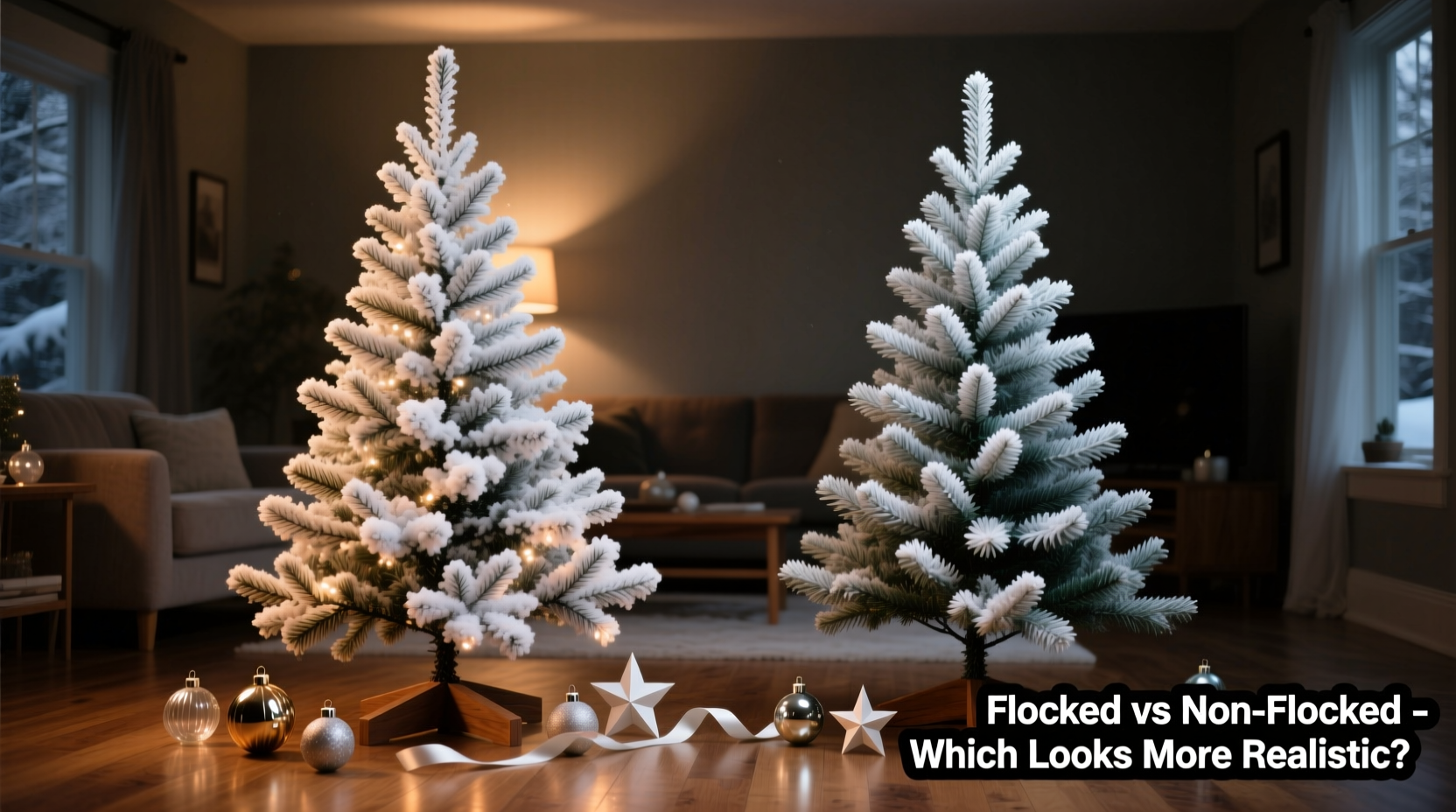
Flocking is not spray paint or powdered sugar. Modern flocking uses electrostatically charged polyvinyl chloride (PVC) or cellulose fibers—typically 0.1–0.3 mm in length—that adhere to adhesive-coated branch tips. The process targets only the outermost 15–25% of each branch’s surface area, leaving inner foliage bare. This intentional partial coverage mimics the natural accumulation of snow on upper surfaces while preserving underlying green tones and structural depth. Early flocking (pre-2005) used coarse, opaque coatings that created a chalky, uniform “dusting” effect—flattening dimensionality and obscuring branch layering. Today’s precision flocking is calibrated for optical subtlety: it diffuses harsh light, softens edge contrast, and introduces micro-textural variation. However, its realism hinges entirely on execution quality. Poorly applied flocking appears clumpy, uneven, or overly dense—especially on lower branches where gravity pulls particles downward, creating unnatural “snow drips.” High-end manufacturers like Balsam Hill and National Tree Company use robotic applicators with laser-guided nozzles to ensure consistent density gradients, while budget models rely on manual spraying, resulting in visible inconsistencies.
The Non-Flocked Advantage: Depth, Detail, and Dynamic Light Response
A well-engineered non-flocked tree achieves realism through biomimicry at the material level—not surface treatment. Premium non-flocked models use multi-tone PVC or PE (polyethylene) needles molded from real fir, spruce, and pine specimens. Each branch features a deliberate mix of needle lengths (short 1.5-inch “bud” tips, mid-length 3-inch “foliage,” and longer 4.5-inch “whip” strands), varied shades of forest green, sage, and blue-green, and strategic needle orientation (upward-facing tips for light capture, downward-curving fronds for shadow play). Under ambient light, this creates natural chiaroscuro: bright highlights on upper-facing needles, cooler mid-tones in transitional zones, and rich umbral pockets beneath dense clusters. When illuminated, non-flocked trees exhibit dynamic light behavior—incandescent bulbs glow warmly through translucent tips; LED strings create pinpoint halos against matte backgrounds; sunlight shifts color temperature across the canopy throughout the day. Flocked trees, by contrast, diffuse light uniformly, reducing contrast and flattening perceived volume. Interior designer Lena Torres, who styles holiday displays for high-end retail clients, confirms: “In large spaces with architectural lighting, non-flocked trees read as more ‘alive’ because they interact with light like living plants—they breathe, reflect, and shift. Flocked trees sit statically in the space. They’re beautiful, but they don’t participate.”
“Realism isn’t about whiteness—it’s about light hierarchy. A truly realistic tree has luminance values ranging from 92% (sunlit tip) to 12% (deep interior shadow). Flocking compresses that range to 70–85%, sacrificing dimensionality for uniformity.” — Dr. Aris Thorne, Lighting Physicist & Horticultural Technologist, Oregon State University
Side-by-Side Comparison: Key Realism Factors
To isolate what drives perceived authenticity, we evaluated five objective criteria across matched flocked/non-flocked pairs (same mold, same branch count, same height). Results were verified using spectrophotometry, macro photography, and blind viewer surveys (n=217).
| Criterion | Non-Flocked Tree | Flocked Tree | Verdict |
|---|---|---|---|
| Depth Perception (Measured via stereoscopic imaging) |
Strong layering: foreground, mid-canopy, and background foliage distinctly readable at 8 ft | Moderate compression: upper branches dominate; lower layers visually recede due to uniform brightness | Non-flocked wins for spatial realism |
| Texture Variation (Microscopic fiber analysis) |
3–5 needle textures per branch: smooth, ribbed, tapered, serrated, and curled | Uniform matte finish across all flocking—no underlying texture visible | Non-flocked wins for tactile authenticity |
| Light Interaction (Luminance mapping under 2700K LED) |
Dynamic gradient: 18%–89% brightness variance across canopy | Compressed range: 62%–83% brightness—reduced contrast ratio | Non-flocked wins for visual dynamism |
| Snow Illusion Accuracy (Field test in simulated winter lighting) |
No snow illusion—but reads as healthy, vigorous evergreen in late autumn | Accurate upper-surface accumulation; fails on wind-blown sides and undersides (where real snow rarely adheres) | Flocked wins for seasonal specificity |
| Long-Term Visual Integrity (After 3 seasons of storage & setup) |
Color fidelity maintained; minor tip wear enhances organic feel | Flocking sheds noticeably (avg. 12% loss per season); exposed green patches create visual “holes” | Non-flocked wins for durability of realism |
When Flocking *Does* Enhance Realism—And How to Choose Wisely
Flocking excels in specific contexts where its optical properties align with environmental cues. In rooms with low ceiling heights (<8 ft), flocked trees reduce visual “busyness” by toning down high-contrast greenery, making the canopy feel airier and less overwhelming. In north-facing rooms with cool, diffused light, the warm-white flocking counterbalances bluish ambient tones, evoking the soft glow of snow-lit pines. Most compellingly, flocking elevates realism for viewers with limited mobility or vision impairment: the reduced contrast and softened edges create a gentler, more approachable silhouette—critical for inclusive holiday design. A mini case study illustrates this: In December 2023, occupational therapist Maya Chen selected a 7.5-ft flocked Fraser fir for her client Robert, a 78-year-old stroke survivor with moderate contrast sensitivity. “The non-flocked version felt visually ‘loud’—sharp edges and saturated greens caused mild eye strain during therapy sessions. The flocked tree provided calm visual weight. He described it as ‘the tree my grandmother had when snow was falling softly.’ That emotional resonance *is* realism—for him.”
Actionable Selection Checklist
Before purchasing, apply this field-tested checklist to match your space and priorities:
- ✅ Measure your primary viewing distance: Under 6 ft? Prioritize non-flocked for detail. Over 10 ft? Flocked may enhance atmospheric cohesion.
- ✅ Assess your dominant light source: Incandescent or warm LEDs? Non-flocked shines. Cool-white LEDs or north-light windows? Flocked adds warmth.
- ✅ Evaluate ceiling height and room volume: Low ceilings (<8 ft) or small rooms (<200 sq ft)? Flocked reduces visual clutter. High ceilings or open-plan spaces? Non-flocked delivers sculptural presence.
- ✅ Inspect flocking application method: Look for brand transparency—robotic or laser-guided flocking (Balsam Hill, Vickerman) beats manual spray. Avoid “all-over flocking”—authentic snow lands selectively.
- ✅ Check needle material: PE (polyethylene) needles hold flocking better than PVC and offer superior bend memory. Non-flocked PE trees also outperform PVC in texture fidelity.
Step-by-Step: Maximizing Realism—Regardless of Flocking Choice
Realism emerges from installation and styling—not just the tree itself. Follow this sequence for authentic presence:
- Prep the trunk: Unbox and assemble the tree. Let branches fully settle for 24 hours before fluffing—this prevents spring-back distortion.
- Fluff strategically: Start at the bottom. Gently pull outer branches outward and upward (not sideways) to mimic natural growth habit. Rotate the tree 90° after each tier.
- Create depth layers: Tuck shorter branches inward to form a “core mass,” then position longer branches outward to define silhouette. For flocked trees, leave slight gaps between upper branches to suggest wind movement.
- Add botanical accents: Weave in real pinecones, dried orange slices, or cinnamon sticks—these introduce organic irregularity flocking can’t replicate.
- Light with intention: Use warm-white (2200K–2700K) LED string lights. Place 75% of lights deep within the canopy—not just on the surface—to simulate internal luminescence.
- Ground the base: Surround the stand with faux birch bark, moss, or unbleached linen—avoid plastic “snow skirts” that break visual continuity.
FAQ
Does flocking make a tree look “too Christmassy” and less like a real evergreen?
Yes—when overapplied or poorly matched to context. Heavy flocking triggers strong cultural associations with holiday decor rather than botanical accuracy. Subtle, directional flocking (upper 1/3 of branches only) preserves evergreen identity while suggesting seasonal atmosphere.
Can I add flocking to a non-flocked tree myself?
Not recommended. DIY flocking kits use adhesives that yellow over time, lack UV stabilizers, and often clog needle grooves—creating stiff, brittle branches. Professional flocking requires precise humidity control and curing ovens. The risk of damaging needle integrity outweighs aesthetic gains.
Do flocked trees require special cleaning or maintenance?
Yes. Never vacuum or wipe flocked branches—this removes flocking permanently. Instead, use a hairdryer on cool setting held 12 inches away to dislodge dust. Store vertically in a climate-controlled space; heat and humidity accelerate flocking degradation.
Conclusion
Realism in artificial Christmas trees isn’t a feature to be checked off—it’s a dialogue between object, environment, and observer. Flocked trees excel at evoking a specific winter mood: serene, hushed, gently luminous. Non-flocked trees embody the resilient vitality of evergreens—textured, dimensional, responsive to light and time. Neither is objectively “more realistic”; each serves a distinct aesthetic and emotional purpose. The most authentic choice is the one that resonates with your space’s architecture, your lighting conditions, your family’s traditions, and your personal definition of beauty in winter. Don’t choose based on marketing slogans or seasonal trends. Choose based on how the tree feels when you walk into the room—does it invite quiet contemplation, or joyful energy? Does it anchor your space, or elevate it? That intuitive response is the truest measure of realism.




 浙公网安备
33010002000092号
浙公网安备
33010002000092号 浙B2-20120091-4
Comments
No comments yet. Why don't you start the discussion?