
In the world of fashion accessories, subtlety has its place—but sometimes, you want to make an impression. A bold piece can elevate an outfit, express individuality, and draw attention where you intend it. Two popular choices for making a sartorial impact are flower bracelets and statement rings. Both offer unique aesthetics and emotional resonance, but when it comes to sheer visual power, which truly commands attention? The answer isn’t always straightforward and depends on context, personal style, and how each piece interacts with your overall look.
Flower bracelets bring softness, romance, and nature-inspired elegance. Statement rings, on the other hand, project confidence, artistry, and a touch of drama. To determine which accessory \"makes a bigger statement,\" we need to go beyond size and consider visibility, symbolism, versatility, and cultural perception.
The Visual Impact: Proximity vs. Presence
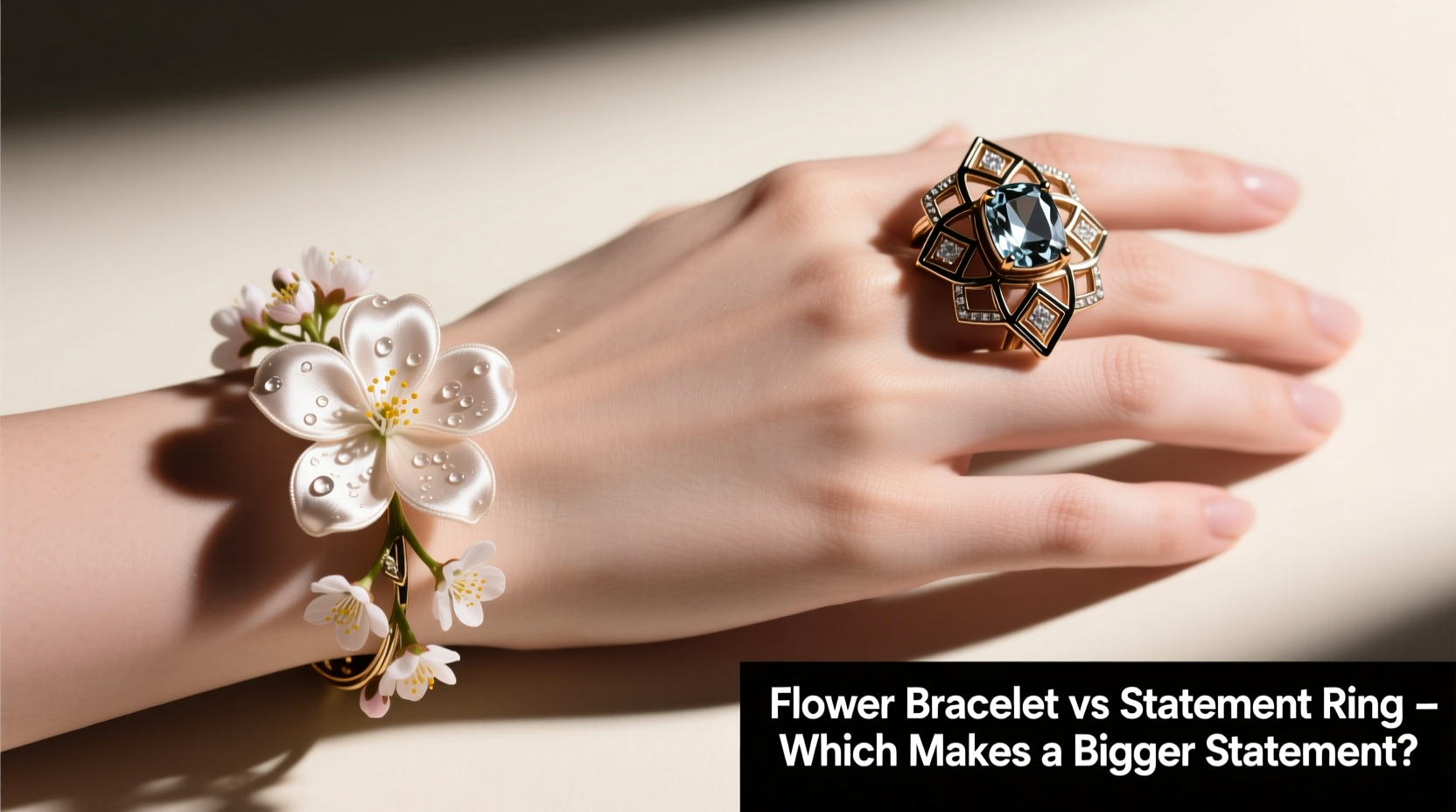
Visual dominance in accessories is influenced by placement on the body. A statement ring sits at the end of the hand—often the most active part of the upper body during conversation and gesture. Every movement draws eyes to the fingers, especially when hands are in motion. This makes rings inherently dynamic; they catch light, interact with space, and naturally attract attention during interaction.
In contrast, a flower bracelet wraps around the wrist—a slightly less prominent zone unless deliberately showcased. While elegant and eye-catching, its visibility depends more on sleeve length, arm positioning, and whether it's worn alone or layered. A delicate floral design may blend into the background in a busy outfit, whereas a large, three-dimensional bloom could rival any ring in presence.
Symbolism and Emotional Resonance
Flowers carry deep symbolic meaning across cultures—roses for love, lotuses for purity, sunflowers for vitality. A flower bracelet transforms the wrist into a canvas of botanical storytelling. It evokes femininity, growth, and connection to nature. For many wearers, this kind of jewelry feels personal, even sentimental. It’s not just decorative—it’s expressive.
Statement rings, meanwhile, often symbolize boldness, independence, or artistic flair. They’re frequently chosen as signature pieces—singular items that define a person’s style. Unlike flower motifs, which lean toward tradition and romance, statement rings can be abstract, architectural, or avant-garde. Their symbolism tends to be self-defined: “This is me.”
“A ring is like a signature on a letter—you sign your name, and people remember it. A bracelet is the envelope: beautiful, but secondary.” — Lila Montague, Fashion Stylist & Jewelry Curator
Comparing Versatility and Styling Options
Versatility plays a crucial role in determining which accessory offers broader styling potential—and thus, more opportunities to make a statement.
| Feature | Flower Bracelet | Statement Ring |
|---|---|---|
| Outfit Compatibility | Best with feminine, bohemian, or spring/summer styles | Works across casual, formal, edgy, and minimalist looks |
| Layering Potential | High—can be stacked with bangles or chains | Limited—usually worn solo to avoid clutter |
| Seasonal Flexibility | Strongest in spring/summer; less common in winter | Year-round appeal, especially in metallic or dark gemstones |
| Maintenance Needs | Delicate petals may snag; enamel can chip | Durable if well-made; prongs may loosen over time |
| Attention Factor (Average Setting) | Moderate to high, depending on design scale | Consistently high due to hand movement |
A Real-World Example: The Cocktail Party Test
Consider Maya, a marketing executive attending a networking cocktail event. She wears a sleek black jumpsuit—minimalist, modern, and neutral. She debates between her vintage rose-gold flower bracelet, with tiny enamel daisies, and a chunky geometric ring set with a deep amethyst.
She chooses the ring. Throughout the evening, she notices people complimenting her hands during handshakes and while holding her drink. One guest says, “I love your ring—it’s so bold!” The bracelet, though charming, would have been partially hidden by her long cuff and required deliberate arm positioning to be seen.
This scenario illustrates a key truth: in social and professional settings, **statement rings dominate through functionality**. Hands are tools of communication—the ring becomes part of the dialogue.
When the Flower Bracelet Wins the Spotlight
That said, there are moments when a flower bracelet doesn’t just compete—it triumphs. Imagine a beach wedding at sunset. A flowing white dress with cap sleeves reveals the arms fully. A wide, sculptural flower bracelet made of oxidized silver and coral blossoms wraps around the wrist like wearable art. Paired with bare sandals and loose waves, it becomes the focal point of the ensemble.
In such contexts—outdoor events, garden parties, artistic performances—the flower bracelet aligns perfectly with the theme and environment. Its thematic strength amplifies its impact. When the setting supports the story the jewelry tells, the emotional resonance can surpass mere visual loudness.
Step-by-Step Guide: Choosing Your Statement Piece
Follow this decision-making process to select the right accessory for maximum impact:
- Assess the occasion. Is it formal, casual, romantic, or professional? Rings tend to excel in fast-paced, interactive environments.
- Evaluate your outfit’s neckline and sleeves. Long sleeves hide bracelets; sleeveless or short-sleeved tops showcase them.
- Consider your hand usage. Do you gesture often? Teach? Type? Active hands benefit from rings that move with you.
- Think about longevity. Will this piece work across seasons and years? Statement rings often have longer stylistic shelf lives.
- Test both options. Wear each with the full outfit and observe in natural light. Ask: Which feels more authentic and commanding?
Expert Insight: Beyond Aesthetics
Jewelry isn’t just seen—it’s felt. The psychological weight of wearing a piece influences how confidently you carry yourself, which in turn affects how others perceive it.
“The biggest statement isn’t always the loudest object. It’s the one that makes the wearer feel unstoppable. Confidence radiates further than sparkle.” — Dr. Naomi Pierce, Psychologist Specializing in Self-Presentation
This insight shifts the focus from pure visual comparison to personal empowerment. A woman who feels radiant in her cherry-blossom bracelet will project more presence than someone wearing a massive ring that feels alien to her identity.
Frequently Asked Questions
Can I wear both a flower bracelet and a statement ring together?
Yes, but balance is essential. If both pieces are large or ornate, they can compete. Try pairing a bold ring with a thinner floral chain bracelet, or vice versa. Avoid clustering too many details on one side of the body.
Which is better for professional settings?
A well-designed statement ring often reads as powerful yet polished in corporate environments. A flower bracelet can work in creative industries but may seem overly decorative in conservative fields like law or finance.
Do flower bracelets look childish?
Not if designed with sophistication. Look for mature materials—oxidized metals, semi-precious stones, or minimalist silhouettes. Size and finish matter more than motif. A small enamel daisy on a gold band may read as playful; a life-sized bronze orchid sculpture reads as artful.
Final Verdict: What Makes the Bigger Statement?
In terms of raw visibility and consistent impact, the **statement ring generally wins**. Its strategic location, dynamic use in daily motion, and universal compatibility give it an edge in capturing attention across diverse settings. It’s the exclamation point at the end of a sentence.
However, the **flower bracelet excels in thematic depth and emotional storytelling**. In the right context—especially nature-inspired, romantic, or artistic environments—it doesn’t just make a statement; it creates a memory.
The true measure of a “big” statement isn’t volume—it’s memorability. And sometimes, the softest whisper lingers longest in the mind.




 浙公网安备
33010002000092号
浙公网安备
33010002000092号 浙B2-20120091-4
Comments
No comments yet. Why don't you start the discussion?