
When holiday lights fail, the frustration is real. You string up hundreds of bulbs, plug them in, and half the strand stays dark. The hunt for the culprit begins — but how do you find it efficiently? Enter two common tools: the foldable light tester, a compact plastic device designed specifically for holiday lights, and the multimeter, a versatile electronic diagnostic instrument used by electricians and hobbyists alike. One is purpose-built; the other is general-purpose. But does that make the light tester just another overpriced gimmick? Or does its simplicity offer real advantages in this niche task?
This isn’t just about convenience versus capability. It’s about understanding when specialization adds value — and when it’s simply clutter in your toolbox.
The Problem with Broken Light Strands
Modern incandescent and LED Christmas light strands are wired in series or partial series configurations. A single dead bulb, loose connection, or faulty shunt can interrupt the circuit and leave entire sections unlit. Unlike household circuits, where voltage remains stable across parallel branches, these low-voltage strings rely on continuity through each component. That makes troubleshooting more complex than simply replacing a fuse.
Many people resort to the “bulb-by-bulb” method — pulling out each bulb and inspecting the filament or trying it in a known-good socket. This is time-consuming and often ineffective, especially with mini-lights that have nearly invisible shunts or cracked filaments. Others try visual inspection under bright light, looking for blackened bulbs or broken wires. Still, many failures are internal or microscopic.
That’s where testing tools come in. Both the foldable light tester and the multimeter promise faster diagnosis, but they work very differently.
How the Foldable Light Tester Works
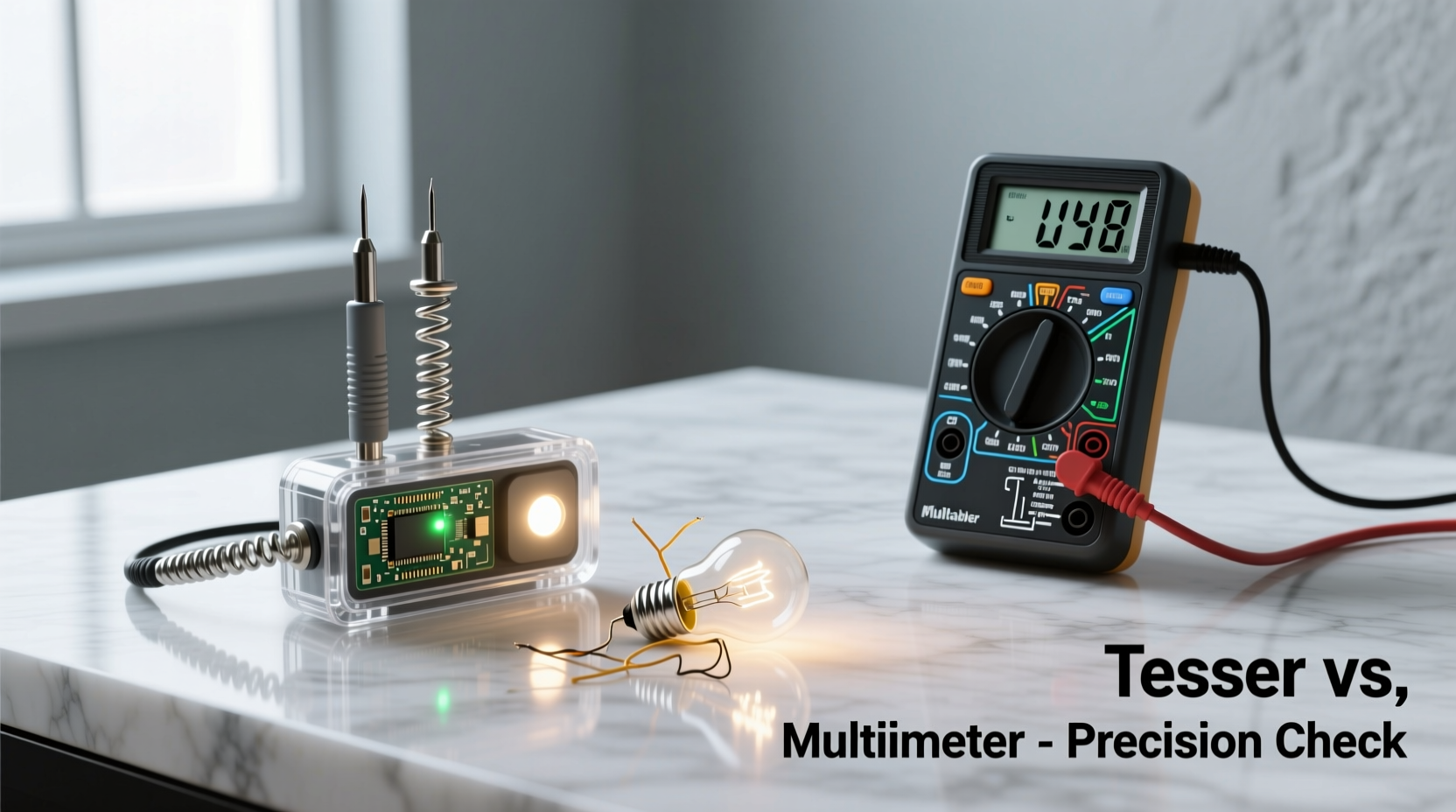
The foldable light tester — sometimes branded as a “light keeper” or “circuit tester” — is a small, hinged plastic tool with metal prongs and an indicator light. You clamp it onto the wire of a plugged-in light strand, usually near the plug end. As you slowly slide it along the cord, the built-in LED lights up when it detects electrical current. When the light goes out, you’ve passed the break. The fault lies between the last point where current was detected and the next visible bulb.
These testers are marketed as foolproof. No settings to adjust. No probes to position. Just plug in the lights, clip on the device, and move it down the line. Most cost between $10 and $20 and fit in a drawer with your holiday decorations.
Its biggest advantage is speed. For someone who decorates once a year and wants results fast, it removes technical barriers. There’s no need to understand AC voltage, resistance, or continuity. It answers one question: “Is there current here?”
However, it has limitations. It only works on energized circuits, meaning the strand must be plugged in and powered. That introduces minor safety concerns, especially outdoors or in damp conditions. It also can’t diagnose open shunts, bad fuses inside the plug, or issues with individual bulbs unless used in conjunction with manual checks.
What a Multimeter Can Do (and Why It’s Different)
A multimeter measures voltage, current, and resistance. Mid-range digital models cost $30–$60 and can test everything from car batteries to circuit boards. When applied to light strands, it offers multiple diagnostic paths:
- Voltage testing: Check if power reaches the plug end of the strand.
- Continuity testing: Isolate sections and check for breaks in the wire or bulb sockets.
- Resistance measurement: Identify high-resistance connections that may not be fully open but still cause dimming or flickering.
To find a broken bulb with a multimeter, you typically start at the plug and work forward. Set the meter to AC voltage, insert one probe into each slot of the female end, and verify ~120V (or local line voltage). If voltage is missing, the issue is in the male plug or upstream. If present, move to continuity mode. Disconnect the strand and remove bulbs sequentially, testing each one by touching the probes to the base contacts. A good bulb shows low resistance (a few ohms); an open one reads infinite.
You can also test socket-to-socket continuity along the strand, though this becomes tedious with long runs. Some advanced users use the multimeter to check shunt functionality in miniature incandescent bulbs — a feature critical to keeping the rest of the strand lit when one bulb burns out.
“Multimeters give you insight, not just indication. They don’t just tell you *that* something’s wrong — they help you understand *why*.” — Rafael Nguyen, Electrical Technician & DIY Educator
The multimeter is far more flexible. It can test extension cords, outlets, batteries, and even check if a replacement fuse is intact. But that versatility comes with a learning curve. Misreading settings, forgetting to switch modes, or using the wrong range can lead to confusion or false conclusions — especially for occasional users.
Head-to-Head Comparison: Tools in Practice
| Feature | Foldable Light Tester | Multimeter |
|---|---|---|
| Primary Use | Holiday light strand diagnostics only | General electrical testing |
| Learning Curve | Minimal — plug in and slide | Moderate — requires knowledge of settings and safety |
| Cost | $10–$20 | $30–$150+ |
| Safety | Requires live voltage during test | Can test de-energized circuits (continuity mode) |
| Accuracy | Good for locating general break zones | Precise — identifies exact open points, resistance values |
| Durability | Plastic housing; prone to cracking | Rugged models available; longer lifespan |
| Storage Size | Folds flat; very compact | Larger; needs case or pouch |
| Other Uses | None | Extensive — home, auto, electronics |
The table reveals a clear trade-off: specialization versus adaptability. The light tester wins on simplicity and storage. The multimeter wins on precision and utility beyond holiday season.
Real-World Example: Diagnosing a 100-Bulb Strand
Consider Sarah, a homeowner preparing her front porch display. She pulls out a C7 LED strand with 100 bulbs — only the first 20 light up. Frustrated, she tries plugging it into a different outlet. Same result. She grabs her foldable light tester, plugs in the strand, clamps the device at the beginning, and slides it down the wire. The tester’s LED glows brightly for the first six inches — then abruptly cuts off.
She knows the break is near the plug. After closer inspection, she finds a corroded contact inside the male end. Cleaning it with contact spray restores the connection. Total time: 5 minutes.
Now imagine James, an amateur electrician, facing the same problem. He unplugs the strand, sets his multimeter to continuity, and checks the male plug. No beep. He disassembles the plug, finds a broken solder joint, and resolders it. He then tests each section for resistance, confirming even current distribution. Total time: 25 minutes — but he now understands the root cause and verified the repair thoroughly.
Sarah got fast results with minimal effort. James gained deeper insight and confidence in the fix. Neither approach is wrong — but their goals differ.
Step-by-Step: Choosing the Right Tool for Your Needs
- Assess your skill level: Are you comfortable with basic electronics terminology (voltage, continuity, resistance)? If not, the light tester reduces risk of error.
- Evaluate frequency of use: Do you handle faulty lights every holiday season, or just once every few years? Occasional users benefit more from simplicity.
- Check existing tools: Do you already own a multimeter for other projects? If yes, investing in a specialty tester may be redundant.
- Consider safety: Will you be working outdoors, in wet conditions, or with children nearby? Testing de-energized circuits with a multimeter is inherently safer.
- Weigh long-term value: If you enjoy fixing things, a multimeter pays for itself over time. If you just want working lights fast, the foldable tester delivers.
FAQ: Common Questions Answered
Can a foldable light tester damage my lights?
No, the device draws negligible current and doesn’t interfere with the circuit. However, ensure the prongs don’t pierce the insulation deeply, which could create future shorts.
Why doesn’t my multimeter detect anything on the light strand?
Double-check your settings. For voltage testing, ensure the meter is set to AC voltage (~V), not DC. For continuity, confirm the strand is disconnected from power. Also, test the multimeter on a known source (like a battery) to rule out user error.
Is the foldable tester worth it if I already have a multimeter?
Probably not — unless you frequently help others fix lights and value speed over precision. The multimeter can perform all the same checks, albeit with more steps.
Final Verdict: Overkill or Underrated?
Calling the foldable light tester “overkill” depends entirely on context. For the average homeowner who decorates once a year and wants functional lights without diving into electronics, it’s not overkill — it’s appropriately simplified. It removes complexity, reduces frustration, and gets the job done quickly. In that sense, it’s a smart application of targeted design.
For the tinkerer, the electrician, or the frequent fixer, it’s redundant. A multimeter offers deeper diagnostics, greater safety through de-energized testing, and lasting value across countless applications. Buying a $15 tool solely for one seasonal task may feel like clutter when a $40 tool already in the garage can do the job — and so much more.
The real issue isn’t whether the gadget is overkill. It’s whether we undervalue simplicity. Not everyone needs to understand electrical theory to hang holiday lights. Sometimes, a tool that just works — without menus, modes, or manuals — is exactly what’s needed.
Action Plan: Make the Right Choice for You
“Tools should match the task and the user — not the other way around.” — Lena Torres, Home Efficiency Consultant
Here’s a quick checklist to guide your decision:
- ✅ I only fix lights once a year → Lean toward foldable tester
- ✅ I already use a multimeter for cars, outlets, or gadgets → Stick with multimeter
- ✅ Safety is a top concern (outdoor, damp areas) → Prefer multimeter (de-energized testing)
- ✅ I enjoy understanding how things work → Go for multimeter
- ✅ I hate spending hours troubleshooting → Foldable tester saves time
Conclusion
The foldable light tester isn’t overkill — it’s specialization in action. It solves one problem exceptionally well for a specific audience. The multimeter is broader, deeper, and more powerful, but demands engagement. Neither renders the other obsolete. Instead, they reflect different philosophies: efficiency versus understanding, speed versus control.
If you’re tired of tossing entire strands because one bulb failed, having any diagnostic tool is better than none. Start with what matches your comfort level and usage pattern. Over time, you might grow into more advanced tools — or find peace in the simplicity of a gadget that just works.




 浙公网安备
33010002000092号
浙公网安备
33010002000092号 浙B2-20120091-4
Comments
No comments yet. Why don't you start the discussion?