
In recent years, the modern workspace has evolved beyond cubicles and static chairs. As more people work from home or adopt hybrid models, attention has turned to how our furniture affects not just productivity, but long-term health. One of the most debated upgrades: whether to invest in a foldable standing desk or stick with a traditional fixed-height model.
The core question isn’t just about price—it’s about value. A foldable standing desk often costs significantly more than a basic fixed desk. But if it supports better posture, reduces back pain, and encourages movement throughout the day, does the investment pay off? To answer this, we need to examine ergonomics, flexibility, physical health outcomes, and real-world usability.
The Ergonomic Case for Adjustable Desks
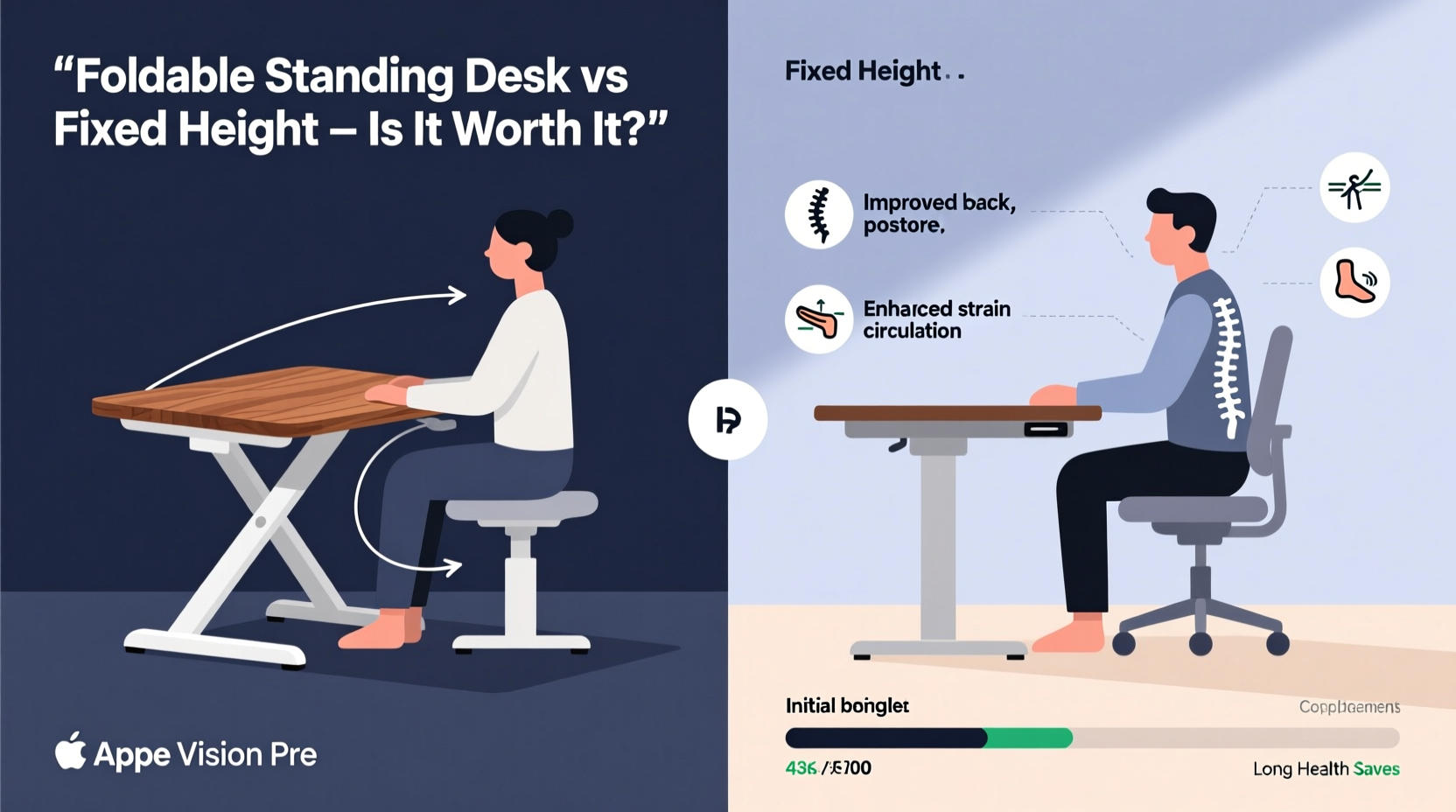
Ergonomics—the science of designing workspaces to fit the user—has become central to discussions about workplace wellness. Poor posture, repetitive strain, and prolonged sitting are linked to chronic issues like lower back pain, carpal tunnel syndrome, and even cardiovascular disease. The human body isn’t designed for eight hours of immobility.
A foldable (or height-adjustable) standing desk allows users to alternate between sitting and standing positions seamlessly. This dynamic movement supports spinal alignment, engages core muscles, and improves circulation. According to the American Journal of Preventive Medicine, alternating between sitting and standing every 30–60 minutes can reduce discomfort by up to 54% and improve mood and energy levels.
“Movement is medicine. Even small shifts in posture throughout the day can significantly reduce musculoskeletal strain.” — Dr. Lena Torres, Occupational Health Specialist
Fixed-height desks, on the other hand, lock users into one position. While they can be paired with ergonomic chairs or external risers, they lack the seamless adaptability that makes adjustable desks effective. For individuals who vary in height or share workspaces, a fixed desk may never offer an optimal ergonomic setup.
Comparing Foldable Standing Desks and Fixed-Height Models
To understand the true difference, let’s break down key features across both types of desks.
| Feature | Foldable Standing Desk | Fixed-Height Desk |
|---|---|---|
| Height Adjustability | Motorized or manual adjustment; typically 24–50 inches | None; standard height ~29–30 inches |
| Ergonomic Flexibility | High – supports sit-stand transitions | Low – requires add-ons for customization |
| Price Range | $250–$800+ | $80–$300 |
| Space Efficiency | Moderate – some models fold or collapse | High – stable footprint, no moving parts |
| Durability | Varies; higher-end models last 7–10 years | Generally high; fewer components to fail |
| Assembly & Setup | Moderate to complex | Simple |
| Health Impact | Proven reduction in back pain and fatigue | Limited unless modified |
The data shows a clear trade-off: foldable desks offer superior ergonomics and health benefits but come at a higher initial cost and sometimes complexity. Fixed desks win on simplicity and affordability but fall short in long-term adaptability.
Real-World Example: Sarah’s Transition to a Sit-Stand Routine
Sarah, a freelance graphic designer from Portland, spent five years working at a fixed-height desk. By her early 30s, she began experiencing persistent lower back pain and afternoon fatigue. She initially dismissed it as part of “desk job life.” After a consultation with a physical therapist, she was advised to incorporate movement into her workday.
She invested $450 in a motorized foldable standing desk. At first, she used it only occasionally, standing for 15 minutes each hour. Over three months, she gradually increased her standing intervals and began pairing them with light stretching.
The results were measurable. Her back pain decreased by 70%, as tracked through a symptom journal. She reported improved focus during afternoon hours and reduced reliance on caffeine. After six months, she noted better posture during video calls and fewer instances of neck stiffness.
While the desk didn’t eliminate all discomfort—she still needed occasional chiropractic visits—it became a foundational tool in her wellness routine. For Sarah, the $450 cost equated to less than $1.25 per day over a three-year lifespan—less than her daily coffee habit.
Cost vs. Long-Term Value: Is It Worth It?
The average foldable standing desk costs $200–$500 more than a comparable fixed desk. So, is that premium justified?
Consider the hidden costs of poor ergonomics:
- Medical expenses from chronic back or joint pain
- Lost productivity due to discomfort or fatigue
- Potential need for ergonomic accessories (risers, cushions, footrests)
- Replacement of poorly fitting furniture down the line
In contrast, a well-built foldable desk can serve multiple users, adapt to changing needs (e.g., pregnancy, injury recovery, growth spurts), and support healthy habits for years. High-quality models from brands like Uplift, Fully, or VariDesk offer warranties of 5–7 years, signaling confidence in longevity.
Moreover, tax deductions or employer reimbursement programs may offset the cost. In the U.S., the IRS allows home office deductions for equipment that promotes health, especially if prescribed by a physician for medical reasons.
For remote workers, freelancers, or anyone spending more than four hours daily at a desk, the foldable option begins to look less like a luxury and more like preventive healthcare.
Action Plan: Choosing the Right Desk for Your Needs
Deciding between a foldable and fixed desk doesn’t have to be overwhelming. Follow this step-by-step guide to make an informed choice.
- Assess your daily routine: How many hours do you spend seated? Do you experience stiffness, pain, or fatigue by midday?
- Measure your space: Will a foldable desk fit comfortably? Some models require clearance above and below for smooth operation.
- Determine your budget: Can you afford a one-time investment of $300–$600, or do you need a sub-$200 solution?
- Check compatibility: Will your current chair, monitor, and peripherals work with a height-adjustable setup?
- Test alternatives: If budget is tight, try a desktop riser on your existing desk before upgrading entirely.
- Research durability: Look for steel frames, dual-motor lifts (for larger desks), and certifications like BIFMA.
- Start small: Begin with 15-minute standing intervals twice a day, then build up based on comfort.
Common Misconceptions About Standing Desks
Despite growing popularity, several myths persist about foldable standing desks:
- Myth: Standing all day is healthier. Reality: Prolonged standing can cause varicose veins and foot pain. The goal is balance—ideally 15–30 minutes of standing per hour.
- Myth: Any adjustable desk is ergonomic. Reality: Poor monitor placement or footwear can negate benefits. Ergonomics involves the entire setup.
- Myth: Cheap models perform just as well. Reality: Low-cost motors may wear out quickly, and wobbly frames discourage consistent use.
- Myth: You’ll burn hundreds of calories. Reality: Standing burns only about 50–100 more calories per hour than sitting. The real benefit is metabolic activation, not weight loss.
Checklist: Evaluating Your Desk Upgrade Options
Before purchasing, ask yourself these questions:
- ✅ Do I spend more than 4 hours a day at my desk?
- ✅ Have I experienced back, neck, or wrist pain related to work?
- ✅ Am I willing to commit to changing my posture habits?
- ✅ Does my space allow for a height-adjustable mechanism?
- ✅ Can I access warranty support or replacement parts?
- ✅ Will this desk serve me for the next 5+ years?
- ✅ Are there employer or tax incentives available?
If you answered “yes” to three or more, a foldable standing desk is likely a worthwhile investment.
Frequently Asked Questions
Can I convert my existing desk into a standing desk?
Yes. Desktop risers and clamp-on lift systems allow you to add height adjustability without replacing your entire desk. These range from $100–$300 and are ideal for renters or those testing the waters. However, they offer less vertical range and stability than full-frame adjustable desks.
How long should I stand at my desk?
There’s no universal rule, but research suggests alternating every 30–60 minutes. Start with 15 minutes of standing per hour and adjust based on comfort. Use a smartwatch or app reminder to prompt transitions. Listen to your body—discomfort is a signal to shift positions.
Are foldable standing desks noisy?
Higher-end models operate quietly (under 50 dB), similar to a refrigerator hum. Budget options may produce more mechanical noise, especially during adjustment. If noise is a concern—such as in shared spaces—look for desks labeled “quiet motor” or “whisper-lift.”
Final Verdict: Ergonomics as an Investment
The upfront cost of a foldable standing desk may seem steep compared to a fixed-height alternative. But when viewed through the lens of long-term health, productivity, and adaptability, it transforms from an expense into an investment.
Ergonomics isn’t just about comfort—it’s about sustainability. A workspace that moves with you reduces strain, supports natural posture, and fosters better daily habits. For knowledge workers, creatives, and remote professionals, this can mean fewer sick days, sharper focus, and greater job satisfaction.
That said, not everyone needs a motorized desk. If your usage is light, your posture is already strong, or your budget is constrained, a fixed desk with thoughtful accessories can still support good ergonomics. The key is awareness and intentionality.
But if you’re serious about creating a healthier, more dynamic workspace—one that evolves with your body and lifestyle—a foldable standing desk isn’t just worth the cost. It’s a cornerstone of modern, human-centered design.




 浙公网安备
33010002000092号
浙公网安备
33010002000092号 浙B2-20120091-4
Comments
No comments yet. Why don't you start the discussion?