
For home cooks and meal prep enthusiasts, the kitchen countertop can quickly become crowded with appliances that promise efficiency but often duplicate functions. Among the most debated are the food processor and the blender. Both are powerful tools capable of transforming ingredients with speed and precision, yet they serve distinctly different purposes. The real question isn’t just about performance—it’s about practicality. Do you actually need both appliances in a functional kitchen, or can one adequately replace the other?
The answer depends on your cooking habits, dietary preferences, and how much variety you bring to your meals. Understanding the core differences between these two devices—beyond marketing claims—is essential to making an informed decision that aligns with your culinary needs.
Understanding the Core Functions
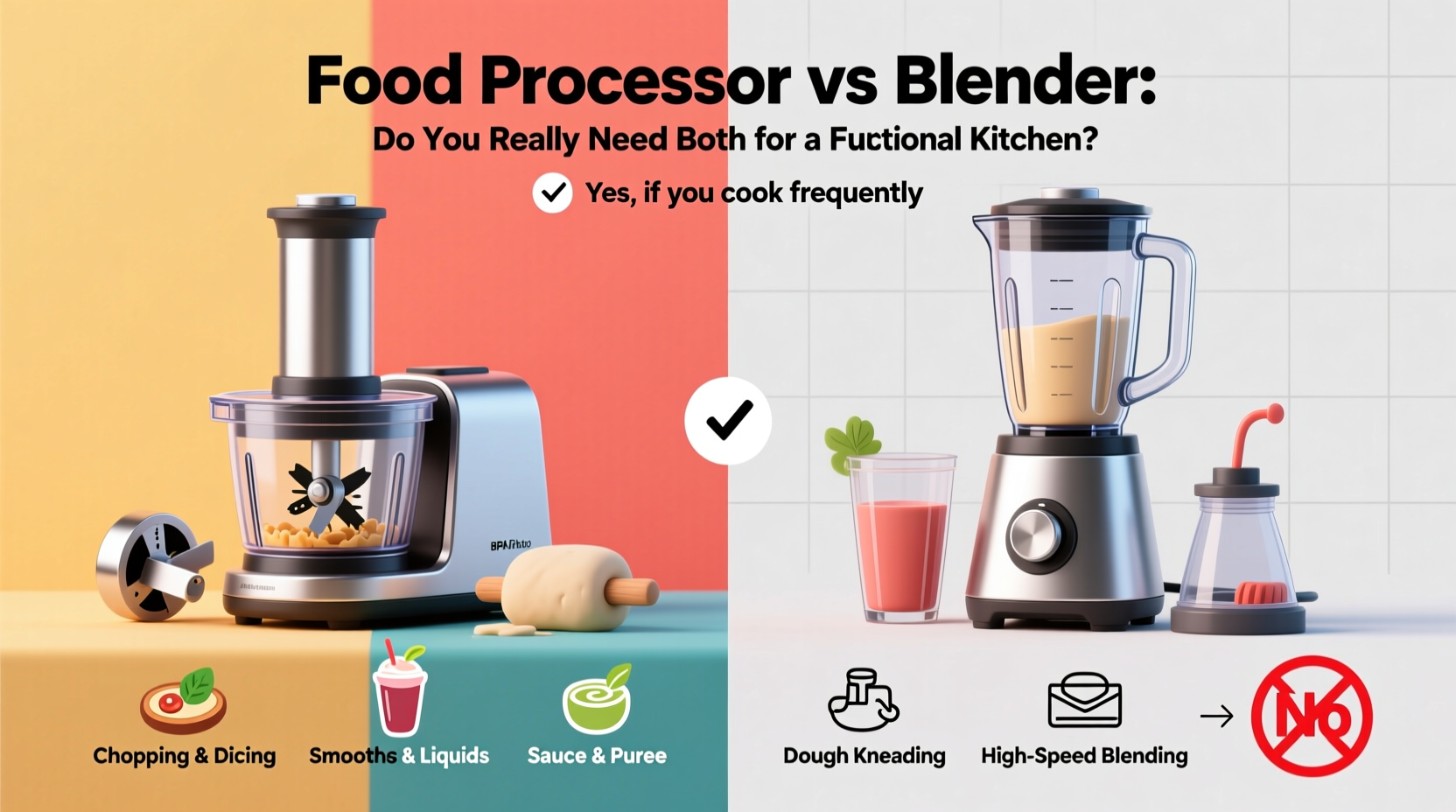
At first glance, blenders and food processors may appear similar: both have motors, blades, and containers designed to chop, mix, or puree. However, their internal mechanics, blade design, and intended use cases set them apart significantly.
Blenders are optimized for liquids. Their tall, narrow pitchers create a vortex that pulls ingredients down toward the blades, making them ideal for smoothies, soups, sauces, and drinks. High-powered blenders can crush ice, pulverize frozen fruit, and emulsify dressings with ease. The focus is on achieving a smooth, uniform consistency—especially important when texture matters, such as in silky bisques or protein shakes.
Food processors, on the other hand, excel at handling solids. With wide, shallow bowls and interchangeable blades (like slicing discs, shredding discs, and S-blades), they’re built for chopping vegetables, grinding nuts, kneading dough, shredding cheese, and making pastry. They offer more control over texture, allowing for coarse chops, fine grinds, or even uniform slices—tasks that blenders simply can't manage effectively.
Performance Comparison: Where Each Excels
To determine whether you need both, it helps to evaluate each appliance across common kitchen tasks. Below is a detailed comparison of key functions:
| Task | Blender Performance | Food Processor Performance |
|---|---|---|
| Smoothies & Shakes | Excellent – creates ultra-smooth textures quickly | Poor – wide bowl prevents proper vortex; uneven blending |
| Chopping Vegetables | Fair – results in mush unless carefully pulsed | Excellent – consistent, adjustable texture with pulse control |
| Making Dough | Poor – not designed for heavy, dry mixtures | Good – handles pie crusts and bread dough with dough blade |
| Grinding Nuts/Seeds | Fair – can overheat and turn into paste quickly | Excellent – precise control for nut meals or butters |
| Slicing/Shredding | Impossible – no disc attachments | Excellent – uses feed tubes and discs for carrots, cabbage, etc. |
| Hot Soups (Immersion Style) | Excellent – especially with thermal-resistant pitchers | Fair – possible, but less efficient and riskier due to heat exposure |
| Emulsifying Sauces | Good – works well with oil-based vinaigrettes | Excellent – better control over gradual oil incorporation |
This table illustrates a clear division of labor. While there's some overlap—both can puree cooked vegetables or mix batters—their strengths lie in different domains. Attempting to force one appliance to do the other’s job often leads to subpar results or unnecessary cleanup.
Real-Life Scenario: A Week of Cooking Without One
Consider Sarah, a working parent who prepares most family meals at home. She loves homemade pesto, fresh salsa, and weekly smoothies. Initially, she relied solely on her blender, assuming it could handle everything. When making pesto, she found the basil bruised and the pine nuts turned into a paste rather than a textured spread. Chopping onions for chili required constant scraping down the sides, and the result was inconsistently sized pieces that cooked unevenly.
After borrowing a friend’s food processor, she discovered how quickly and evenly it handled onions, garlic, and herbs. The pesto had the perfect rustic texture, and shredding cheese for casseroles took seconds. However, when she tried making a morning green smoothie in the food processor, the liquid didn’t circulate properly, leaving chunks at the top and foam at the bottom.
Sarah concluded that while she could technically get by with just one, having both significantly improved her cooking experience, reduced prep time, and enhanced dish quality. Her solution? Keep both, but store the food processor in a cabinet when not in use to save counter space.
“Many people assume blenders and food processors are interchangeable, but they solve different problems in the kitchen. It’s like comparing a chef’s knife to a paring knife—one doesn’t replace the other.” — Chef Marcus Lin, Culinary Instructor at Pacific Kitchen Academy
When One Might Be Enough
Not every kitchen requires both appliances. For individuals with limited space, budget constraints, or simpler cooking routines, choosing one over the other—or relying on a hybrid device—can be perfectly adequate.
If your diet centers around:
- Daily smoothies, protein shakes, or juices
- Blended soups (like tomato or butternut squash)
- Homemade nut milks or frozen desserts
- Limited chopping or raw food prep
…then a high-performance blender like a Vitamix or Blendtec may suffice. These models offer “dry container” attachments that allow for grinding grains or nuts, and some even include mini bowls for small chopping tasks.
Conversely, if you frequently:
- Prepare large batches of chopped vegetables
- Bake pies, crackers, or homemade breadcrumbs
- Make dips like hummus or guacamole from scratch
- Shred cheese or cabbage for slaws and stir-fries
…a food processor becomes far more valuable. Many modern models come with multiple bowl sizes and specialized discs, offering versatility that blenders can’t match.
Hybrid Options and Smart Alternatives
Manufacturers have responded to the space-versus-functionality dilemma with multi-functional appliances. Some blenders now include small food processor attachments, and certain food processors offer blending jars. However, these hybrids often compromise on power or capacity.
For example, a blender with a 2-cup food processor attachment may work for small herb chopping but struggles with larger volumes. Similarly, a food processor with a blending jar might not achieve the same smoothness as a dedicated high-speed blender due to lower RPMs and less optimized jar shape.
Another alternative is the immersion blender with attachments. While excellent for soups and light mixing, it lacks the capacity and power for serious processing tasks. Stand mixers with food grinder and slicer attachments can also fill some gaps but are typically slower and less intuitive.
The verdict? Hybrid tools are convenient for minimalists or occasional users, but serious home cooks will still benefit from owning both a full-sized blender and food processor for optimal results.
Checklist: Do You Need Both Appliances?
Use this checklist to assess your actual needs:
- Do you make smoothies, shakes, or blended drinks more than twice a week? → Blender recommended
- Do you regularly chop, slice, or shred large quantities of vegetables? → Food processor recommended
- Do you bake frequently and need to make dough or crumble toppings? → Food processor helpful
- Do you make nut butters, flours, or seed meals at home? → Food processor preferred
- Is counter or cabinet space extremely limited? → Consider prioritizing one
- Do you already own a high-end blender with a dry grains container? → Test its limits before buying a processor
- Are you on a tight budget? → Choose based on most frequent use case
Frequently Asked Questions
Can I use a food processor instead of a blender for smoothies?
Technically yes, but not effectively. Food processors don’t create the vortex needed for smooth blending, often leaving chunks at the top and requiring frequent scraping. The result is usually less smooth and more foamy than a blender-produced drink.
Can a blender chop vegetables like a food processor?
Only to a limited extent. While pulsing can achieve rough chopping, the narrow base tends to over-process the bottom layer while leaving larger pieces on top. Texture control is poor, and cleaning can be harder due to splatter. A food processor delivers consistent, uniform results with minimal effort.
Is it worth buying both if I cook for one?
It depends on your cooking style. If you enjoy diverse meals—smoothies, salsas, roasted veggie prep, and baked goods—owning both can enhance convenience and meal quality. However, if your routine is simple, a single high-quality appliance may be sufficient. Consider usage frequency over idealism.
Final Verdict: Practical Recommendations
So, do you really need both a food processor and a blender for a functional kitchen? The short answer: not always—but very often, yes.
A blender is unmatched for liquid-based tasks. Its ability to deliver silky textures, crush ice, and blend hot soups safely makes it a cornerstone of modern kitchens. Meanwhile, a food processor saves time and effort in meal prep, offering precision and consistency for chopping, shredding, and dough-making that blenders cannot replicate.
Think of them as complementary tools rather than competitors. Just as you wouldn’t use a whisk to knead bread or a spatula to peel potatoes, each appliance has a role where it performs best. Owning both allows you to work smarter, reduce prep time, and elevate the quality of your dishes.
If space or budget forces a choice, prioritize based on your most common kitchen activities. But if you cook regularly and value efficiency, investing in both is a decision most seasoned home chefs don’t regret.




 浙公网安备
33010002000092号
浙公网安备
33010002000092号 浙B2-20120091-4
Comments
No comments yet. Why don't you start the discussion?