
When your speedometer starts acting up—showing erratic readings, dropping to zero, or failing entirely—it’s natural to suspect a sensor issue. In Ford vehicles, two sensors often come into play: the Vehicle Speed Sensor (VSS) and the Transmission Speed Sensor (TSS). While these terms are sometimes used interchangeably, they serve different functions in most modern Fords. Understanding which one actually controls your speedometer can save time, money, and unnecessary part replacements.
The confusion between VSS and TSS stems from overlapping terminology across model years and transmission types. Some older models use a single sensor for multiple functions, while newer electronic systems separate responsibilities more precisely. To get an accurate diagnosis, it's essential to know not only where each sensor is located but also how data flows through your vehicle’s network.
Understanding the Vehicle Speed Sensor (VSS)
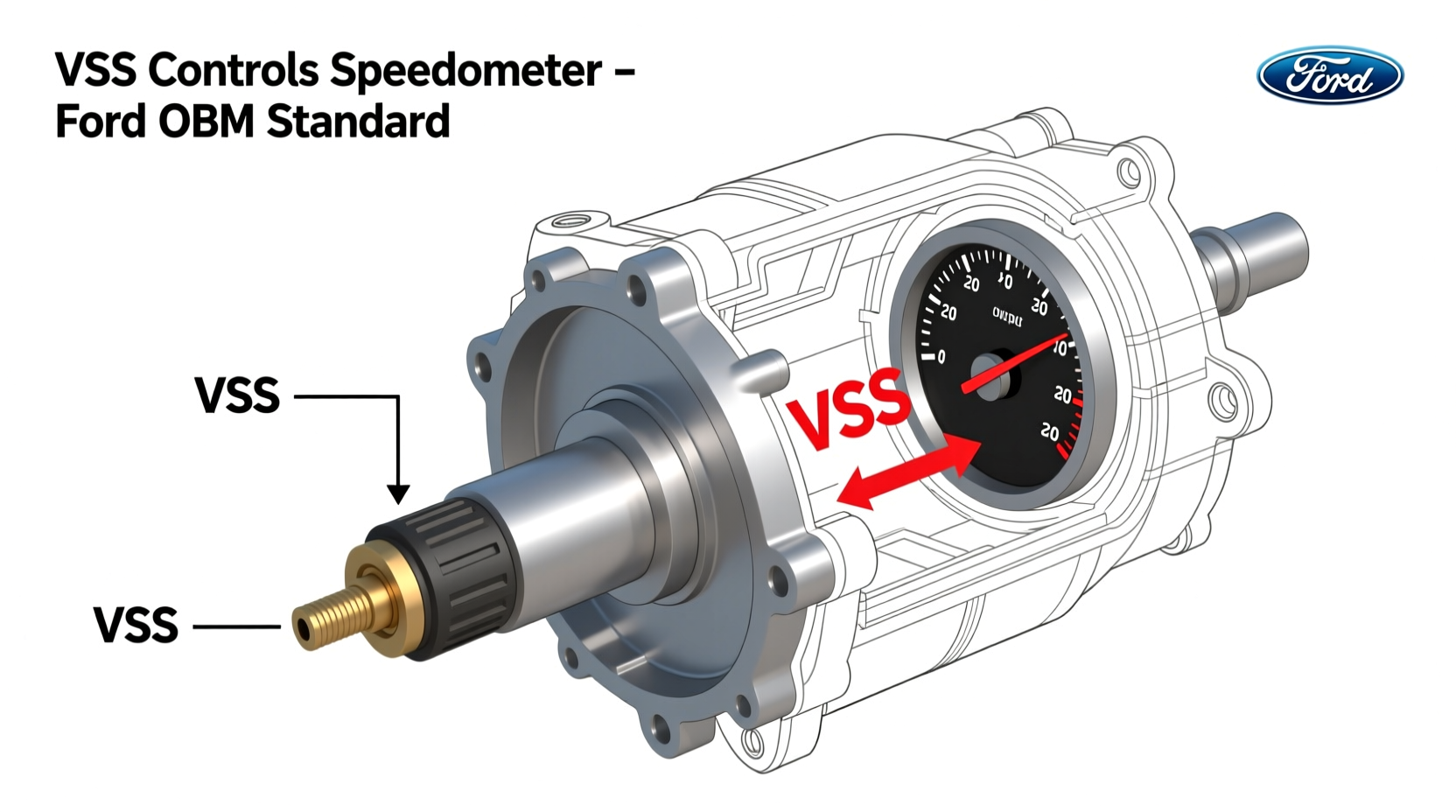
The Vehicle Speed Sensor (VSS) is traditionally responsible for measuring the rotational speed of the transmission output shaft. This measurement is converted into an electrical signal that the Powertrain Control Module (PCM) interprets as vehicle speed. The PCM then relays this information to the instrument cluster, which displays the reading on the speedometer.
In many pre-2000s Ford models—especially those with rear-wheel-drive platforms like the F-150, Explorer, and Mustang—the VSS was mounted on the tailshaft of the transmission. It directly provided speed data used by:
- The speedometer
- Cruise control system
- Transmission shift timing
- Anti-lock braking system (ABS)
- Electronic Stability Control (ESC)
Because the VSS generates a direct speed signal based on driveline rotation, it has historically been the primary source for speedometer operation in analog and early digital clusters.
Transmission Speed Sensors (TSS): Input vs Output
The term \"Transmission Speed Sensor\" (TSS) typically refers to one or two sensors inside or on the exterior of the transmission: the Input Shaft Speed Sensor (ISS) and the Output Shaft Speed Sensor (OSS).
- Input Shaft Speed Sensor (ISS): Monitors the speed of the torque converter or input shaft, helping the PCM determine gear engagement efficiency.
- Output Shaft Speed Sensor (OSS): Measures the speed of the transmission’s output shaft—functionally similar to the traditional VSS.
In many modern Ford transmissions—including 6R80, 10R80, and Powershift units—the OSS effectively replaces the standalone VSS. However, manufacturers may still refer to it as a TSS within diagnostic software, leading to confusion.
Crucially, in post-2010 Ford vehicles, the OSS (often labeled as TSS by scan tools) becomes the actual source of speedometer data. So even though the label says “transmission” sensor, it’s feeding speed info to the dashboard.
“Don’t be misled by naming conventions. On late-model Fords, the so-called 'TSS'—specifically the output speed sensor—is what drives the speedometer.” — Mark Reynolds, ASE Master Technician & Ford Specialist
VSS vs TSS: Key Differences and Functions
| Feature | Vehicle Speed Sensor (VSS) | Transmission Speed Sensor (TSS) |
|---|---|---|
| Location | Tailshaft housing (older models), transfer case (4x4) | On or inside transmission (input/output shafts) |
| Main Purpose | Provide vehicle speed to PCM and instruments | Monitor gear slippage, shift quality, torque converter lockup |
| Controls Speedometer? | Yes – in older Fords (pre-2010) | Yes – if it's the Output Shaft Sensor (OSS) in newer models |
| Common Failure Symptoms | No speedo reading, hard shifts, cruise failure | Slipping gears, delayed shifts, stored P0720 codes |
| Diagnostic Trouble Codes | P0500 (Vehicle Speed Sensor A) | P0720 (Output Speed Sensor), P0717 (Input Speed Sensor) |
This table highlights a critical point: while functionally distinct in design intent, both sensors can influence speedometer performance depending on the vehicle generation and architecture.
Which Sensor Actually Controls the Speedometer?
The definitive answer depends on your Ford’s year, make, model, and transmission type.
For Ford vehicles manufactured before 2010: The VSS is almost always the sensor responsible for speedometer input. It sends a pulse signal proportional to driveshaft rotation directly to the PCM, which forwards it to the instrument cluster.
For Ford vehicles from 2010 onward: Most rely on the Transmission Output Shaft Speed Sensor (OSS)—labeled as TSS in diagnostics—as the primary speed reference. The PCM uses this data not only for shifting logic but also to calculate road speed for display.
For example, in a 2015 Ford F-150 with a 6R80 transmission:
- The Input Speed Sensor monitors turbine RPM.
- The Output Speed Sensor tracks final drive speed.
- The PCM uses the Output Speed Sensor signal to derive vehicle speed.
- This value is sent via CAN bus to the instrument cluster.
So technically, the TSS (output version) controls the speedometer—even though it wasn't originally designed solely for that purpose.
Real-World Diagnostic Example
A technician receives a 2017 Ford Escape with a complaint: “Speedometer drops to zero at highway speeds.” No warning lights appear initially, but a scan reveals code P0720—“Output Speed Sensor Circuit Malfunction.”
Despite the code pointing to the transmission, the root symptom is speedometer failure. Replacing the output speed sensor (a TSS-type unit) resolves both issues. Post-repair, the speedometer reads accurately, and no further codes return.
This illustrates how modern integration blurs the line between transmission monitoring and instrumentation. The sensor labeled as part of the transmission system is, in fact, the one governing speed display.
Step-by-Step Diagnosis Guide
If you're experiencing speedometer problems, follow this logical process to identify whether VSS or TSS is at fault:
- Check for Stored DTCs: Use an OBD-II scanner to pull codes. Look for P0500 (VSS), P0720 (OSS/TSS), or U0405 (lost communication with PCM).
- Verify Symptom Pattern: Does the speedometer drop intermittently? Fail completely? Lag behind actual speed?
- Inspect Wiring and Connectors: Check harnesses near the transmission for damage, corrosion, or loose plugs—common causes of false failures.
- Test Live Data: Monitor VSS and TSS values using a capable scan tool. Compare them to GPS-based speed apps. Discrepancies indicate faulty sensors.
- Determine Sensor Type Based on Model Year: Consult service manuals. For instance, a 1998 Ranger uses a VSS; a 2020 Edge uses OSS as the speed source.
- Replace the Correct Sensor: Ensure you’re replacing the output speed sensor—not the input—if diagnosing a speedometer issue on newer models.
Frequently Asked Questions
Can a bad TSS cause the speedometer to stop working?
Yes, especially in Ford vehicles from 2010 onward. If the TSS refers to the Output Shaft Speed Sensor (OSS), it provides the main speed signal used by the PCM to calculate vehicle speed for the instrument cluster.
Is the VSS the same as the odometer sensor?
Effectively, yes. The VSS (or modern equivalent TSS/OSS) provides the speed data that the vehicle accumulates over time to track mileage on the odometer. A failed sensor will halt both speedometer and odometer function.
Where is the speed sensor located on a Ford F-150?
On older F-150s (1997–2008), the VSS is on the rear of the transmission or transfer case. On newer models (2009+), the output speed sensor is typically on the side or top of the transmission, near the bellhousing or extension housing.
Conclusion: Take Action Before Small Issues Become Big Problems
Misdiagnosing VSS versus TSS can lead to wasted time and parts. Knowing that modern Ford speedometers rely on the transmission’s output speed sensor—even if labeled as TSS—empowers you to troubleshoot accurately. Whether you're a DIY mechanic or preparing to speak with a technician, clarity on this distinction ensures faster repairs and safer driving.




 浙公网安备
33010002000092号
浙公网安备
33010002000092号 浙B2-20120091-4
Comments
No comments yet. Why don't you start the discussion?