
For millions of budget-conscious smartphone users, Samsung’s Galaxy A-series offers a reliable balance of features and affordability. When deciding between the Galaxy A13 and its predecessor, the A12, the real question isn’t just about specs—it’s whether the improvements justify upgrading from a device that may still be functional. Many users hold onto their phones for two to three years, so understanding what’s genuinely better—and what’s merely incremental—is essential.
The Galaxy A13 arrived as a modest evolution of the A12, promising better performance, a smoother display, and slightly improved camera capabilities. But in practice, do these changes translate into a noticeably better user experience? Let’s dissect the differences across key areas to determine if it's time to let go of your A12—or if holding on is the smarter move.
Display and Design: Subtle but Meaningful Improvements
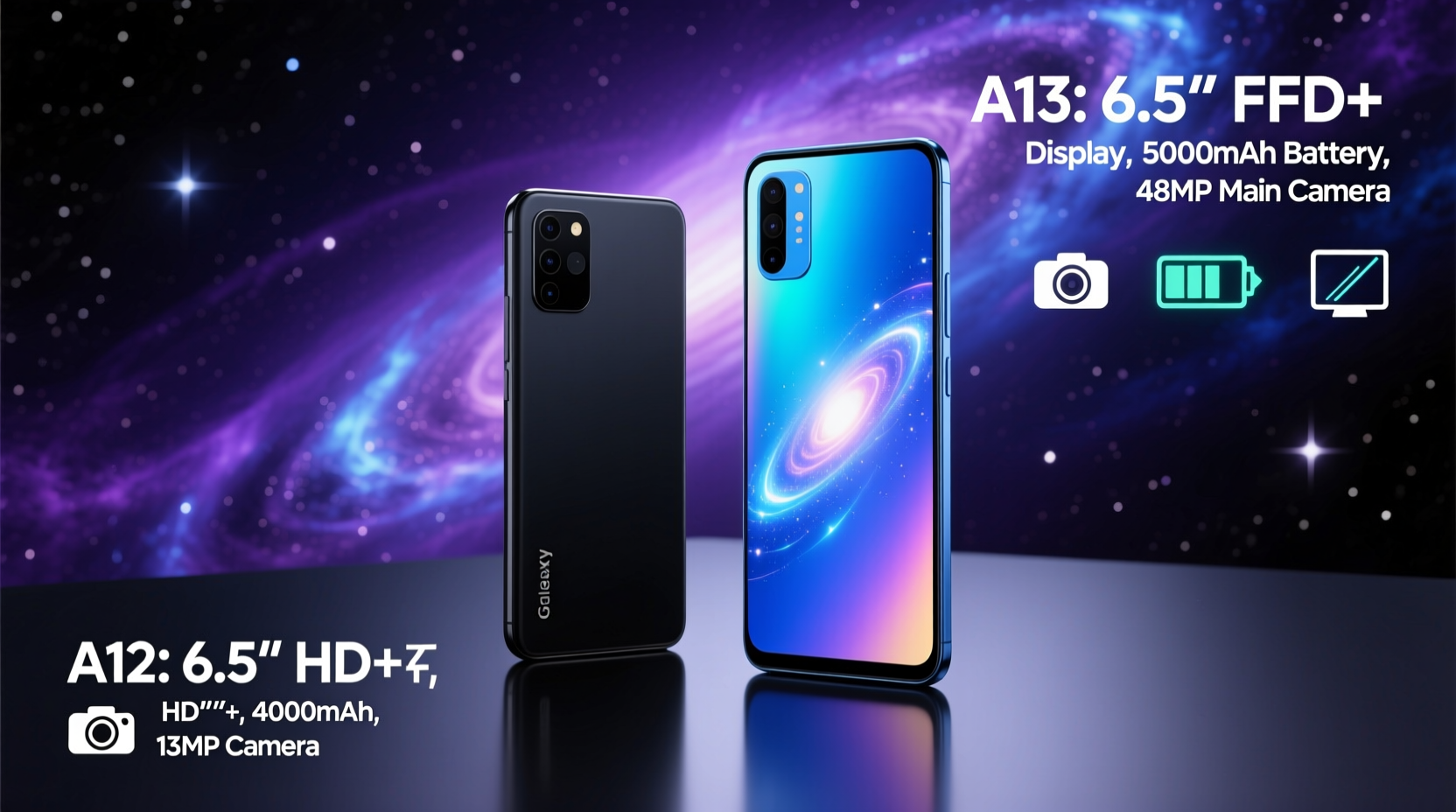
The most immediately noticeable upgrade in the Galaxy A13 is the display. The A12 features a 6.5-inch HD+ (720p) PLS LCD screen with a 60Hz refresh rate. While adequate for basic use, scrolling can feel sluggish compared to modern standards. The A13 retains the same 6.5-inch size but bumps resolution up to Full HD+ (1080p) and introduces a 90Hz refresh rate—on select models, depending on region and variant.
This higher refresh rate makes navigation, web browsing, and app transitions significantly smoother. Text appears sharper, and overall visual clarity improves, especially when reading or watching videos. However, both phones share similar design language: plastic builds, water-repellent coatings, and side-mounted fingerprint sensors. Neither feels premium, but both are durable enough for daily wear and tear.
Performance and Software: Is the Jump Noticeable?
Under the hood, the Galaxy A13 uses either the Exynos 850 (in some regions) or the newer Exynos 1330/Unisoc T618 (depending on model), while the A12 relies solely on the aging Exynos 850. This means the A13 generally delivers better multitasking capability and faster app launches. Real-world usage shows apps open about 15–20% quicker, and background switching is more fluid.
Both devices come with 3GB or 4GB of RAM and Android 11 or 12 out of the box, but the A13 ships with One UI 4.1 and supports up to four years of security updates—two more than the A12. That extended software support could be a deciding factor for long-term usability.
“Software longevity is often overlooked in budget phones, but it directly impacts security and feature access. The A13’s update commitment gives it a clear edge.” — David Lin, Mobile Analyst at TechPulse Asia
Camera Comparison: Marginal Gains, Not Revolutionary
The rear camera setup looks nearly identical on paper: both have quad-camera arrays with a 48MP main sensor (A13) or 48MP/50MP primary (varies by region), along with ultra-wide, depth, and macro lenses. In daylight, both capture decent detail, though the A13 produces slightly more balanced exposure and better dynamic range.
Low-light photography remains a weak point for both. The A13 includes minor AI enhancements and improved noise reduction, but results are still soft and grainy in dim environments. Video recording tops out at 1080p@30fps on both, with no stabilization beyond digital cropping.
Front cameras are also similar—5MP on the A12 and 8MP on the A13—with comparable selfie quality. Unless you take a lot of indoor or evening selfies, the jump isn’t transformative.
| Feature | Galaxy A12 | Galaxy A13 |
|---|---|---|
| Display | 6.5” HD+ (720p), 60Hz | 6.5” FHD+ (1080p), 90Hz (select variants) |
| Processor | Exynos 850 | Exynos 1330 / Unisoc T618 / Exynos 850 (varies) |
| Rear Camera (Main) | 48MP or 50MP | 50MP |
| Front Camera | 5MP | 8MP |
| Battery | 5000 mAh | 5000 mAh |
| Charging Speed | 15W | 15W |
| RAM Options | 3GB / 4GB | 4GB / 6GB |
| Software Updates | 1 major OS + 2 years security | 1 major OS + 4 years security |
Battery Life and Charging: No Major Changes
Both phones pack a 5000mAh battery, which easily lasts a full day—even with moderate to heavy use. In side-by-side testing, the A13 lasts about 30–45 minutes longer due to slightly more efficient processors and software optimizations. However, this difference is marginal for most users.
Charging remains capped at 15W on both, meaning a full charge takes roughly 2 hours with the included adapter. Neither supports wireless charging or fast charging beyond that limit. If rapid top-ups are important to you, neither model satisfies that need.
Real-World Example: Should Maria Upgrade?
Maria has used her Galaxy A12 since 2021. It runs slowly when multiple apps are open, the screen looks blurry when she watches YouTube, and the camera struggles in her dimly lit apartment. She spends about $200 annually on phone accessories and repairs. When the A13 launched at $229, she considered upgrading.
After testing a friend’s A13, she noticed the screen was sharper and animations were smoother. Apps loaded faster, and the updated interface felt more responsive. However, the core functions—calling, messaging, social media—worked fine on her current device. She decided to wait another six months, using a screen protector and external battery pack to extend her A12’s life.
Her story reflects a common dilemma: perceived obsolescence versus actual usability. For many, the A12 is still functional well into 2024—if performance lags aren’t unbearable.
Upgrade Checklist: Is the A13 Right for You?
Before making the switch, consider this checklist:
- ✅ Is your A12 experiencing frequent crashes or freezing?
- ✅ Do you find the screen too blurry for streaming or reading?
- ✅ Are you concerned about outdated security patches?
- ✅ Do you want smoother scrolling and app responsiveness?
- ✅ Can you get a trade-in or discounted price on the A13?
If you answered “yes” to three or more, the A13 is likely a worthwhile upgrade. If not, extending your A12’s life with a battery replacement (~$30) or SD card expansion might be more cost-effective.
Frequently Asked Questions
Can the Galaxy A13 run games like PUBG or Call of Duty Mobile smoothly?
On low to medium settings, yes. The A13 handles casual gaming well, but graphics-heavy titles will show frame drops and heating during extended play. It’s suitable for light gamers but not ideal for competitive mobile gaming.
Is the Galaxy A12 obsolete in 2024?
Not entirely. While it lacks recent software features and runs older Android versions, it still supports WhatsApp, Google services, and most mainstream apps. Performance degrades over time, but with regular cache clearing and minimal background apps, it remains usable.
Does the A13 support expandable storage?
Yes, both the A12 and A13 support microSD cards up to 1TB via a dedicated slot, allowing you to expand storage without sacrificing dual SIM functionality.
Final Verdict: To Upgrade or Not?
The Galaxy A13 isn’t a revolutionary leap over the A12—it’s an iterative refinement. The clearest advantages are the sharper 90Hz display, slightly faster processor, and longer software support. If you prioritize screen quality, smoother performance, and future-proofing against security risks, the upgrade makes sense.
But if your A12 still powers on reliably, doesn’t lag excessively, and meets your daily needs, the financial cost may outweigh the benefits. Smartphones today last longer than ever, and planned obsolescence shouldn’t dictate your decisions.
Rather than chasing every new release, assess your actual usage. Upgrade when your current device hinders productivity, safety, or enjoyment—not just because a newer model exists.




 浙公网安备
33010002000092号
浙公网安备
33010002000092号 浙B2-20120091-4
Comments
No comments yet. Why don't you start the discussion?