
When Samsung released the Galaxy S21 in early 2021, many owners of the Galaxy Note 20 Ultra were left wondering: is this really an upgrade, or just another iteration wrapped in marketing buzz? The Note 20 Ultra, launched just months earlier, was already a powerhouse with its advanced display, S Pen integration, and top-tier camera system. So how does the S21 stack up? This isn’t just about specs on paper—it’s about real-world usability, longevity, and whether the changes justify an upgrade.
Design and Build: Refined, But Missing a Signature Feature
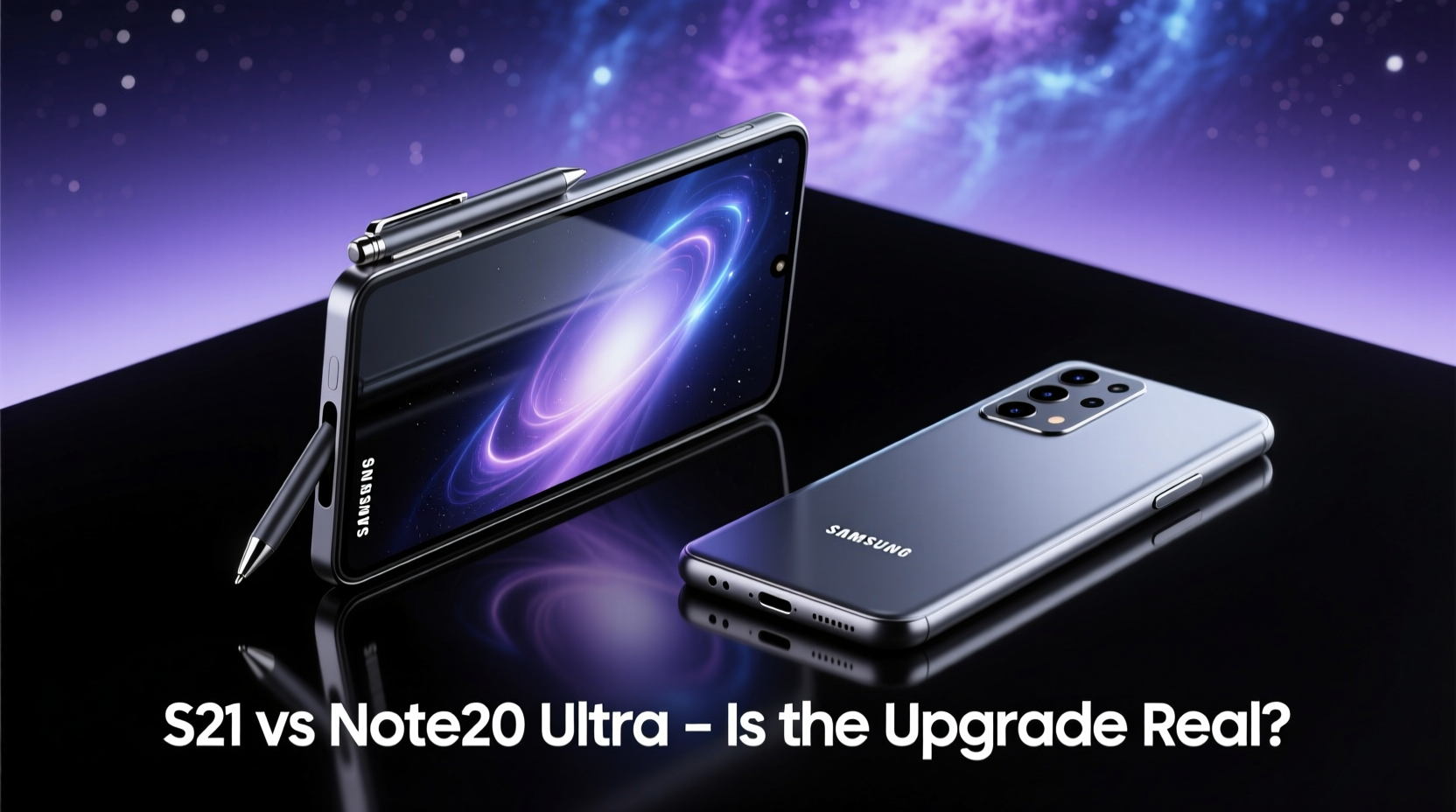
The Galaxy S21 brought a noticeable shift in design language. It adopted a more angular frame with a matte finish and a distinctive camera housing that blends into the metal frame. While it feels modern, the build quality takes a step back from the Note 20 Ultra. The S21 uses plastic on the back instead of the Ultra’s sleek Gorilla Glass Victus, which impacts perceived premiumness and scratch resistance.
One major trade-off: the S21 lacks an S Pen slot. For users who relied on the Note series for note-taking, sketching, or precise navigation, this is a significant downgrade. While the S21 supports the S Pen via external cases or Bluetooth styluses, the seamless integration—both physically and functionally—is gone.
Display and Performance: Incremental Gains, Not Revolution
Both phones feature Dynamic AMOLED 2X displays with 120Hz refresh rates, but the Note 20 Ultra edges ahead in resolution (3088 x 1440 vs. 2400 x 1080 on the S21). In practical terms, text appears sharper, and fine details in photos and videos are more defined on the Ultra.
Performance-wise, both devices use high-end chipsets—the Exynos 990 or Snapdragon 865+ in the Note 20 Ultra, and the newer Snapdragon 888 (or Exynos 2100) in the S21. Benchmarks show the S21 is slightly faster in CPU tasks and significantly better in GPU performance, making it ideal for gaming and intensive multitasking. However, real-world usage differences are minimal. Apps open quickly on both, and day-to-day responsiveness is nearly identical.
“While the S21 has newer silicon, the Note 20 Ultra remains a performance leader. For most users, the difference won’t be noticeable outside synthetic benchmarks.” — David Kim, Mobile Hardware Analyst at TechPulse Asia
Camera Comparison: Similar Sensors, Smarter Processing
The camera hardware between the two models is surprisingly similar. Both have a 108MP main sensor, a 12MP ultra-wide, and a 12MP periscope telephoto with 5x optical zoom. The S21 improves slightly with enhanced AI processing, better low-light algorithms, and improved video stabilization—especially in 8K recording.
In daylight, both capture rich, detailed images with accurate color reproduction. The S21 tends to apply more aggressive HDR, which can sometimes oversharpen skies or flatten contrast. The Note 20 Ultra produces a more natural tone preferred by photography purists.
Night mode sees a modest improvement on the S21, particularly in preserving detail in darker areas without introducing excessive noise. Video quality remains excellent on both, though the S21 benefits from Director’s View and improved Super Steady mode for action shots.
Camera Feature Breakdown
| Feature | Note 20 Ultra | S21 |
|---|---|---|
| Main Sensor | 108MP f/1.8 | 108MP f/1.8 |
| Telephoto Zoom | 5x optical, up to 50x digital | 3x hybrid, up to 30x digital |
| Ultra-Wide Aperture | f/2.2 | f/2.2 |
| Video Recording | 8K@24fps, 4K@60fps | 8K@24fps, 4K@60fps |
| Low-Light Optimization | Good | Better (AI-enhanced) |
Battery and Software: Longevity vs. Future-Proofing
The Note 20 Ultra packs a 4,500mAh battery, while the S21 has a slightly smaller 4,000mAh unit. Despite this, both deliver around a full day of heavy use. The S21 benefits from slightly more efficient software optimization in One UI 3.1+, but the larger battery in the Ultra often gives it an edge in endurance.
Software support is where the S21 pulls ahead. As part of Samsung’s flagship S-series, it received four years of OS upgrades (up to Android 14), whereas the Note 20 Ultra, being one of the last Note devices, may not receive the same long-term commitment post-Note discontinuation. This makes the S21 a better choice if you plan to keep your phone for three years or more.
Mini Case Study: Maria’s Upgrade Dilemma
Maria, a freelance architect, used her Note 20 Ultra for sketching blueprints, managing client calls, and presenting designs on-site. She considered upgrading to the S21 for its lighter weight and newer processor. After testing both, she realized the lack of built-in S Pen storage disrupted her workflow. She also found the lower-resolution screen made reviewing intricate CAD files harder. Ultimately, she kept her Note 20 Ultra and paired it with a protective case and wireless stylus—a compromise that balanced innovation with practicality.
Is the S21 a Real Upgrade? A Practical Checklist
Deciding whether the S21 is worth switching to depends on your priorities. Use this checklist to evaluate your needs:
- ✅ Need the latest chipset and future-proof software updates?
- ✅ Prefer a lighter, more compact device?
- ✅ Use your phone primarily for media, social apps, and casual photography?
- ❌ Rely heavily on the S Pen for work or creativity?
- ❌ Value maximum screen sharpness and premium materials?
- ❌ Already satisfied with your Note 20 Ultra’s performance?
If most of your answers are “yes” to the first three and “no” to the last three, the S21 is a legitimate upgrade. Otherwise, the changes may feel more like refinement than revolution.
Frequently Asked Questions
Can I use the S Pen with the Galaxy S21?
Yes, but not natively. You can pair a Bluetooth-enabled S Pen (like the S Pen Pro) or use third-party styluses. However, there’s no built-in storage, so you’ll need a case with a holder or risk losing it.
Is the S21 more durable than the Note 20 Ultra?
No. The Note 20 Ultra features Gorilla Glass Victus on both front and back, while the S21 uses plastic on the rear. The Ultra is more resistant to scratches and drops, despite both having aluminum frames.
Does the S21 offer better value now?
Today, yes—especially on the used or refurbished market. With the Note 20 Ultra discontinued and the S21 succeeded by newer models, prices have dropped. If you don’t need the S Pen and want a capable flagship at a lower cost, the S21 is a strong contender.
Conclusion: Upgrade Based on Need, Not Hype
The Galaxy S21 is not a revolutionary leap over the Note 20 Ultra. It refines certain aspects—processor efficiency, software support, and camera AI—but sacrifices key strengths like build quality, screen resolution, and S Pen integration. Calling it a “real upgrade” depends entirely on your usage pattern.
For tech enthusiasts chasing the latest model, the S21 delivers. For professionals who depend on precision input and top-tier display fidelity, the Note 20 Ultra remains unmatched. Samsung’s shift away from the Note line marked a turning point—not just in product design, but in user expectations. The S21 represents evolution, not replacement.




 浙公网安备
33010002000092号
浙公网安备
33010002000092号 浙B2-20120091-4
Comments
No comments yet. Why don't you start the discussion?