
For long-time Galaxy users, the decision to upgrade isn’t always about chasing the latest specs. It’s about whether the improvements deliver real-world benefits. The Galaxy S9+ remains a capable flagship phone even years after its release, while the S10e brings modern design and efficiency upgrades. But does that make the S10e a worthy successor? For owners still on the fence with a perfectly functional S9+, the answer depends on priorities: screen size, battery life, charging speed, or long-term software support.
This comparison dives into every key aspect—design, display, performance, camera, battery, and software—to help you determine if stepping up from the S9+ to the S10e is a meaningful leap or just incremental change.
Design and Build: Compact Power Meets Familiar Comfort
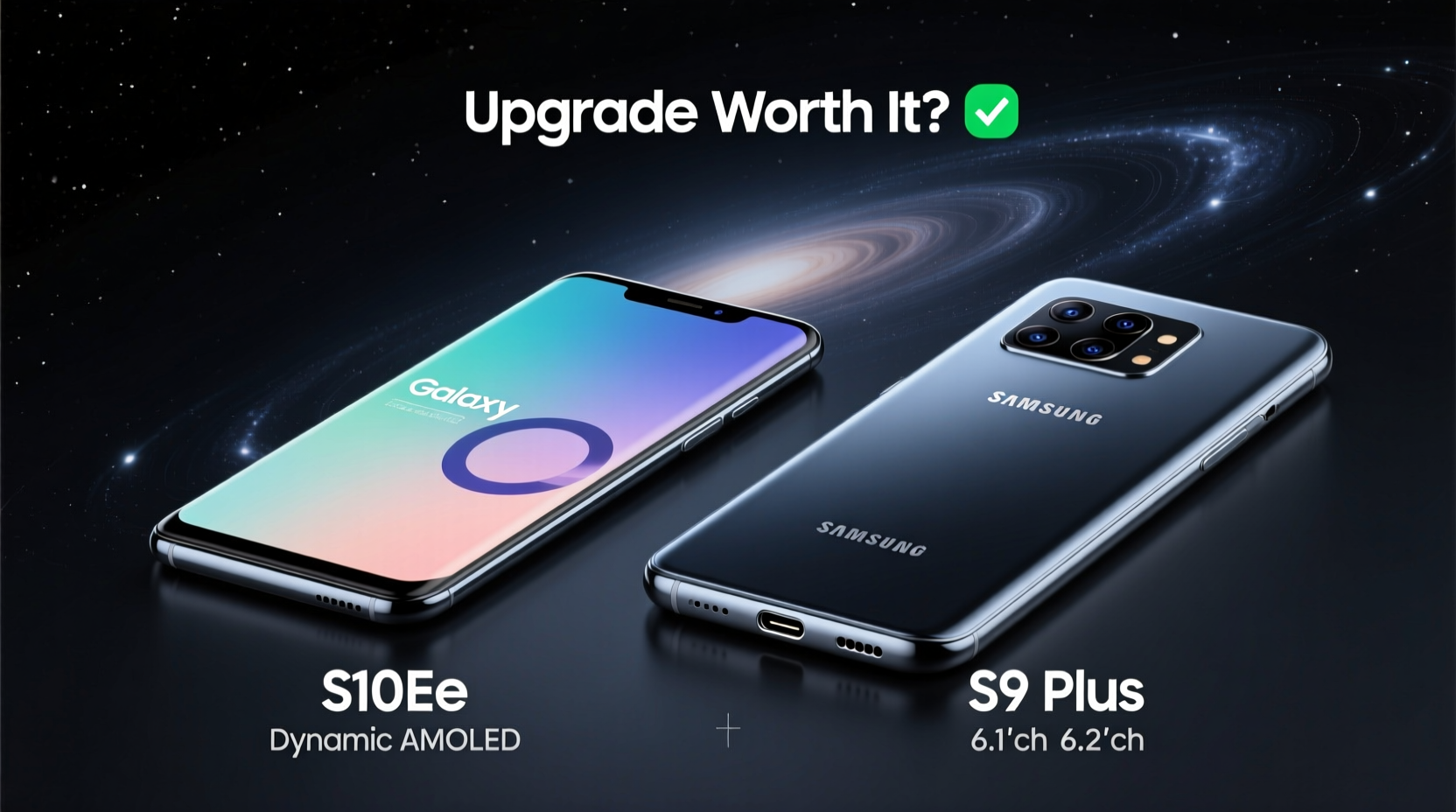
The S9+ was Samsung’s last large dual-display flagship before shifting toward more varied sizes in the S10 series. With a 6.2-inch curved Super AMOLED panel, it’s noticeably larger than the S10e’s 5.8-inch flat display. Despite being newer, the S10e feels smaller and lighter at 150g compared to the S9+’s 189g. This makes the S10e significantly easier to handle one-handed—a growing preference among users tired of oversized phones.
The S10e ditches the S9+’s glass back for a polycarbonate rear in some variants, which improves grip and reduces slip risk but sacrifices the premium feel. However, both are IP68-rated for water and dust resistance, so durability in daily use remains strong.
Display Quality: Curved Luxury vs Flat Practicality
The S9+’s curved display was once a hallmark of high-end smartphones. Its Quad HD+ resolution (1440 x 2960) delivers sharper visuals than the S10e’s FHD+ (1080 x 2280). However, in everyday usage—browsing, video streaming, social media—the difference is subtle, especially on a 5.8-inch screen.
What matters more is usability. The S10e’s flat screen eliminates accidental edge touches and glare issues common with curved panels. It also supports HDR10+ for enhanced video playback. While the S9+ technically has a higher-resolution display, the S10e compensates with better viewing angles and reduced reflection thanks to improved panel coating.
Display Comparison Summary
| Feature | Galaxy S9+ | Galaxy S10e |
|---|---|---|
| Screen Size | 6.2 inches | 5.8 inches |
| Resolution | 1440 x 2960 (QHD+) | 1080 x 2280 (FHD+) |
| Panel Type | Curved Super AMOLED | Flat Dynamic AMOLED |
| HDR Support | HDR10 | HDR10+ |
| One UI Flex Mode | No | No (introduced later) |
Performance and Software: Generational Gains in Efficiency
Under the hood, both phones launched with top-tier chipsets—S9+ with Snapdragon 845 or Exynos 9810, and S10e with Snapdragon 855 or Exynos 9820. The jump from 845 to 855 brought tangible gains: up to 45% better CPU performance and 20% faster GPU speeds. Apps launch quicker, multitasking is smoother, and gaming performance sees noticeable improvement, especially in titles like Genshin Impact or Madden NFL Mobile.
More importantly, the S10e supports longer software updates. While the S9+ received three major Android upgrades (up to Android 12), the S10e was eligible for four (up to Android 13), giving it extended relevance. Security patches also continued longer on the S10e, making it a safer choice today.
“Even modest hardware improvements can extend device usability by 1–2 years when paired with timely OS support.” — David Kim, Senior Analyst at Mobile Insights Group
Camera Capabilities: Evolution Over Revolution
The S9+ introduced Samsung’s dual-lens system: a 12MP wide and 12MP telephoto lens, enabling 2x optical zoom and depth effects. The S10e keeps this same rear setup but enhances processing through updated AI scene optimization and better low-light algorithms.
Front cameras differ significantly. The S9+ has an 8MP shooter, while the S10e steps up to 10MP with wider field-of-view and improved autofocus. For vloggers or frequent selfie-takers, this is a clear win.
In daylight, both produce excellent results. But in dim lighting, the S10e’s Night Mode—absent on the S9+—makes a real difference. It captures brighter images with less noise by combining multiple exposures automatically.
Real Example: Daily Use Photography
Consider Maya, a freelance photographer who used her S9+ for client previews and social content. After switching to the S10e, she noticed immediate improvements during evening shoots at cafes and outdoor markets. “I used to carry a small LED light for indoor shots,” she said. “Now I rely on Night Mode—it pulls details out of shadows without looking artificial.”
Battery Life and Charging: Smaller Cell, Smarter Management
The S9+ packs a 3500mAh battery; the S10e uses a slightly smaller 3100mAh unit. On paper, that suggests shorter endurance. In practice, the gap is narrower due to the S10e’s more efficient processor and optimized software.
However, the S10e introduces reverse wireless charging—a feature allowing you to power accessories like earbuds or smartwatches directly from the phone. It’s not essential, but useful in emergencies. Both support fast charging and wireless charging, though neither includes a fast charger in-box (a trend starting with these models).
Battery & Charging Overview
- S9+: 3500mAh | Fast charging (~80% in 30 mins) | Wireless charging
- S10e: 3100mAh | Fast charging (~70% in 30 mins) | Wireless + Reverse Wireless Charging
Upgrade Checklist: Should You Make the Switch?
Before trading in your S9+, consider this checklist to assess whether the S10e aligns with your needs:
- Do you want a more compact, manageable phone size? → S10e wins
- Are you experiencing app slowdowns or lag on your S9+? → S10e offers smoother performance
- Do you take many photos in low light? → Night Mode on S10e is a significant advantage
- Is extended software support important for security or app compatibility? → S10e receives updates longer
- Do you value newer features like reverse wireless charging? → Only available on S10e
- Are you satisfied with your current battery life and don’t mind the bulk? → Sticking with S9+ may be fine
Frequently Asked Questions
Can the S10e last as long as the S9+ on a single charge?
In moderate use, yes. Despite its smaller battery, the S10e’s power-efficient chipset and software optimizations balance out capacity loss. Heavy users may still prefer the S9+’s stamina, but most will find the S10e sufficient for a full day.
Does the S10e have a headphone jack?
Yes—this is a rare advantage the S10e holds over other S10 models. Like the S9+, it retains the 3.5mm headphone jack, appealing to audiophiles and commuters who avoid Bluetooth.
Is the S10e still receiving updates?
Mainstream Android updates have ended, but some regions may still receive periodic security patches. Compared to the S9+, it enjoys marginally better update longevity overall.
Final Verdict: When the Upgrade Makes Sense
The Galaxy S10e isn’t a radical reinvention over the S9+. It’s a refinement—one that prioritizes portability, efficiency, and future-ready features. If your S9+ is still performing well and you don’t need the latest camera tricks or compact form factor, holding onto it remains a smart, economical choice.
But if you’re facing performance bottlenecks, want better night photography, or crave a lighter, modern-feeling device with longer software support, the S10e delivers tangible benefits. It proves that sometimes, \"newer\" doesn’t mean flashy—it means smarter, leaner, and more sustainable in daily use.




 浙公网安备
33010002000092号
浙公网安备
33010002000092号 浙B2-20120091-4
Comments
No comments yet. Why don't you start the discussion?