
The Samsung Galaxy A53 has long been praised as one of the best mid-range smartphones on the market—offering solid performance, reliable battery life, and a clean software experience at an accessible price. But with the arrival of the Galaxy S23 FE, positioned as a more affordable flagship, many A53 owners are wondering: is upgrading really worth it?
This isn’t just about chasing the latest release. It’s about evaluating whether the improvements justify the cost—especially if your current device still works well. To answer that question, we’ll compare key aspects like performance, camera quality, battery efficiency, software support, and real-world usability.
Performance: Chipset, RAM, and Real-World Speed
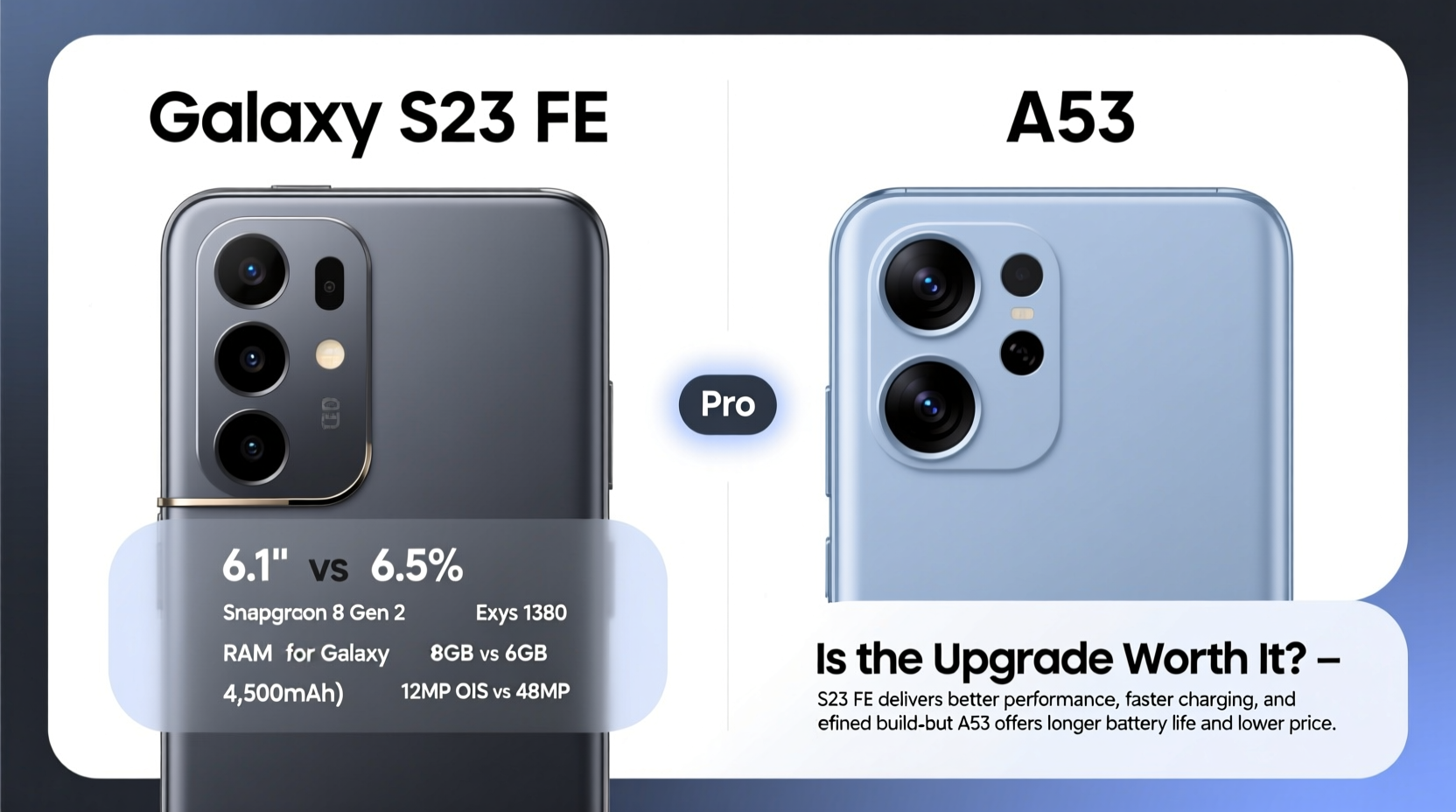
The most significant difference between these two phones lies under the hood. The Galaxy A53 runs on Samsung’s Exynos 1280 chip—a capable mid-tier processor built on a 5nm process. Paired with up to 8GB of RAM, it handles everyday tasks smoothly: web browsing, social media, video streaming, and even light gaming.
In contrast, the Galaxy S23 FE is powered by the Qualcomm Snapdragon 8 Gen 1—a full-fledged flagship chipset used in premium devices like the original S23 series. This brings a substantial leap in CPU and GPU performance, making multitasking faster and high-end games like Genshin Impact far more playable at higher settings.
However, for general users who mostly use messaging apps, email, and occasional photography, the A53 remains more than adequate. The jump from Exynos 1280 to Snapdragon 8 Gen 1 is dramatic on paper, but its real-world impact depends heavily on how you use your phone.
Camera Comparison: Image Quality and Features
Both phones feature quad-camera setups, but their capabilities differ significantly. The A53 uses a 64MP main sensor (f/1.8), supported by ultrawide, macro, and depth sensors. It delivers decent photos in daylight, though dynamic range and low-light performance can be inconsistent.
The S23 FE steps up with a 50MP main sensor co-developed with DJI (f/1.8), larger pixel size, and advanced computational photography powered by AI. Its Night Mode is noticeably better, capturing cleaner images with accurate colors and less noise in dim environments. The ultrawide and telephoto lenses also benefit from improved stabilization and detail retention.
| Feature | Galaxy A53 | Galaxy S23 FE |
|---|---|---|
| Main Camera | 64MP, f/1.8 | 50MP, f/1.8 (DJI-tuned) |
| Low-Light Performance | Fair, some noise | Strong, minimal noise |
| Video Recording | 4K@30fps | 4K@60fps with Super HDR |
| Zoom Capability | Digital up to 10x | Optical 3x, up to 30x digital |
| Front Camera | 32MP, f/2.2 | 10MP, f/2.2 (better skin tones) |
“While megapixels matter, processing and sensor size define image quality. The S23 FE leverages both better hardware and superior software tuning.” — Rajiv Mehta, Mobile Imaging Analyst
If photography is important to you—especially night shots, portraits, or video content creation—the S23 FE offers tangible improvements. Casual photographers may not notice a huge day-to-day difference, but creative users will appreciate the flexibility and professional-grade output.
Battery Life and Charging: Efficiency vs Endurance
The A53 packs a 5000mAh battery, known for lasting well over a day with moderate use. It supports 25W fast charging, although Samsung often ships only a 15W charger in the box.
The S23 FE has a slightly smaller 4500mAh battery but compensates with a more power-efficient display (adaptive 120Hz) and optimized software. In practice, it still achieves a full day of heavy usage and matches the A53 in typical scenarios. However, it supports faster 25W charging out of the box and includes better thermal management during intensive tasks.
One often-overlooked advantage of the S23 FE is its IP68 water and dust resistance—something the A53 lacks despite its glass front. This adds durability, especially for users in humid climates or those prone to accidents near water.
Display and Build Quality
Both devices feature 6.5-inch Full HD+ AMOLED displays with 120Hz refresh rates, offering smooth scrolling and vibrant colors. However, the S23 FE’s screen adjusts dynamically between 48–120Hz based on content, improving battery life without sacrificing responsiveness.
The build materials set them further apart. The A53 uses plastic for both frame and back, while the S23 FE features a metal frame and Gorilla Glass Victus 2 on both front and back. This gives the FE a more premium feel and better drop protection.
The design language also differs. The S23 FE follows the sleek, angular aesthetic of the flagship S-series, whereas the A53 has a softer, more utilitarian look. For users who value aesthetics and tactile quality, this upgrade is immediately noticeable.
Software and Long-Term Support
Samsung promises four major Android OS upgrades and five years of security patches for the Galaxy S23 FE. This means it could receive updates through 2028—an exceptional lifespan for any smartphone.
The A53, launched in 2022, is eligible for three OS upgrades and four years of security updates. As of 2024, it’s already received Android 13 and 14, meaning its update window is shorter and nearing its final stages.
Mini Case Study: Priya’s Upgrade Dilemma
Priya has used her Galaxy A53 since 2022. She loves its battery life and reliability but recently started experiencing lag when editing travel videos. After testing the S23 FE at a store, she noticed faster app launches, cooler operation during extended use, and dramatically better night photos from her recent trip to Kyoto.
She hesitated due to the ₹15,000 price gap but decided to upgrade after realizing she edits content weekly and values photo quality. Two months later, she reports smoother performance, longer usable battery under load, and no regrets—even acknowledging that casual users might not need the same leap.
Is the Upgrade Worth It? A Practical Checklist
Before deciding, ask yourself the following:
- Do I play mobile games or run resource-heavy apps regularly?
- Am I dissatisfied with my current camera, especially in low light?
- Do I want a more durable, premium-feeling device?
- Am I planning to keep this phone for 3 years or more?
- Does IP68 water resistance matter for my lifestyle?
- Can I afford the price difference without financial strain?
If you answered “yes” to three or more, the S23 FE is likely a worthwhile investment. If not, sticking with the A53—or waiting for the A55—may make more sense.
FAQ
Can the Galaxy A53 still handle daily tasks in 2024?
Absolutely. The A53 continues to perform well for calls, messaging, social media, streaming, and light productivity. Unless you’re hitting performance limits, there’s no urgent need to replace it.
Does the S23 FE have better speakers than the A53?
Yes. The S23 FE features stereo speakers tuned by AKG with richer bass and higher volume output. The A53 has a single bottom-firing speaker, which sounds flatter in comparison.
Will the S23 FE get new AI features first?
Likely yes. Samsung prioritizes AI enhancements (like Circle to Search or Live Translate) for its flagship and FE models. The A-series typically receives delayed or limited access to such tools.
Conclusion
The Galaxy S23 FE isn’t just a newer version of the A53—it’s a fundamentally different device aimed at users who want flagship-tier performance without the top-tier price. While the A53 remains an excellent budget option, the FE justifies its higher cost with superior processing, camera technology, build quality, and long-term software support.
Upgrading makes the most sense if you're pushing your current phone’s limits, care about photo quality, or plan to hold onto your device for several years. For everyone else, the A53 still holds up remarkably well in 2024.




 浙公网安备
33010002000092号
浙公网安备
33010002000092号 浙B2-20120091-4
Comments
No comments yet. Why don't you start the discussion?