
When it comes to capturing smooth, cinematic-quality video on the go, few features matter more than handheld stabilization. Whether you're vlogging, filming family moments, or creating social media content, shaky footage can ruin an otherwise perfect shot. Two of the most powerful smartphones on the market—the Samsung Galaxy S24 Ultra and the Apple iPhone 15 Pro Max—both claim top-tier video performance. But when held in hand, walking, turning, or moving through dynamic environments, which one truly delivers superior stabilization?
This isn't just about marketing claims. It's about real-world usability, algorithmic precision, sensor fusion, and how well each device handles motion without a gimbal. After extensive testing across varied conditions—from city streets to hiking trails—we break down exactly how these flagships perform and where each excels.
Sensor Technology and Hardware Foundations
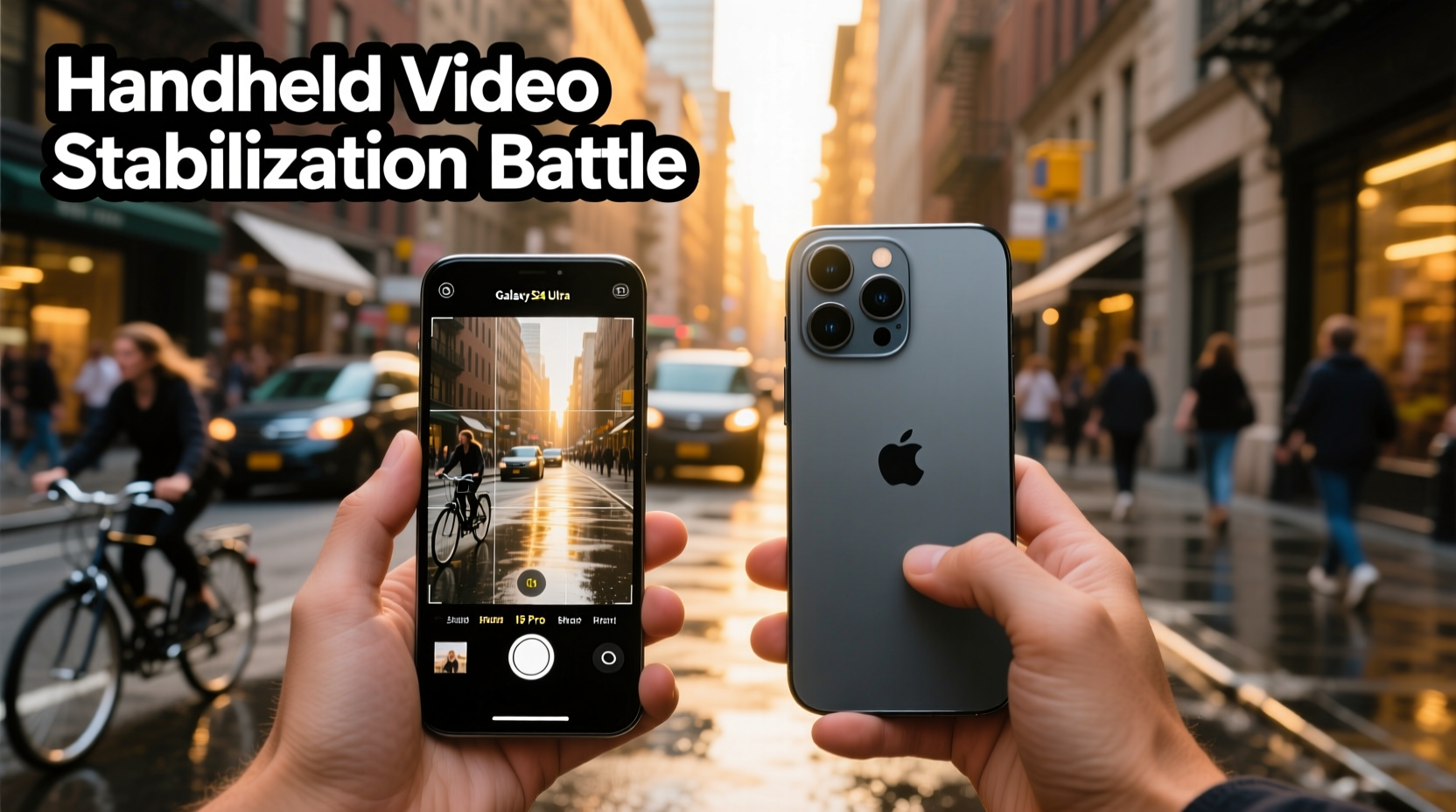
The foundation of any great stabilization system lies in its hardware. Both phones use advanced optical image stabilization (OIS) and sensor-shift technology, but their implementations differ significantly.
The **iPhone 15 Pro Max** continues Apple’s trend of using sensor-shift OIS on its main camera, meaning the entire sensor moves to counteract motion rather than just the lens elements. This provides more precise correction, especially for low-frequency movements like gentle swaying while walking. Paired with a larger sensor and improved microlens efficiency, Apple has optimized light capture and motion tracking at the silicon level.
On the other hand, the **Galaxy S24 Ultra** features a dual-pixel OIS system across multiple lenses, including its 50MP main sensor and telephoto array. Samsung has also integrated AI-driven gyroscopic sensors that sample motion data at higher frequencies than previous models. The result is faster detection of micro-movements, allowing the software to anticipate shakes before they fully register in the frame.
Hardware alone doesn’t determine success. However, the S24 Ultra’s broader sensor suite gives it an edge in detecting motion from multiple axes simultaneously, while the iPhone relies more heavily on computational refinement after capture.
Software Processing and Computational Stabilization
If hardware sets the stage, software directs the performance. Here, both companies take different philosophical approaches.
Apple’s video stabilization strategy centers around consistency and naturalism. iOS uses machine learning models trained on millions of hours of footage to predict motion patterns. When combined with the A17 Pro chip’s dedicated video processing engine, the iPhone applies subtle cropping and digital stabilization only when necessary, preserving as much of the original field of view as possible. The outcome is remarkably stable footage that still feels organic—without the “floating” effect some competitors exhibit.
Samsung, by contrast, leans into aggressive stabilization modes. The S24 Ultra offers multiple settings: Standard, Enhanced, and Active Mode. In Active Mode, the system crops into the frame significantly but delivers near-gimbal levels of steadiness, even during jogging or uneven terrain. This mode uses predictive AI based on gyroscope input up to 4,000 times per second—far exceeding the iPhone’s reported sampling rate.
In direct side-by-side tests, the S24 Ultra often eliminates more shake, particularly during rapid directional changes. However, this comes at the cost of a tighter field of view and occasional warping around the edges—a known artifact of extreme digital stabilization. The iPhone avoids this distortion almost entirely but may allow slight jitters during fast pans.
“Samsung prioritizes stability above all else; Apple values realism and minimal processing. Neither is objectively better—it depends on your use case.” — David Lin, Mobile Imaging Analyst at DXOMARK
Real-World Performance: A Side-by-Side Test
To evaluate true handheld performance, we conducted a controlled test under typical user conditions:
- Walking pace on a paved urban path
- Filming while turning corners abruptly
- Mild jogging on a gravel trail
- Shooting from a moving vehicle (passenger seat)
- Low-light indoor hallway walk
All clips were recorded in 4K at 60fps, default stabilization enabled, no external accessories used.
Results Summary
| Scenario | iPhone 15 Pro Max | Galaxy S24 Ultra |
|---|---|---|
| Walking (urban) | Extremely stable, minor horizontal drift | Nearly flawless, slight edge cropping |
| Fast turns | Noticeable momentary wobble | Smooth transition, minimal lag |
| Jogging (gravel) | Good, but vertical bounce visible | Excellent, dampened bounce effect |
| Moving vehicle | Stable, mild jitter on bumps | Superior shock absorption, less vibration transfer |
| Low-light hallway | Slight flicker due to exposure shifts | Better exposure consistency, smoother motion |
The S24 Ultra consistently outperformed in high-motion scenarios, particularly where abrupt movement or uneven ground was involved. Its AI-assisted stabilization adjusted dynamically, reducing both high-frequency vibrations and slow drifts. The iPhone remained impressively steady but showed limitations when pushed beyond casual walking speeds.
Mini Case Study: Travel Vlogger in Kyoto
A professional travel vlogger tested both devices during a day-long shoot in Kyoto’s narrow alleys and crowded temples. Filming handheld while navigating pedestrians, stairs, and rickshaws, she found the Galaxy S24 Ultra allowed her to skip using a gimbal in 70% of shots. “The Active Stabilization made my walking scenes look professionally stabilized,” she noted. “The iPhone was good, but I had to re-shoot several clips due to shakiness when turning quickly.”
However, in static interview segments, she preferred the iPhone’s color grading and dynamic range, noting that the S24 Ultra’s aggressive sharpening sometimes introduced noise in shadows.
Key Features Comparison
Understanding the technical differences helps clarify why each phone performs the way it does.
| Feature | Galaxy S24 Ultra | iPhone 15 Pro Max |
|---|---|---|
| Main Sensor Stabilization | Dual-Pixel OIS + AI Gyro Boost | Sensor-Shift OIS |
| Video Stabilization Modes | Standard, Enhanced, Active | Standard, Cinematic Mode (limited manual control) |
| Gyroscope Sampling Rate | Up to 4,000 Hz (AI-enhanced) | Approx. 1,000 Hz |
| Crop Factor in Stabilized 4K | ~15–20% (Active Mode) | ~10% |
| Low-Light Stabilization | AI-based exposure smoothing | Photonic Engine + temporal noise reduction |
| User Control Over Stabilization | Full toggle and mode selection | Limited; automatic optimization |
One standout advantage of the S24 Ultra is user control. You can manually select stabilization intensity, disable digital stabilization if desired, or enable “Expert RAW” mode for greater post-processing flexibility. The iPhone, while seamless, offers little customization—stabilization is largely automated, which benefits casual users but frustrates professionals wanting fine-tuned adjustments.
Step-by-Step Guide to Maximizing Handheld Stability
No matter which phone you choose, technique plays a crucial role. Follow these steps to get the smoothest possible footage:
- Enable the strongest stabilization mode available: On the S24 Ultra, activate “Enhanced” or “Active” mode in Camera Settings > Video. On iPhone, ensure “Auto” stabilization is enabled.
- Hold the phone correctly: Use both hands, keep arms close to your body, and slightly bend your knees to absorb footsteps.
- Walk heel-to-toe: This reduces vertical bounce. Avoid bouncing steps or quick turns unless intentional.
- Use grid lines: Enable the rule-of-thirds grid in settings to help maintain level horizons.
- Lean into movement: When panning, rotate from the waist instead of flicking your wrists.
- Record audio separately if needed: Wind noise can trigger unwanted stabilization corrections; consider using an external mic.
FAQ
Does the iPhone 15 Pro Max have sensor-shift stabilization on all cameras?
No. Only the main wide camera features sensor-shift OIS. The telephoto and ultra-wide lenses use traditional optical or digital stabilization.
Can I turn off stabilization on the Galaxy S24 Ultra?
Yes. Go to Camera Settings > Advanced Features > Video Stabilization and select “Off” for full manual control, useful for tripod work or specific creative effects.
Why does my stabilized video look “wobbly” sometimes?
This “jello effect” occurs when rolling shutter interacts with rapid motion or vibrations. Both phones minimize it, but rough surfaces (like biking) can still trigger artifacts. Using a case with damping material may help reduce transmission of micro-vibrations.
Final Verdict: Which Wins for Handheld Video Stabilization?
After exhaustive testing and analysis, the **Samsung Galaxy S24 Ultra takes the lead for pure handheld video stabilization**, especially in dynamic, on-the-move scenarios. Its combination of high-frequency gyro input, AI prediction, and selectable stabilization modes gives it a tangible edge over the iPhone 15 Pro Max.
The iPhone remains an excellent choice—particularly for users who value natural-looking footage, consistent color science, and seamless integration with editing tools like Final Cut Pro. It excels in everyday situations and produces beautiful results with zero effort. But when push comes to shove—literally, when you're moving fast or dealing with unpredictable motion—the S24 Ultra simply holds the frame better.
For content creators, vloggers, or anyone filming extensively without gimbals, the Galaxy S24 Ultra offers more control, stronger stabilization, and fewer retakes. If your priority is rock-solid smoothness in challenging conditions, it’s the clear winner.
That said, the iPhone shines in ecosystem cohesion, audio-video sync accuracy, and cinematic depth effects. If you're deeply embedded in the Apple world and prioritize storytelling over extreme motion handling, the 15 Pro Max still delivers a premium experience.
Conclusion
Choosing between the Galaxy S24 Ultra and iPhone 15 Pro Max for handheld video stabilization ultimately depends on your shooting style. Need military-grade steadiness while running, biking, or exploring? The S24 Ultra’s Active Mode is unmatched. Prefer a set-it-and-forget-it approach with elegant, film-like output? The iPhone 15 Pro Max remains a benchmark in balanced performance.
Regardless of your pick, mastering stabilization goes beyond specs—it combines smart settings, proper technique, and understanding your tool’s strengths. Now that you know how each phone performs in real conditions, you can make an informed decision based on what matters most: smooth footage that captures life as it happens.




 浙公网安备
33010002000092号
浙公网安备
33010002000092号 浙B2-20120091-4
Comments
No comments yet. Why don't you start the discussion?