
Five years can change everything in the smartphone world. If you're still holding onto your Galaxy S8—once a flagship powerhouse—it's natural to wonder whether switching to a modern mid-range device like the Galaxy A23 makes sense today. On paper, the A23 looks like a massive leap forward. But does that translate into meaningful improvements for everyday use? More importantly, is the upgrade worth the cost, effort, and potential learning curve?
The answer isn't as straightforward as specs suggest. While newer phones generally outperform older ones, real-world value depends on how you use your device, what you expect from it, and whether the benefits outweigh the trade-offs.
Performance and Hardware: A Generational Leap
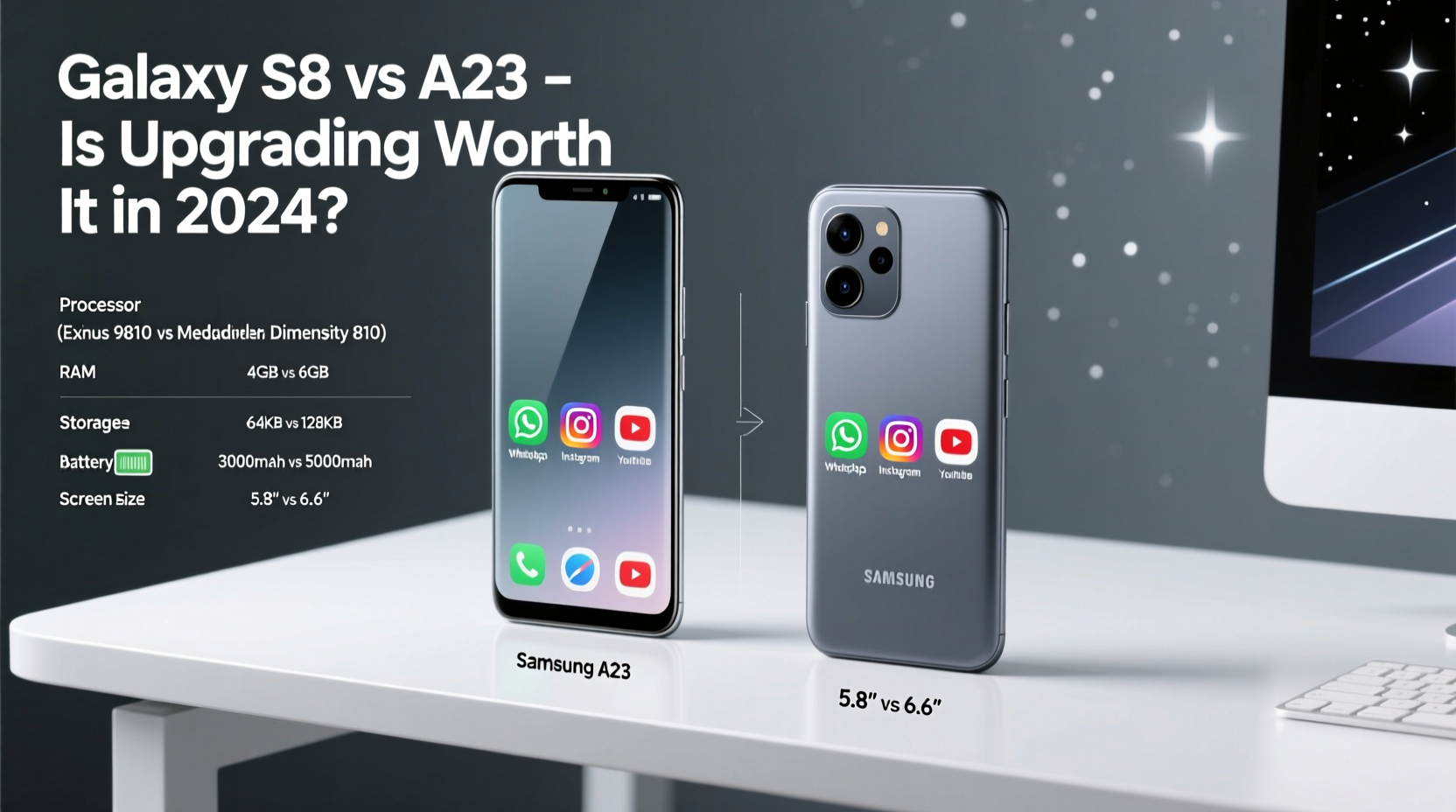
The Galaxy S8 launched in 2017 with Samsung’s Exynos 8895 or Snapdragon 835 (depending on region), 4GB of RAM, and up to 64GB of storage. At the time, it was top-tier. Fast-forward to 2023 and beyond, and even budget phones like the Galaxy A23 (released in 2022) come with more capable hardware.
The A23 runs on Qualcomm’s Snapdragon 680 (or Exynos 850 in some regions), paired with 4GB or 6GB of RAM and 64GB/128GB storage. While the Snapdragon 680 isn’t a performance monster, it’s built on a more modern 6nm process, supports faster memory, and includes better power efficiency than the aging S8 chip.
Benchmarks tell part of the story. The S8 scores around 6,000 on Geekbench 5; the A23 hits roughly 1,700 single-core and 5,500 multi-core—slightly behind but far more consistent due to better thermal management and software optimization.
Display and Design: Trade-offs Between Old and New
The S8 was revolutionary for its time, introducing the “Infinity Display” with slim bezels and an 18.5:9 aspect ratio. Its 5.8-inch Quad HD+ Super AMOLED panel remains sharp and vibrant, even by today’s standards.
The A23 features a larger 6.6-inch Full HD+ LCD screen. While bigger, it lacks the pixel density and deep blacks of AMOLED. It also uses a flat LCD panel, which feels less premium and performs worse in sunlight and contrast.
Design-wise, the S8 feels sleek and compact, while the A23 is bulkier but more durable with a plastic build and IP67 water resistance in some variants. The A23 also includes a side-mounted fingerprint sensor and a modern 3.5mm headphone jack—something the S8 lost after its era.
“Display quality isn’t just about size. The S8’s AMOLED still delivers richer visuals, but the A23 wins in practicality with longer life and replaceability.” — David Lin, Mobile Hardware Analyst
Battery Life and Charging: Where the A23 Shines
This is one area where the upgrade is almost guaranteed to impress. The S8 came with a 3,000mAh battery—a modest capacity even in 2017. After years of charging cycles, most surviving units hold significantly less charge, leading to frequent top-ups.
In contrast, the A23 packs a 5,000mAh battery. Even under heavy use, it routinely lasts two full days. Combined with 25W fast charging (on select models), the A23 eliminates the anxiety of low-battery emergencies.
| Feature | Galaxy S8 | Galaxy A23 |
|---|---|---|
| Battery Capacity | 3,000 mAh | 5,000 mAh |
| Charging Speed | 15W (Fast Charging) | 25W (Fast Charging supported) |
| Actual Daily Use | ~1 day (with degradation) | 1.5–2 days |
| Wireless Charging | Yes | No |
While the S8 had wireless charging—a feature the A23 lacks—the convenience of extended battery life and faster wired charging often outweighs that loss for most users.
Software and Security: The Hidden Cost of Staying Behind
Perhaps the most critical factor in deciding whether to upgrade is software support. The Galaxy S8 originally shipped with Android 7 Nougat and received updates up to Android 9 Pie with One UI 1.0. It has not seen a major OS update since 2019 and no security patches since 2021.
Running outdated software exposes you to security vulnerabilities, app incompatibility, and poor integration with modern services. Many newer apps either won’t install or run poorly on Android 9.
The Galaxy A23, meanwhile, launched with Android 12 and is eligible for three major OS upgrades (up to Android 15) and four years of security patches. This means continued access to Google Play Protect, updated APIs, and long-term reliability.
Real-World Example: Maria’s Upgrade Dilemma
Maria has used her Galaxy S8 since 2017. She likes its size, responsiveness, and camera quality. But over the past year, she’s struggled with constant app crashes, slow WhatsApp loading, and her battery dying by noon. She considered buying another used flagship but decided to test the A23 at a local store.
She noticed the screen wasn’t as crisp, but apps opened instantly, messages loaded without delay, and the battery lasted through her weekend trip without charging. Within a week of switching, she realized how much mental load her old phone had created. “I didn’t know I was stressed about my phone dying until it stopped happening,” she said.
Maria’s experience reflects a common truth: performance isn’t just speed—it’s peace of mind.
Camera Comparison: Evolution Over Revolution
The S8’s 12MP rear camera was exceptional in its time, known for accurate colors and excellent low-light performance. However, it lacks multiple lenses, Night Mode, and AI enhancements.
The A23 features a quad-camera setup: 50MP main, 5MP ultrawide, 2MP macro, and 2MP depth. While the primary sensor captures more detail in daylight, processing can be inconsistent. Low-light photos often appear grainy, and the ultrawide lens is low-resolution.
Despite more megapixels, the A23 doesn’t deliver a dramatically better photography experience. But it does offer modern conveniences like portrait mode, improved video stabilization, and faster autofocus.
When the Upgrade Makes Sense: A Checklist
- You’re experiencing daily battery anxiety
- Your phone struggles with basic apps (messaging, browsing, email)
- It hasn’t received a security update in over a year
- You want reliable access to modern banking, shopping, or productivity apps
- You frequently charge your phone more than once a day
When You Might Hold Off
- You only use the phone occasionally (e.g., as a backup)
- You’ve replaced the battery recently and performance is stable
- You rely heavily on wireless charging or prefer the S8’s compact design
- You’re planning to buy a high-end phone within the next 6–12 months
Frequently Asked Questions
Can the Galaxy S8 still be used safely in 2024?
Possibly, but with significant caveats. Without security updates, it’s vulnerable to malware and phishing attacks. App developers are phasing out support for Android 9 and below. Use it only if isolated from sensitive accounts or as a secondary device.
Is the Galaxy A23 future-proof?
Not entirely, but it’s reasonably equipped for the next 2–3 years. With Android 15 support expected, regular users should get reliable performance through 2026, especially with light to moderate usage.
Will my accessories work with the A23?
Most wired headphones and chargers will work (it has a USB-C port and headphone jack). However, S8-specific cases, docks, or DeX stations won’t be compatible.
Final Verdict: Yes, Upgrading Is Worth It—for Most Users
If you rely on your phone daily for communication, navigation, banking, or entertainment, upgrading from the Galaxy S8 to the A23 is not just beneficial—it’s necessary. The gains in battery life, software support, app compatibility, and overall reliability far outweigh the minor losses in display quality or design elegance.
The A23 isn’t a flagship, but it represents a new generation of dependable, accessible smartphones designed for real-world needs. For under $200, it offers a refreshed experience that the S8, no matter how well-maintained, simply can’t match in 2024.
Technology evolves not just in specs, but in how seamlessly it integrates into our lives. The Galaxy S8 was ahead of its time. The Galaxy A23 may not turn heads, but it works—consistently, securely, and without frustration. And sometimes, that’s exactly what you need.




 浙公网安备
33010002000092号
浙公网安备
33010002000092号 浙B2-20120091-4
Comments
No comments yet. Why don't you start the discussion?