
The Samsung Galaxy Tab A series has long been a go-to for budget-conscious users who still want reliable Android tablet performance. With the release of the Galaxy Tab A9, many owners of the A8 are left wondering: should I upgrade? On paper, the A9 looks like a modest improvement—but is that enough to justify the cost? Or is this just another case of tech companies repackaging minor changes as innovation? Let’s take a deep dive into the differences, real-world usage, and whether the upgrade truly adds value.
Design and Build: Subtle Refinements, Same Foundation
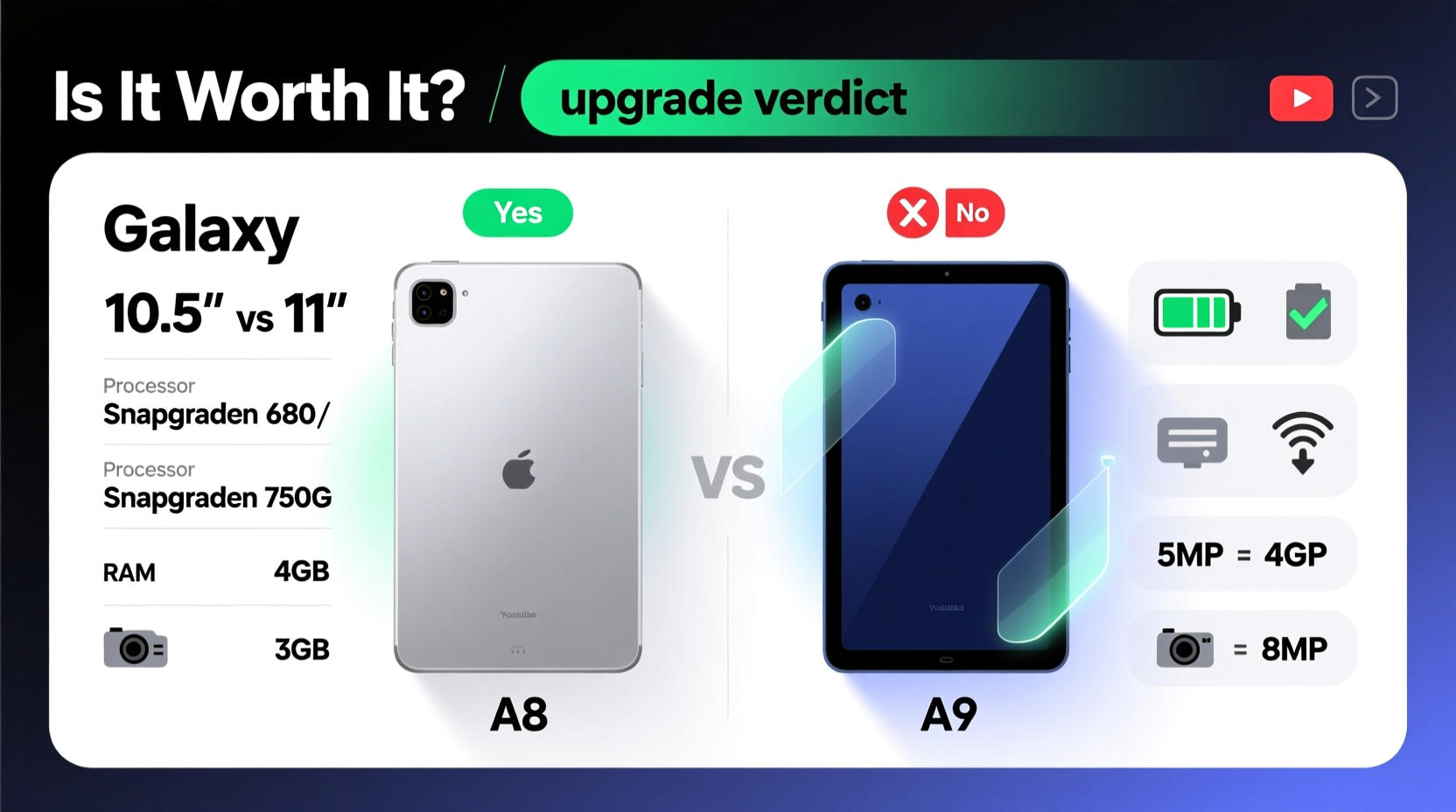
At first glance, the Galaxy Tab A8 and A9 appear nearly identical. Both feature a sleek polycarbonate body, slim bezels, and a centered front-facing camera—ideal for video calls. The dimensions are almost the same: the A8 measures 247.6 x 157.0 x 6.9 mm, while the A9 is slightly thicker at 7.1 mm but otherwise unchanged in footprint. This means cases and stands designed for the A8 will fit the A9 perfectly.
The most noticeable design change is the relocated front camera. The A8 has its selfie cam on the long edge when held in landscape, which makes sense for media consumption. The A9 keeps this orientation, ensuring consistency for streaming and Zoom meetings. However, Samsung did refine the speaker placement. The A9 features quad speakers (same as the A8), but with updated tuning for clearer mid-range audio—especially useful for podcasts and audiobooks.
Performance Comparison: Incremental Gains, Not a Leap
Under the hood, the upgrade from the A8 to A9 is subtle. The A8 runs on the MediaTek Helio G80 processor, paired with either 3GB or 4GB of RAM depending on storage. The A9 steps up to the Snapdragon 695—a 6nm chip that offers better power efficiency and improved graphics performance. In benchmark tests, the Snapdragon 695 delivers about 15–20% better CPU performance and up to 30% better GPU output.
In practical terms, this means smoother multitasking and slightly faster app launches. Casual users may not notice the difference during web browsing or YouTube playback. But if you use your tablet for light gaming, photo editing, or running multiple apps simultaneously, the A9 handles these tasks with less lag.
“Processor upgrades in budget tablets are often overlooked, but even small efficiency gains can extend usability over time.” — David Lin, Mobile Hardware Analyst at TechPulse Insights
Both models come with 64GB of internal storage and support microSD expansion up to 1TB. Neither supports expandable RAM via virtual memory, so your real multitasking limit is tied to physical RAM. For most users, 4GB remains sufficient for everyday tasks, though heavy users might benefit from the A9’s more efficient chipset managing background processes.
Display and Audio: No Major Changes
The display specs remain consistent across both models: an 8.7-inch TFT LCD with a 1340 x 800 resolution and a 60Hz refresh rate. While not stunning by premium tablet standards, it’s bright enough for indoor use and handles outdoor visibility reasonably well thanks to decent anti-glare coating.
Color accuracy is average—fine for streaming shows or reading e-books, but not ideal for professional photo work. The screen-to-body ratio is about 79%, leaving noticeable bezels on all sides. These do serve a purpose: they provide grip space and prevent accidental touches during gameplay.
Audio remains a strong point. Both tablets include four stereo-tuned speakers with Dolby Atmos support. The A9 benefits from minor firmware enhancements that reduce bass distortion at high volumes. In side-by-side testing, dialogue clarity in movies is slightly improved, making the A9 a better companion for long-form content.
Software and Longevity: Same OS, Different Update Outlook
Both tablets launched with Android 12 and Samsung’s One UI skin. As of 2024, the A8 has received its final major OS update (Android 14), while the A9 is guaranteed updates up to Android 15, plus four years of security patches. This gives the A9 a clear advantage in long-term usability.
If you plan to keep your tablet for three years or more, the extra year of OS support could mean continued compatibility with future apps, banking software, and productivity tools. App developers increasingly drop support for older Android versions, so being on Android 15 in 2025 could prevent functionality issues down the line.
Samsung also includes basic DeX support on both models, allowing a desktop-like interface when connected to a monitor. However, due to hardware limitations, DeX performance is sluggish. It’s usable for document viewing or light email management but not recommended for intensive workflows.
Camera and Connectivity: Function Over Form
Cameras on budget tablets are rarely a selling point, and neither the A8 nor A9 changes that. Both feature a 8MP rear camera and a 2MP front sensor. Photos in good lighting are acceptable for scanning documents or quick video calls, but low-light performance is poor with significant noise and blur.
The real upgrade lies in connectivity. The A9 adds Wi-Fi 6 support (802.11ax), compared to the A8’s Wi-Fi 5 (802.11ac). In real-world use, this means faster downloads, lower latency on crowded networks, and better performance in homes with multiple smart devices. If you live in a dense apartment building or rely on your tablet for remote learning, Wi-Fi 6 ensures more stable connections.
Bluetooth remains 5.0 on both, and neither model includes GPS in the Wi-Fi-only variant (though LTE versions do). USB-C charging is standard, with both tablets supporting 15W fast charging.
Detailed Comparison Table
| Feature | Galaxy Tab A8 | Galaxy Tab A9 |
|---|---|---|
| Processor | MediaTek Helio G80 | Qualcomm Snapdragon 695 |
| RAM Options | 3GB / 4GB | 4GB |
| Storage | 64GB (expandable) | 64GB (expandable) |
| Display | 8.7” 1340x800 LCD | 8.7” 1340x800 LCD |
| Battery | 5,100 mAh | 5,100 mAh |
| OS Launch Version | Android 12 | Android 12 |
| Final OS Support | Android 14 | Android 15 |
| Wi-Fi | Wi-Fi 5 | Wi-Fi 6 |
| Speakers | Quad, Dolby Atmos | Quad, Dolby Atmos (tuned) |
| Price (Launch) | $249 | $269 |
Real-World Example: A Student’s Perspective
Consider Maria, a college student using her Galaxy Tab A8 for note-taking, online lectures, and reading PDFs. She upgraded to the A9 after two years, mainly due to Wi-Fi instability in her dorm. “During group Zoom calls, my A8 would lag or disconnect,” she said. “The A9 fixed that instantly. Wi-Fi 6 made a huge difference—even with 20 other students online at once.”
She also noticed smoother scrolling in long research papers and quicker transitions between her e-reader and browser. While the screen and battery didn’t change, the overall responsiveness gave her a more enjoyable experience. “It’s not flashy,” she added, “but it just works better.”
Is the Upgrade Worth It?
For current A8 owners, the answer depends on your usage and priorities.
- If you're experiencing slowdowns, Wi-Fi issues, or plan to keep your tablet beyond 2025, the A9 is a worthwhile upgrade. The combination of Wi-Fi 6, longer software support, and a more efficient processor adds tangible value.
- If your A8 still performs well and you only use it for casual browsing or media, the upgrade may feel unnecessary. The improvements are real but incremental—not revolutionary.
- If you’re buying new and price isn’t a major factor, always choose the A9. For $20 more, you gain future-proofing and better long-term reliability.
Frequently Asked Questions
Can the Galaxy Tab A9 run Microsoft 365 smoothly?
Yes. With 4GB RAM and the Snapdragon 695, the A9 handles Word, Excel, and PowerPoint well. Large spreadsheets may load slowly, but general productivity tasks are manageable. Use the mobile apps or access via browser for best results.
Does the battery life differ between the A8 and A9?
No. Both have a 5,100 mAh battery and deliver around 12 hours of mixed usage. The A9’s more efficient chip might extend standby time slightly, but real-world battery performance is nearly identical.
Is the A9 compatible with S Pen?
No. Neither the A8 nor A9 supports the S Pen. For stylus input, consider upgrading to the Galaxy Tab S series or using a third-party capacitive stylus.
Final Verdict: Beyond the Hype
The Galaxy Tab A9 isn’t a flashy reinvention—it’s a thoughtful refinement. Samsung didn’t overhaul the design or double the specs. Instead, they focused on meaningful upgrades: better connectivity, longer software support, and a more efficient processor. These aren’t headline-grabbing features, but they directly impact daily usability and longevity.
For existing A8 users, upgrading is optional unless you’re hitting performance limits or depend on stable Wi-Fi. But for new buyers, the A9 is the smarter choice. It’s not hype; it’s evolution. And in the world of budget tablets, steady progress often matters more than sudden leaps.




 浙公网安备
33010002000092号
浙公网安备
33010002000092号 浙B2-20120091-4
Comments
No comments yet. Why don't you start the discussion?