
Choosing between Samsung’s Galaxy Tab S8 and the older Tab S7 FE can feel like a balancing act between budget and ambition. The S8 commands a higher price, but does it deliver enough improvements to justify the jump? For students, professionals, or creatives relying on tablets for productivity and entertainment, understanding the tangible differences matters. This isn’t just about specs on paper—it’s about how those specs translate into daily use, longevity, and overall satisfaction.
Design and Build: Premium Feel vs Functional Simplicity
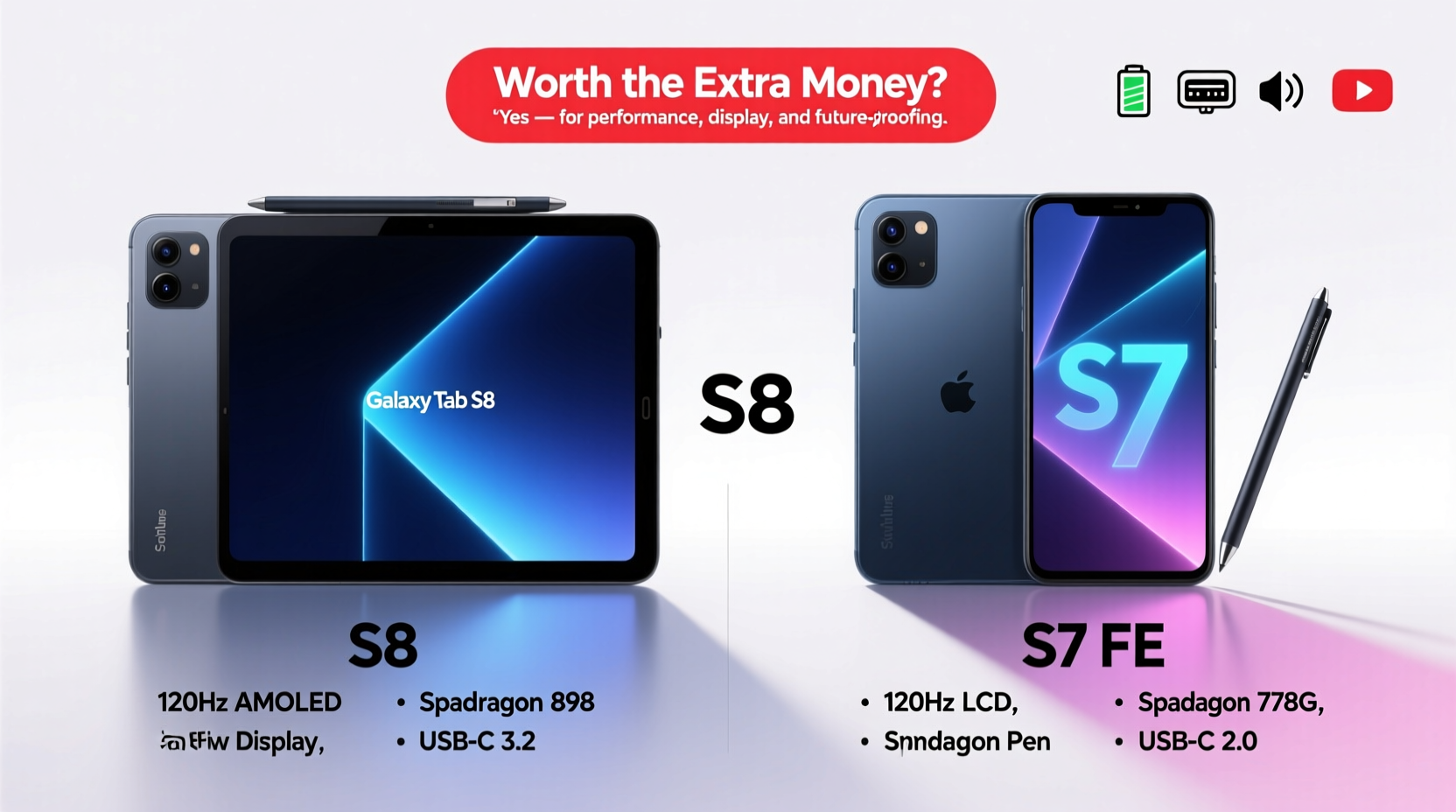
The Galaxy Tab S8 reflects Samsung’s flagship tablet philosophy with a sleek aluminum unibody that feels solid and refined in hand. At 503 grams (Wi-Fi model), it’s slightly lighter than the S7 FE’s 508 grams despite similar dimensions. More importantly, the S8 features narrower bezels, resulting in a more immersive screen-to-body ratio. It also supports IP68 water and dust resistance—a rare feature in tablets—meaning it can survive spills or brief submersion.
In contrast, the S7 FE uses a polycarbonate frame, which keeps costs down but lacks the premium tactile feel of metal. Its larger top bezel accommodates the Wacom EMR pen storage, allowing the S Pen to magnetically attach and charge. While practical, this design choice adds bulk and breaks visual symmetry. The S7 FE lacks any official IP rating, making it less resilient in unpredictable environments.
Display Quality: Brightness, Resolution, and Refresh Rate
The display is where the gap becomes most apparent. The Tab S8 sports a 11-inch LTPS TFT panel with a 2560x1600 resolution and a smooth 120Hz refresh rate. Colors are vibrant, blacks are deep, and motion feels fluid whether scrolling through documents or watching high-frame-rate videos. Peak brightness reaches around 500 nits, making outdoor visibility acceptable under shade.
The S7 FE also has an 11-inch display, but it’s an LCD with a lower 2560x1600 resolution and only a 60Hz refresh rate. While sharp, the lack of high refresh rate makes interactions feel less responsive. It peaks at 500 nits too, but the absence of HDR10+ support limits its media potential. For reading and note-taking, both are serviceable—but for creative work or media consumption, the S8 clearly wins.
“High refresh rates aren’t just for gamers. They make every interaction—from typing to swiping—feel more intuitive and immediate.” — David Lin, UX Analyst at MobileInsight Group
Performance Comparison: Chipset, RAM, and Real-World Speed
Under the hood, the Tab S8 runs on Qualcomm’s Snapdragon 8 Gen 1, a true flagship processor from 2022. Paired with 8GB of RAM (or 12GB in Ultra models), it handles multitasking, photo editing, and even light gaming with ease. Apps launch quickly, and switching between five or six open windows in Samsung DeX is seamless.
The S7 FE, released earlier, uses the older Snapdragon 750G—a mid-tier chip designed for smartphones, not power tablets. With only 6GB of RAM (8GB in select regions), it struggles when multiple resource-heavy apps run simultaneously. Users report occasional stutters when using Adobe Illustrator Draw or splitting screens across three apps.
If your workflow includes video rendering, coding via Termux, or using Procreate-like tools, the S8’s processing power pays dividends. But for email, web browsing, and casual streaming, the S7 FE remains adequate.
Performance Summary Table
| Feature | Galaxy Tab S8 | Galaxy Tab S7 FE |
|---|---|---|
| Processor | Snapdragon 8 Gen 1 | Snapdragon 750G |
| RAM Options | 8GB / 12GB | 6GB / 8GB |
| Storage Options | 128GB / 256GB / 512GB | 64GB / 128GB / 256GB |
| Expandable Storage | Yes (up to 1TB) | Yes (up to 1TB) |
| Refresh Rate | 120Hz | 60Hz |
| OS Launch Version | Android 12 (Upgradable to Android 14) | Android 11 (Upgradable to Android 13) |
S Pen and Productivity: Which Stylus Experience Wins?
Both tablets include the S Pen, but the experience differs subtly. The S8’s pen has lower latency (2.8ms) compared to the S7 FE’s 9ms, translating to more natural writing and drawing. Pressure sensitivity is identical at 4096 levels, but the S8’s updated software integration—especially in Samsung Notes and third-party apps—makes inking feel more precise.
The S7 FE’s built-in pen slot is convenient—you won’t lose the stylus easily. However, the S8 compensates with magnetic attachment on the side and wireless charging, so it’s always ready. Over time, losing track of the pen is less likely with either method, but the S8’s approach aligns better with modern tablet ergonomics.
A mini case study illustrates the difference: Sarah, a university student majoring in architecture, used the S7 FE for her first year. She appreciated the included pen but found sketching digital floor plans laggy and imprecise. After upgrading to the S8, she reported “a night-and-day difference” in responsiveness, especially when zooming and redrawing complex lines.
Actionable Tips for Maximizing Your Tablet Investment
- Pair a folio keyboard to unlock full desktop-like functionality.
- Enable “Link to Windows” for seamless clipboard sharing and phone notifications.
- Use private mode folders to separate personal and professional data.
- Regularly clear cached data to maintain speed over time.
- Update firmware monthly to benefit from security patches and performance tweaks.
Battery Life and Charging: Endurance vs Convenience
The S7 FE holds a larger 10,090mAh battery versus the S8’s 8,000mAh, and this translates to real-world gains. Under moderate use—web browsing, video calls, note-taking—the S7 FE lasts about 14 hours. The S8 manages around 10–11 hours, which is still respectable but shorter.
However, the S8 supports faster 45W charging (though ships with a 15W charger), reaching 50% in roughly 30 minutes. The S7 FE maxes out at 15W charging, taking nearly two hours for a full charge. So while the S7 FE lasts longer, the S8 recovers quicker when time is tight.
For travelers or remote workers without consistent access to outlets, battery life may tip the scale toward the S7 FE. But if you’re near power sources during the day and value fast top-ups, the S8’s charging advantage matters.
Is the S8 Worth the Extra Money? A Value Timeline
Let’s walk through a realistic ownership timeline to assess long-term value:
- Month 1: Both tablets feel fast. You enjoy the included S Pen and explore preloaded apps. The S8’s smoother interface stands out immediately.
- Month 3: You begin multitasking heavily—split-screen research, video lectures, and cloud sync. The S8 continues to perform fluidly; the S7 FE shows minor delays.
- Year 1: Software updates arrive. The S8 receives Android 14 and One UI 6; the S7 FE gets Android 13 and stops there. App developers start optimizing for higher-end hardware.
- Year 2: The S7 FE feels sluggish launching large files. The S8 remains responsive. Resale value of the S8 is 30–40% higher due to demand for flagship models.
- Year 3: You consider an upgrade. The S8 still functions well for secondary tasks. The S7 FE struggles with newer OS features and app requirements.
This progression suggests the S8 delivers longer usable life, reducing the need for early replacement.
Frequently Asked Questions
Can the S7 FE run the same apps as the S8?
Yes, both tablets run Android and support the same apps from the Google Play Store. However, graphically intensive apps (like Autodesk SketchBook or video editors) may run slower or lack advanced features on the S7 FE due to hardware limitations.
Does the S8 come with the S Pen included?
Yes, unlike many brands, Samsung includes the S Pen free with both the Tab S8 and S7 FE—no extra cost.
Which tablet is better for online classes?
The S7 FE is sufficient for joining Zoom or Google Meet, taking notes, and viewing slides. But if you annotate PDFs, draw diagrams, or join back-to-back sessions, the S8’s responsiveness and superior speakers provide a noticeably better experience.
Final Verdict: Who Should Upgrade?
The Galaxy Tab S8 is absolutely worth the extra money—if your usage demands performance, precision, and future-proofing. Creative professionals, business users, and students in technical fields will benefit from the faster processor, higher refresh rate, and IP68 durability.
The S7 FE remains a strong budget-friendly option for casual users who prioritize battery life and don’t need cutting-edge speed. It’s ideal for reading, streaming, basic note-taking, and light web work.
Ultimately, the $150–$200 price difference reflects more than incremental upgrades—it represents a shift from functional to premium. When you factor in software support lifespan, resale value, and daily usability, the S8 justifies its cost over time.




 浙公网安备
33010002000092号
浙公网安备
33010002000092号 浙B2-20120091-4
Comments
No comments yet. Why don't you start the discussion?