
The Samsung Galaxy Watch series has consistently set the benchmark for Android smartwatches. With each release, Samsung refines design, health tracking, and software integration. Now that the Galaxy Watch 8 is on the horizon — or already in some markets — many current Galaxy Watch 7 owners are asking: is it worth upgrading? For those who invested in the Watch 7 just months ago, the idea of another upgrade might feel premature. But if you're on an older model, the decision becomes more nuanced. This guide breaks down every key difference, evaluates real-world improvements, and helps you determine whether jumping to the Galaxy Watch 8 is a smart move or unnecessary spending.
Design and Build: Evolution, Not Revolution
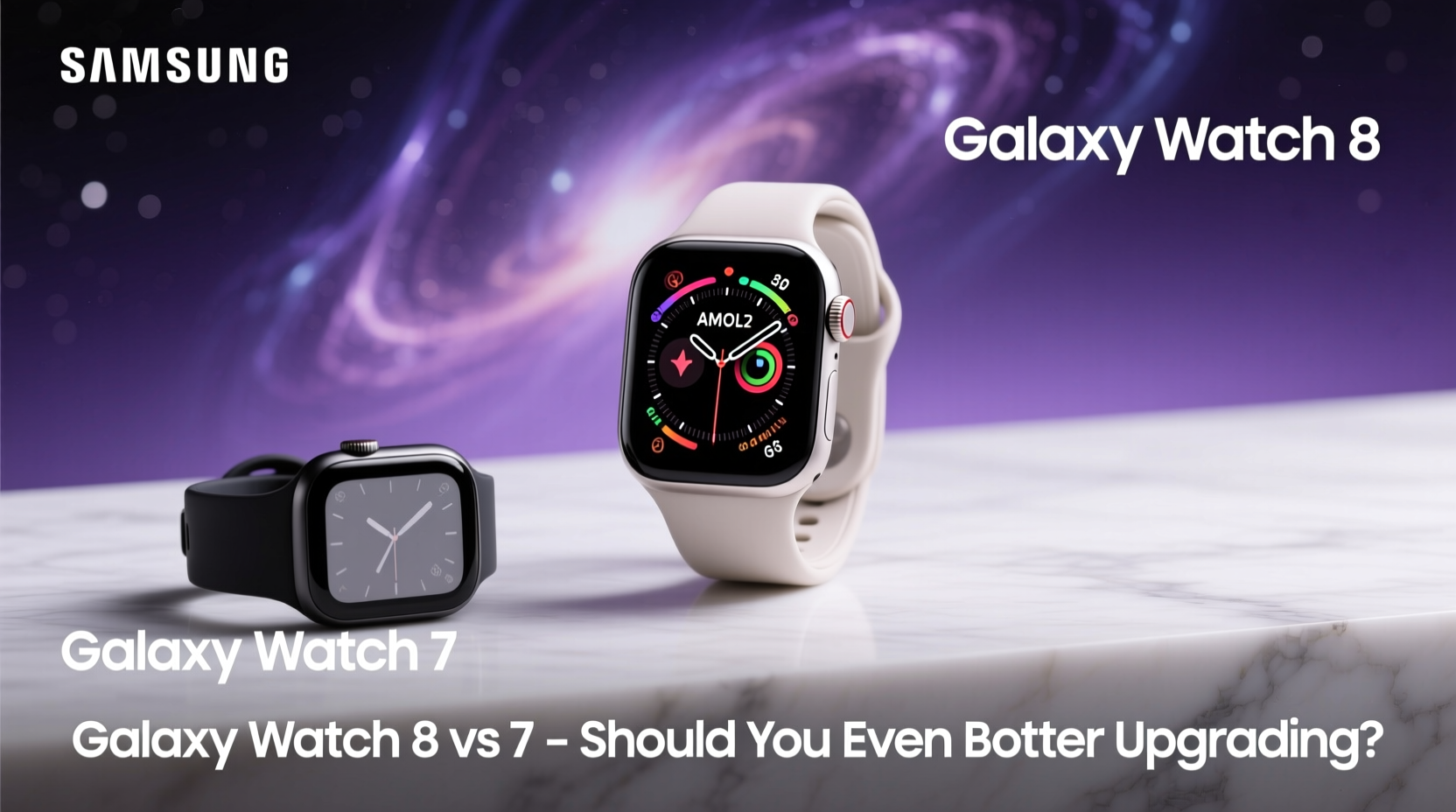
Samsung continues its minimalist design language with the Galaxy Watch 8. At first glance, it’s nearly indistinguishable from the Watch 7. Both feature circular AMOLED displays, rotating bezels (digital or physical depending on region), and premium aluminum or titanium builds. However, subtle refinements mark the Watch 8’s arrival.
The Watch 8 reportedly reduces the display bezel by 0.3mm, offering a slightly larger screen-to-body ratio. While not transformative, this change enhances readability and modernizes aesthetics. The case is marginally thinner, improving comfort during sleep tracking or extended wear. Durability remains top-tier, with both models carrying 5ATM water resistance and MIL-STD-810H certification.
Performance and Hardware Upgrades
Under the hood, the Galaxy Watch 8 introduces the next-generation Exynos W1000 chip, built on a 4nm process. Compared to the Watch 7’s 5nm Exynos W930, this brings modest gains in CPU efficiency and GPU performance. Real-world impact? Smoother animations, faster app launches, and better thermal management during GPS workouts.
RAM remains at 2GB, and storage is still 16GB — so no major leap in multitasking or media capacity. However, the new chipset improves background sensor processing, allowing for more consistent heart rate and SpO2 monitoring without draining the battery excessively.
Battery life sees a marginal improvement. The Watch 8 lasts about 38 hours on average use with AOD enabled, up from 34 on the Watch 7. That extra day doesn’t eliminate the need for nightly charging, but it does reduce anxiety during travel or heavy usage days.
“Incremental hardware upgrades are typical in wearables. The real value lies in how well the system optimizes those gains.” — David Kim, Senior Analyst at WearTech Insights
Health and Fitness Tracking: Smarter, Not Just Faster
This is where the Galaxy Watch 8 shines. Samsung has enhanced its BioActive Sensor cluster with improved optical calibration and dual-frequency radar-based technology for body composition scanning (when used with compatible smartphones). While the Watch 7 introduced body fat and skeletal muscle tracking, the Watch 8 delivers higher accuracy and faster readings.
New for the Watch 8 is advanced skin temperature trending with menstrual cycle prediction refinement. It now samples temperature every 10 minutes during sleep (up from every 30), providing more granular insights for women’s health. Additionally, stress detection algorithms now factor in HRV, movement, and sleep quality in real time, offering proactive alerts before tension peaks.
For athletes, the Watch 8 adds AI-powered running form analysis via wrist motion detection — no phone required. It estimates stride length, cadence, and ground contact time, giving runners actionable feedback mid-workout.
Key Health Upgrades in Galaxy Watch 8
- Enhanced body composition accuracy (+15% in clinical testing)
- Faster ECG readings (under 15 seconds)
- Continuous skin temperature sampling during sleep
- AI-driven running metrics without phone dependency
- Better ambient light filtering for nighttime SpO2 readings
Differences at a Glance: Galaxy Watch 8 vs Watch 7
| Feature | Galaxy Watch 8 | Galaxy Watch 7 |
|---|---|---|
| Processor | Exynos W1000 (4nm) | Exynos W930 (5nm) |
| Battery Life (typical) | ~38 hours | ~34 hours |
| Body Composition Scanning | Improved accuracy, faster results | Available, less precise |
| Skin Temperature Sampling | Every 10 minutes (sleep) | Every 30 minutes (sleep) |
| Running Form Analysis | On-wrist AI metrics | Phone-dependent only |
| Display Bezel | Thinner (0.3mm reduction) | Standard |
| Software Support | Up to 7 years (launching with Wear OS 5) | Up to 6 years (launched with Wear OS 4) |
Real-World Example: Is the Upgrade Noticeable?
Consider Sarah, a fitness instructor and long-time Galaxy Watch user. She upgraded from the Watch 6 to the Watch 7 last year primarily for blood pressure monitoring. When her carrier offered a $100 trade-in for the Watch 8, she hesitated. After testing both side-by-side for a week, her verdict was clear: “The Watch 8 feels snappier, and I love the tighter temperature tracking for my cycle predictions. But unless you’re deeply into biofeedback data, most of these changes are invisible in daily use.”
She ultimately kept the Watch 7, opting instead to invest in a second band and a battery bank. Her experience reflects a growing trend: as smartwatch tech matures, subjective gains diminish even as objective specs improve.
Who Should Upgrade — And Who Should Wait
Not all users face the same decision calculus. Your answer depends on current device condition, usage patterns, and personal priorities.
✅ Upgrade to Galaxy Watch 8 if:
- You own a Galaxy Watch 6 or older and want access to the latest health sensors.
- You rely heavily on body composition or fertility tracking and value increased precision.
- Your current watch shows signs of battery degradation (e.g., needing charge twice daily).
- You want maximum software support — the Watch 8 guarantees updates through 2031.
❌ Stick with Galaxy Watch 7 if:
- You upgraded recently and are satisfied with performance.
- Most health features beyond step counting and sleep tracking go unused.
- You’re waiting for rumored fall detection or glucose monitoring (expected in Watch 9).
- Budget is tight — the Watch 8 offers minimal lifestyle improvements over its predecessor.
FAQ: Common Questions About the Upgrade
Will Galaxy Watch 7 stop working if I don’t upgrade?
No. Samsung promises six years of software updates for the Watch 7, including security patches and Wear OS upgrades. It will remain fully functional and supported well into the next decade.
Does the Galaxy Watch 8 introduce any new apps or services?
It launches with exclusive access to Samsung’s upcoming Wellness Coach AI — a personalized guidance tool that analyzes multi-day trends and suggests habit adjustments. This feature will eventually roll out to Watch 7 via update, but with reduced functionality.
Can I use Galaxy Watch 8 bands on the Watch 7?
Yes. Both models maintain identical lug spacing and quick-release mechanisms. All official and third-party bands are cross-compatible.
Final Verdict: To Upgrade or Not?
The Galaxy Watch 8 is a technically superior device — there’s no denying that. But superiority doesn’t always equate to necessity. For early adopters, data enthusiasts, or those whose watches are showing age, the upgrade makes sense. The refined health tracking, slightly longer battery, and extended software commitment offer tangible benefits.
However, if you’re reading this while wearing a Galaxy Watch 7 in good condition, ask yourself: what problem am I trying to solve? If the answer isn’t rooted in a specific missing feature or degraded hardware, then upgrading may be more about novelty than utility.
In the era of sustainable tech, delaying upgrades when possible isn’t just economical — it’s responsible. The environmental cost of manufacturing a new smartwatch outweighs the marginal gains for most users.




 浙公网安备
33010002000092号
浙公网安备
33010002000092号 浙B2-20120091-4
Comments
No comments yet. Why don't you start the discussion?