
The smartphone market has reached a crossroads. On one side, you have the pinnacle of traditional smartphone engineering: the iPhone 15 Pro, refined over years of iteration. On the other, Samsung’s Galaxy Z Fold 5 — a bold reimagining of what a phone can be, with a folding screen that transforms from pocket-sized device to mini tablet. But beneath the marketing buzz, a practical question emerges: is the Fold’s innovation worth the trade-offs, or does the iPhone 15 Pro still deliver more real-world value?
Design & Usability: Form Meets Function
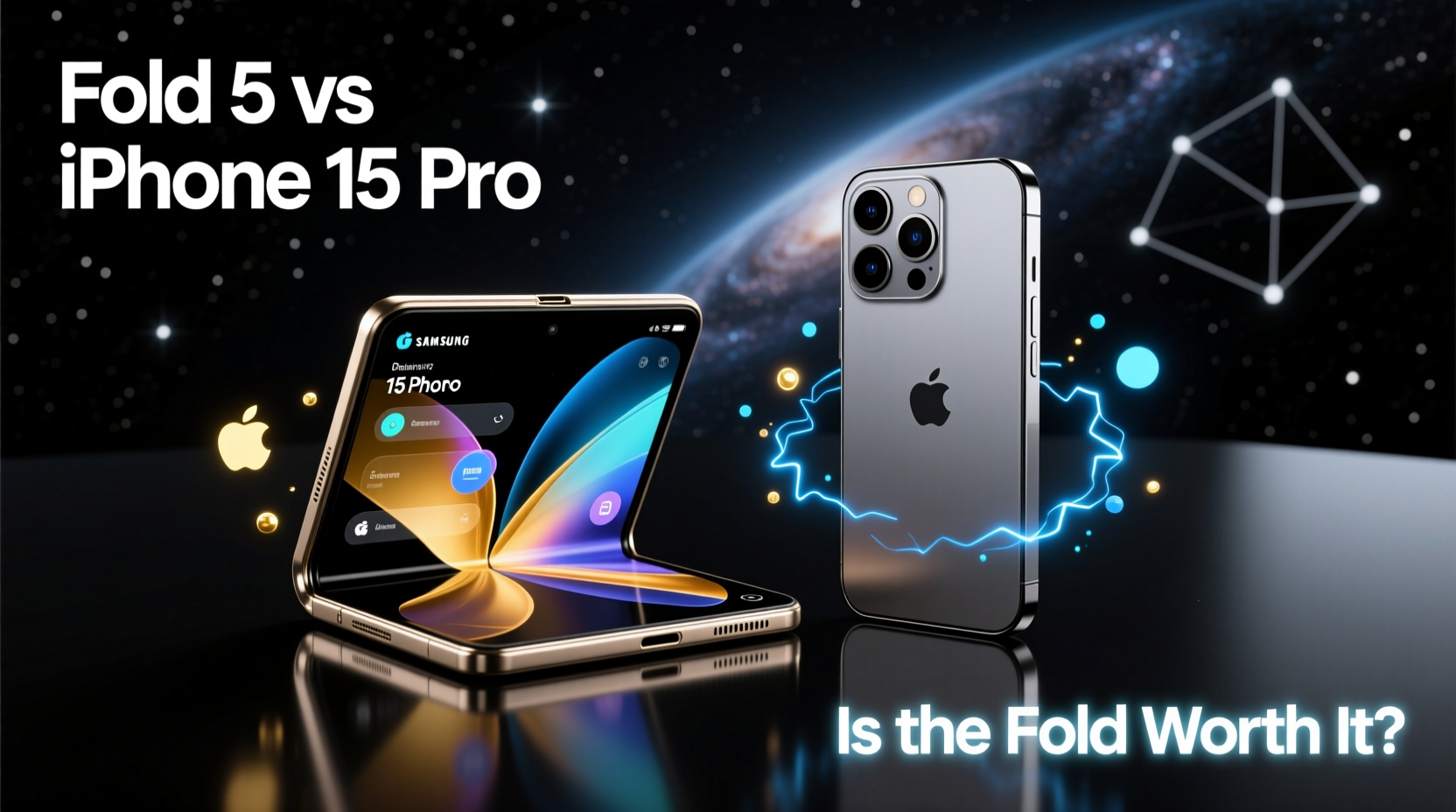
The most immediate difference between these two devices lies in their physical philosophy. The iPhone 15 Pro sticks to a familiar, compact slab design — titanium frame, flat edges, and a 6.1-inch display optimized for one-handed use. It fits easily in pockets, works seamlessly with existing accessories, and feels like an extension of your hand.
The Galaxy Z Fold 5 takes a different approach. When closed, it’s thick and slightly awkward — about the size of a small paperback. Opened, it reveals a 7.6-inch interior display that enables multitasking, immersive video, and desktop-like browsing. This dual-state functionality reshapes how you interact with your phone. You can watch a YouTube video on one half while replying to messages on the other, or edit a spreadsheet while referencing a document side-by-side.
But this flexibility comes at a cost. The Fold is heavier (253g vs 187g), more fragile, and demands extra care. Its hinge mechanism, while improved, still collects dust. The outer screen is narrow when open, making typing less comfortable than on the iPhone. Meanwhile, the iPhone 15 Pro offers superior ergonomics, better drop resistance, and a proven track record of durability.
Performance & Software Experience
Under the hood, both phones are powered by top-tier chipsets. The iPhone 15 Pro uses Apple’s A17 Pro chip — built on a 3nm process, offering unmatched efficiency and raw power. Apps launch instantly, games run at maximum settings, and video editing is buttery smooth. iOS remains tightly optimized, with minimal lag even after months of use.
The Galaxy Z Fold 5 runs on the Snapdragon 8 Gen 2 for Galaxy, a high-end Android chip that handles demanding workloads well. However, Android’s multitasking interface on the Fold still feels like a work in progress. While Samsung DeX and split-screen apps offer productivity gains, they require learning curves and occasional troubleshooting. Notifications don’t always sync cleanly across panels, and some apps aren’t optimized for the wide inner display.
“Foldables are no longer science fiction, but they’re not yet everyday seamless. The software still plays catch-up with the hardware.” — David Liu, Mobile UX Analyst at TechInsight Labs
iOS offers consistency. Every app behaves predictably. Features like Face ID, iMessage, and Handoff integrate flawlessly with other Apple devices. For users embedded in the Apple ecosystem, switching isn’t just about the phone — it’s about losing continuity across Mac, iPad, and Watch.
Camera Comparison: Quality vs Versatility
The iPhone 15 Pro continues Apple’s tradition of reliable, consistent photography. Its 48MP main sensor captures rich detail, especially in daylight. The new tetraprism telephoto lens offers 5x optical zoom — a game-changer for distant subjects. Video recording remains best-in-class, with Cinematic Mode, Log encoding, and ProRes support appealing to creators.
The Galaxy Z Fold 5 matches it with a 50MP main, 12MP ultra-wide, and 10MP telephoto (3x zoom). Image processing favors vibrancy, sometimes oversharpening skies or boosting saturation unnaturally. Low-light performance is good but not class-leading. Where the Fold shines is in flexibility: you can shoot hands-free using the foldable stand mode, or use the outer screen as a viewfinder while the subject sees themselves on the larger inner display.
| Feature | iPhone 15 Pro | Galaxy Z Fold 5 |
|---|---|---|
| Main Camera | 48MP, f/1.78 | 50MP, f/1.8 |
| Telephoto Zoom | 5x optical | 3x optical |
| Video Capabilities | ProRes, Log, 4K HDR | 8K@30fps, HDR10+ |
| Unique Camera Use Case | Filmmaking-grade tools | Hands-free shooting with foldable stance |
Battery Life & Long-Term Value
Battery life is where the Fold faces its biggest challenge. Despite a 4,400mAh dual-cell setup, the larger screen and power-hungry processor drain energy quickly. Heavy users often need a midday charge. In contrast, the iPhone 15 Pro, while not class-leading, delivers a solid full day under normal use, aided by iOS efficiency.
Durability is another concern. The Fold’s screen, though protected by ultra-thin glass, is still more vulnerable than the iPhone’s Ceramic Shield. Replacing a damaged Fold panel can cost upwards of $300 — and insurance options are limited. The iPhone, while not indestructible, benefits from widespread repair networks and better resale value.
Pricing reflects these differences. The iPhone 15 Pro starts at $999. The Galaxy Z Fold 5 starts at $1,799. That $800 gap buys you a radically different experience — but only if you’ll actually use the folding functionality daily.
Real-World Example: A Freelancer’s Workflow
Consider Maya, a freelance writer and editor who travels frequently. She switched from an iPhone 14 Pro to the Galaxy Z Fold 5 for its multitasking potential. Her typical day involves researching articles, drafting in Google Docs, and communicating via Slack and email.
On the Fold, she opens her browser on the left and writes on the right. During calls, she props the phone in stand mode and takes notes on the lower half. She uses Samsung Notes with an S Pen to annotate PDFs during client meetings. Over three months, she estimates she saves nearly two hours per week by avoiding app switching.
But she also faced frustrations: the battery died during a flight without a charger, the phone cracked when dropped on tile (despite a case), and some apps didn’t support drag-and-drop between windows. After six months, she returned to the iPhone 15 Pro — keeping the Fold as a secondary device for travel days only.
Her experience highlights a key insight: the Fold excels in specific workflows but doesn’t replace the reliability of a traditional flagship.
Checklist: Should You Choose the Fold or iPhone?
- ✅ Need a mobile workstation? → Fold
- ✅ Prioritize camera quality and video? → iPhone
- ✅ Already use Mac, iPad, or Apple Watch? → iPhone
- ✅ Want to try cutting-edge tech with higher risk? → Fold
- ✅ Prefer long-term durability and resale value? → iPhone
- ✅ Frequently use two apps at once? → Fold
- ✅ Travel often and hate carrying multiple devices? → Fold
Frequently Asked Questions
Can the Galaxy Z Fold 5 replace my laptop?
For light tasks — email, document editing, web browsing — yes, especially with Samsung DeX. But for intensive work like coding, video editing, or running desktop software, it’s not a full replacement.
Is the iPhone 15 Pro too similar to older models?
In design, yes — but internally, the A17 Pro chip, USB-C port, and 5x zoom lens bring meaningful upgrades. If you’re upgrading from an iPhone 12 or earlier, the jump is significant.
How long will the Fold’s hinge last?
Samsung rates it for 200,000 folds — about five years of average use. Real-world reports show most hinges hold up well, but exposure to sand or moisture increases failure risk.
Final Verdict: Innovation vs. Reliability
The Galaxy Z Fold 5 is a glimpse into the future — a device that redefines what a phone can do. It’s ideal for power users, travelers, and early adopters who value screen real estate and multitasking. But it’s not without compromises: fragility, shorter battery life, high cost, and software inconsistencies.
The iPhone 15 Pro, meanwhile, represents the peak of evolutionary smartphone design. It’s dependable, powerful, and deeply integrated into a broader ecosystem. It won’t surprise you, but it also won’t let you down.
If you're seeking novelty and are willing to pay a premium for experimental form factors, the Fold is worth trying. But if you want a phone that just works — every day, in every situation — the iPhone 15 Pro remains the smarter choice for most people.




 浙公网安备
33010002000092号
浙公网安备
33010002000092号 浙B2-20120091-4
Comments
No comments yet. Why don't you start the discussion?