
The Garmin Fenix 7 and Epix (Gen 2) represent two of the most advanced multisport GPS watches on the market today. Both are built for endurance athletes, outdoor adventurers, and fitness enthusiasts who demand top-tier performance, durability, and data accuracy. The key difference lies in their display technology: the Fenix 7 uses a transflective solar MIP (memory-in-pixel) display, while the Epix Gen 2 features a vibrant AMOLED touchscreen. This distinction raises a critical question among users: Is the AMOLED screen on the Epix Gen 2 a significant battery drainer compared to the Fenix 7?
The short answer is yes—but with important caveats. While AMOLED displays consume more power under typical usage, especially with bright content and animations, they also offer superior visual clarity, deeper blacks, and better responsiveness. The real-world impact on battery life depends heavily on user habits, settings, and activity profiles.
Display Technology: MIP vs AMOLED Explained
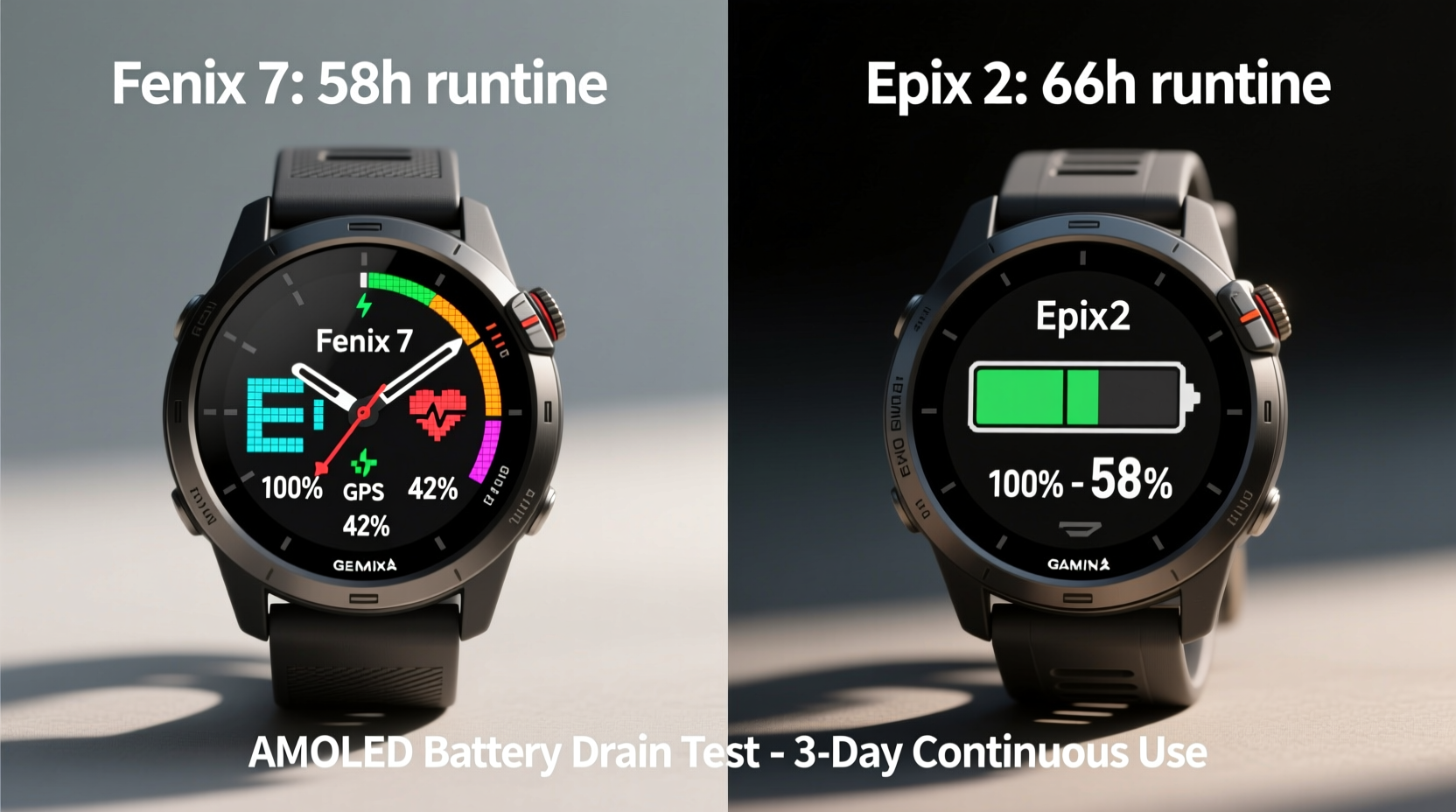
To understand the battery implications, it’s essential to compare the fundamental differences between the display types used in these watches.
The **Fenix 7** uses a transflective memory-in-pixel (MIP) display. This technology reflects ambient light to improve visibility in sunlight and consumes minimal power because pixels only refresh when the screen content changes. It's always visible without backlighting in daylight, making it ideal for long hikes or trail runs where checking your watch frequently is necessary.
In contrast, the **Epix Gen 2** uses an AMOLED (Active-Matrix Organic Light-Emitting Diode) display. Each pixel emits its own light, which allows true black levels (since unlit pixels are completely off), high contrast, and vivid colors. However, this comes at an energy cost—especially when displaying bright or white-heavy interfaces.
Battery Life Comparison: Real Numbers Matter
Garmin provides official battery ratings, but real-world usage often tells a different story. Below is a direct comparison based on standard modes and typical conditions.
| Model | Display Type | Smartwatch Mode (Days) | GPS Mode (Hours) | UltraTrac Mode (Hours) |
|---|---|---|---|---|
| Fenix 7 (Large) | MIP + Solar | Up to 23 days | Up to 57 hours | Up to 131 hours |
| Epix Gen 2 (Large) | AMOLED + Solar | Up to 16 days | Up to 34 hours | Up to 72 hours |
The numbers show a clear gap: the Epix Gen 2 offers up to 7 fewer days in smartwatch mode and nearly 23 fewer hours in full GPS mode. However, both benefit from solar charging, which can add substantial runtime under consistent sunlight exposure.
It’s worth noting that the Epix Gen 2 defaults to an AMOLED-only mode during active use, but reverts to a lower-power MIP-like state when inactive or using \"Always-On Display\" with certain watch faces. This hybrid approach helps mitigate some of the energy drain.
“AMOLED screens are inherently less power-efficient than MIP displays, but modern optimizations like auto-brightness, sleep timers, and adaptive UIs have narrowed the gap considerably.” — Dr. Lena Torres, Wearable Energy Systems Researcher, MIT Media Lab
Real-World Usage: How Settings Impact Battery
Lab conditions don’t reflect how people actually use their devices. In practice, several factors determine whether the Epix Gen 2 becomes a battery hog.
Key Power-Draining Behaviors on Epix Gen 2
- Always-On Display (AOD): When enabled, AOD keeps the screen lit continuously. On AMOLED, even dimmed pixels consume power—especially if the background is bright.
- Bright Watch Faces: White or colorful watch faces require more pixel activation than dark ones. Pure black backgrounds save energy due to AMOLED’s per-pixel lighting.
- Frequent Screen Activation: Wrist flicks, touch interactions, and notifications keep the screen waking up, increasing cumulative power draw.
- High GPS Sampling Rates: Using full-color maps or multi-band GPS with constant screen-on navigation drains both the processor and display.
Power-Saving Features That Help
- Solar Charging: Both models include solar charging, extending battery life by up to 20–30% under strong sunlight.
- Auto-Brightness: Adjusts screen intensity based on environment, reducing unnecessary output.
- Sleep Mode Optimization: The Epix can switch to a low-power MIP-style view overnight or during inactivity.
- Activity Mode Presets: Users can create custom profiles that disable non-essential sensors and dim the screen during long events.
Mini Case Study: Ultrarunner’s 100-Mile Experience
Consider Sarah Kim, an experienced ultrarunner preparing for the Leadville Trail 100. She tested both the Fenix 7X and Epix Gen 2 during her final training block—a 98-mile simulated race over rugged terrain with intermittent cloud cover.
She used both watches in identical conditions: GPS + GLONASS, wrist-based heart rate, music storage, and weather alerts. The Fenix 7X lasted the entire distance with 18% battery remaining after 38 hours. The Epix Gen 2, however, shut down at hour 34 with 5% left—just enough to finish but requiring careful management.
Post-race analysis revealed that Sarah had used a semi-transparent map overlay on the Epix for navigation, which kept the screen active longer than necessary. When she repeated the test with a turn-by-turn cue-only profile and a black watch face, the Epix lasted 37 hours—still slightly behind the Fenix, but within acceptable range.
This example illustrates that while hardware differences exist, user behavior plays a decisive role in actual battery longevity.
Step-by-Step Guide: Maximizing Epix Gen 2 Battery Life
If you choose the Epix Gen 2 for its superior screen quality, follow this sequence to minimize battery drain without sacrificing functionality.
- Select a Dark Watch Face: Go to your watch face options and pick one with a black or near-black background. Avoid gradients or animated elements.
- Adjust Always-On Display Settings: In Settings > Display > Always On Display, set timeout to 10 seconds or shorter. Consider disabling AOD during long activities.
- Lower Screen Brightness: Set maximum brightness to 70–80%. Enable Auto-Brightness to let the sensor adjust dynamically.
- Optimize Activity Profiles: For endurance events, create a dedicated profile that disables music, reduces GPS frequency (e.g., UltraTrac), and turns off pulse ox unless needed.
- Use Navigation Wisely: Instead of live maps, rely on breadcrumb trails or audio cues. Preload routes to avoid constant screen-on navigation.
- Enable Power Manager Modes: Use Battery Saver or Expedition mode during multi-day trips to limit background processes.
- Leverage Solar Charging: Wear the watch exposed to sunlight during daytime hikes. Even indirect light adds incremental charge.
When the AMOLED Advantage Outweighs Battery Cost
Despite higher power consumption, the AMOLED screen brings tangible benefits that may justify the trade-off for many users.
- Better Readability in Low Light: Unlike MIP displays that require backlighting in darkness, AMOLED’s self-emissive pixels provide crisp visibility in nighttime conditions.
- Touch Responsiveness: The Epix Gen 2 supports full touchscreen interaction even with gloves in cold weather—a feature appreciated by skiers and mountaineers.
- Rich Interface Experience: Apps, maps, and music controls look sharper and feel more intuitive, enhancing usability during complex workouts.
- Personalization: More dynamic watch faces, animations, and third-party app support make the Epix feel more like a premium smartwatch.
For users who value aesthetics, interactivity, and indoor readability, the Epix Gen 2’s screen is not just a luxury—it’s a functional upgrade.
Frequently Asked Questions
Does the Epix Gen 2 battery degrade faster than the Fenix 7 over time?
No, both watches use similar lithium-ion battery chemistry and are rated for hundreds of charge cycles. Long-term degradation depends more on charging habits and temperature exposure than model type. However, frequent deep discharges (common with heavy Epix use) may accelerate wear slightly.
Can I use the Epix Gen 2 for a week-long backpacking trip without recharging?
Possibly, but with limitations. In smartwatch mode with solar assist and conservative settings (dim screen, no AOD, periodic GPS), the Epix Gen 2 can last 10–14 days. For uninterrupted GPS tracking over multiple days, consider bringing a portable charger or switching to Expedition mode.
Is the Fenix 7 screen really better in sunlight?
Yes. The transflective MIP display excels in direct sun because it reflects ambient light rather than fighting it. The Epix Gen 2, while improved over earlier AMOLED wearables, still requires max brightness to match Fenix visibility—increasing power draw.
Checklist: Choosing Between Fenix 7 and Epix Gen 2
Use this checklist to decide which watch suits your priorities:
- ✅ Need maximum battery life for multi-day adventures? → Fenix 7
- ✅ Prioritize screen clarity and color depth? → Epix Gen 2
- ✅ Spend lots of time in bright sunlight? → Fenix 7
- ✅ Want a more smartphone-like interface? → Epix Gen 2
- ✅ Frequently navigate with maps? → Epix Gen 2 (with optimized settings)
- ✅ Prefer physical buttons over touch? → Fenix 7
- ✅ Willing to manage settings closely for best battery? → Epix Gen 2 is viable
Final Verdict: Is the AMOLED Screen a Battery Drainer?
Yes, the AMOLED screen on the Epix Gen 2 does consume more power than the Fenix 7’s MIP display—there’s no way around that physics. But calling it a “battery drainer” oversimplifies the reality. With intelligent configuration, the Epix Gen 2 delivers a compelling balance of visual excellence and usable longevity.
The real issue isn't the screen itself, but how it's used. An Epix Gen 2 set to maximum brightness with AOD enabled and bright watch faces will indeed die quickly. But so will any device pushed beyond its efficient operating range. Conversely, a well-tuned Epix with dark themes, auto-brightness, and solar assistance can rival the Fenix in many scenarios.
Ultimately, the choice comes down to lifestyle. If you're an expeditionist, thru-hiker, or someone who hates charging devices, the Fenix 7 remains the gold standard for endurance. But if you want a luxurious, responsive, and visually stunning experience—and are willing to tweak a few settings—the Epix Gen 2 earns its place as a top-tier alternative.




 浙公网安备
33010002000092号
浙公网安备
33010002000092号 浙B2-20120091-4
Comments
No comments yet. Why don't you start the discussion?