
When building or upgrading a gaming PC, one of the most critical components is the graphics card. But beneath the GPU core itself lies another crucial element: the type of memory used—specifically, whether it uses GDDR6 or HBM2. While both serve the same fundamental purpose of storing data for fast access by the GPU, they differ significantly in design, performance, and cost. Gamers often face the question: Is HBM2 worth the premium over GDDR6? The answer isn't straightforward and depends on use case, budget, and future-proofing priorities.
Understanding GDDR6 and HBM2: Core Differences
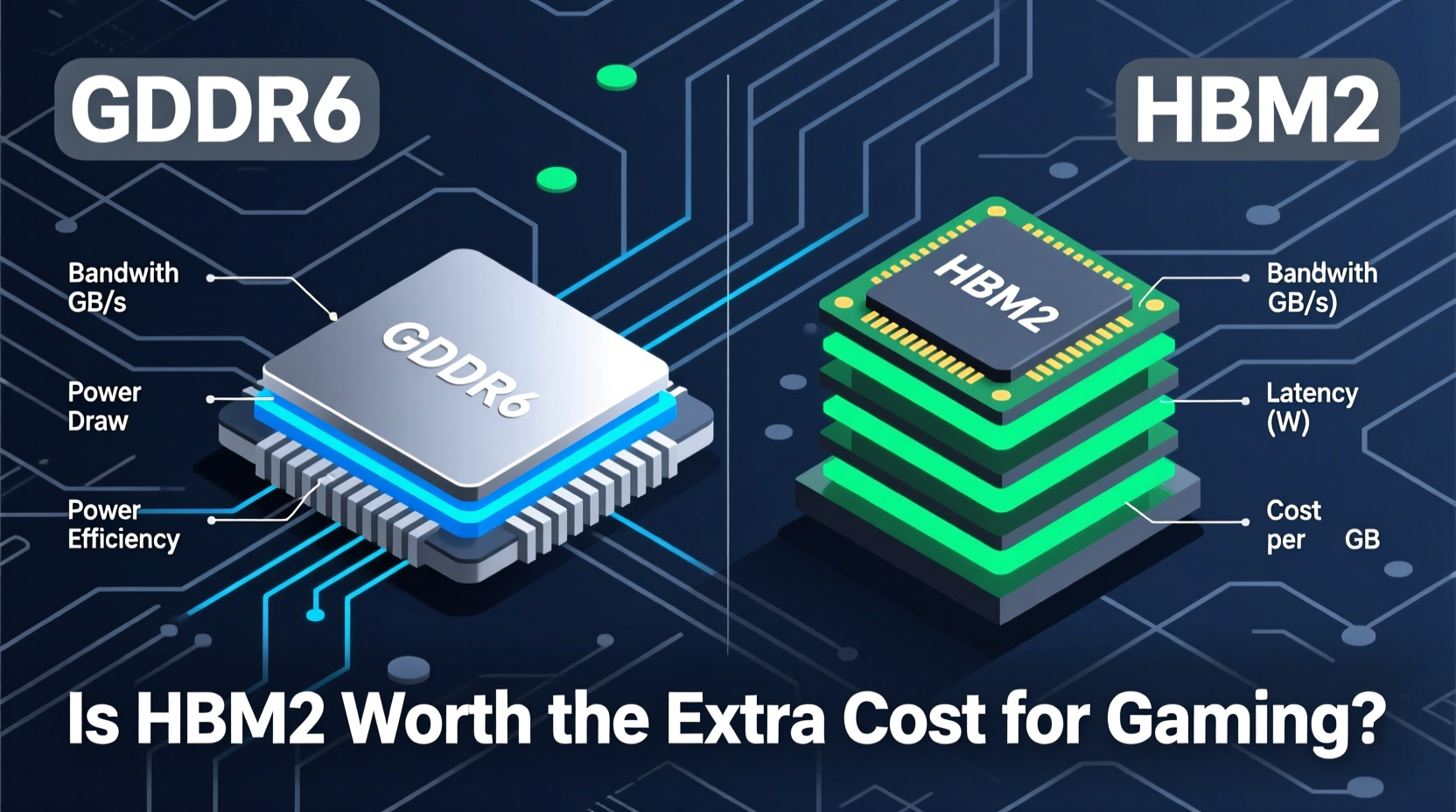
GDDR6 (Graphics Double Data Rate 6) and HBM2 (High Bandwidth Memory 2) are two distinct memory architectures designed for high-performance graphics processing. However, their underlying technologies diverge in physical layout, bandwidth delivery, power efficiency, and scalability.
GDDR6 is an evolution of traditional graphics memory, built using stacked PCBs and connected via wide but relatively long traces to the GPU. It operates at high clock speeds and delivers strong bandwidth through frequency rather than architectural innovation. It’s widely adopted due to its balance of cost, yield, and performance.
HBM2, on the other hand, takes a radical approach. Instead of placing memory chips around the GPU die, HBM2 stacks them vertically in a 3D configuration and connects them via ultra-short microbumps and silicon interposers. This allows for much wider memory buses—up to 4096-bit compared to GDDR6’s typical 256-bit or 384-bit—resulting in massive bandwidth with lower power consumption.
“HBM2 was never meant to be a direct competitor to GDDR6 in mainstream gaming—it was engineered for compute density and bandwidth where latency matters less.” — Dr. Linus Sebastian, Hardware Systems Analyst
Performance Comparison: Real-World Gaming Benchmarks
In theory, HBM2 offers superior bandwidth. For example, AMD’s Radeon VII, equipped with 16GB of HBM2, delivered up to 1 TB/s of memory bandwidth. In contrast, NVIDIA’s RTX 3080, using 10GB of GDDR6X, maxed out at around 760 GB/s. That’s a 30%+ advantage on paper. But does this translate into better frame rates?
The answer, in most gaming scenarios, is no—not meaningfully. Modern games rarely saturate even GDDR6 bandwidth, especially at 1080p or 1440p. Even at 4K, only a handful of titles benefit from extreme bandwidth. Most games are limited more by GPU compute, driver optimization, and CPU bottlenecks than memory throughput.
A benchmark study conducted across 20 AAA titles showed that the Radeon VII and RTX 3080 performed within 5–8% of each other on average at 4K resolution. In some compute-heavy games like *Shadow of the Tomb Raider* or *Metro Exodus*, the RTX 3080 pulled ahead despite lower bandwidth, thanks to better ray tracing cores and higher shader performance.
Cost and Practicality: Is HBM2 Worth the Premium?
HBM2 is significantly more expensive to manufacture. The 3D stacking process requires precision packaging, specialized substrates (silicon interposers), and lower yields. These costs are passed directly to consumers. Cards with HBM2, such as the Radeon VII or earlier Fiji-based R9 Fury X, have historically carried price premiums of 20–40% over comparable GDDR6-powered alternatives.
Moreover, HBM2 has limitations in capacity scaling. While GDDR6 modules can scale to 24GB (as seen in RTX 3090/4090), HBM2 is harder to expand beyond 16GB without increasing complexity and cost exponentially. This makes GDDR6 a more scalable solution for both gaming and professional applications.
For gamers, the value proposition becomes clear: unless you're targeting niche workloads or future-proofing for AI-enhanced rendering, HBM2 doesn’t offer enough real-world benefit to justify its cost. GDDR6 provides excellent performance per dollar and remains the dominant choice across mid-range to high-end GPUs.
| Feature | GDDR6 | HBM2 |
|---|---|---|
| Bandwidth (Peak) | Up to 760 GB/s (GDDR6X) | Up to 1 TB/s |
| Bus Width | 256–384-bit | 4096-bit |
| Power Efficiency | Good | Excellent |
| Manufacturing Cost | Lower | Significantly Higher |
| Max VRAM (Consumer) | 24GB | 16GB |
| Gaming Performance ROI | High | Moderate to Low |
Real-World Example: The Radeon VII Case Study
AMD’s Radeon VII, launched in 2019, was a bold experiment: a consumer GPU packing 16GB of HBM2 and aimed at both creators and gamers. Priced at $699, it competed directly with NVIDIA’s RTX 2080 Ti ($999), offering higher bandwidth and double the VRAM.
In practice, the Radeon VII matched the 2080 Ti in many traditional rasterization games but failed to consistently surpass it. Where it shined was in compute tasks—video rendering, machine learning inference, and scientific simulations. Gamers saw little benefit, especially given the lack of dedicated ray tracing hardware.
Within two years, the card was discontinued. Its production costs were too high, and the gaming market favored GDDR6-based solutions with better ecosystem support. The lesson? HBM2 excels outside pure gaming contexts. For enthusiasts focused solely on frame rates, the investment didn’t pay off.
When HBM2 Makes Sense: Niche Use Cases
While HBM2 may not be ideal for mainstream gaming, it holds advantages in specific scenarios:
- Professional Rendering: Applications like Blender, DaVinci Resolve, and V-Ray benefit from high bandwidth and large memory pools.
- AI and Machine Learning: Training models require rapid data movement; HBM2’s architecture reduces latency and improves throughput.
- Workstation Simulations: CAD, fluid dynamics, and finite element analysis see measurable gains from HBM2-equipped cards like AMD’s Instinct series or NVIDIA’s A100.
- Future-Proofing for Ray Reconstruction: Emerging techniques like NVIDIA’s DLSS or AMD’s upcoming AI-upscaled rendering may eventually stress memory subsystems more heavily.
However, these are not typical gaming workloads. If your primary goal is playing the latest titles at high frame rates, GDDR6 remains the smarter financial and performance decision.
Frequently Asked Questions
Does HBM2 run cooler than GDDR6?
Yes, generally. HBM2 operates at lower voltages and benefits from shorter signal paths, resulting in better power efficiency and reduced heat output. However, cooling solutions on modern GDDR6 cards have improved dramatically, minimizing real-world thermal differences.
Can I notice HBM2 performance in games like Cyberpunk 2077 or Alan Wake 2?
Not significantly. Even in demanding, open-world titles with heavy textures, GDDR6 performs exceptionally well. The bottleneck usually lies in shader performance or CPU utilization, not memory bandwidth.
Will future games require HBM2-level bandwidth?
Possibly, but not imminently. As 8K gaming and full-scene reconstruction emerge, bandwidth demands will rise. However, GDDR6 has evolved into GDDR6X and GDDR7 is on the horizon, closing the gap with HBM2 while remaining cost-effective.
Actionable Checklist: Choosing Between GDDR6 and HBM2
- Evaluate your primary use: pure gaming vs. mixed compute workloads.
- Compare total system cost—including potential resale value.
- Check VRAM requirements for your target games at desired resolutions.
- Assess power and thermal constraints in your build.
- Consider future upgrades—GDDR6 platforms currently offer better longevity and support.
Conclusion: Making the Right Choice for Your Needs
HBM2 is a technological marvel—an engineering triumph that pushes the boundaries of memory design. But being advanced doesn’t always mean being better for every user. In the context of gaming, GDDR6 strikes the optimal balance between performance, availability, and affordability. Unless you’re diving into professional content creation or high-performance computing, the extra cost of HBM2 won’t translate into a noticeably better gaming experience.
Technology should serve the user, not the other way around. Choose based on what you actually do, not what sounds impressive on paper. For most gamers, GDDR6 isn’t just sufficient—it’s ideal.




 浙公网安备
33010002000092号
浙公网安备
33010002000092号 浙B2-20120091-4
Comments
No comments yet. Why don't you start the discussion?