
Walk into any modern living room featured in a design magazine, and you’ll likely see a sofa layered with an array of throw pillows—some bold and geometric, others smooth and solid. The arrangement appears effortless, yet carefully curated. This raises a common question among homeowners and interior enthusiasts alike: Does mixing geometric and solid pillows truly elevate a space, or is it merely a stylistic trend without substance? The answer isn’t binary. It hinges on execution, balance, and an understanding of design fundamentals.
Pattern mixing has long been celebrated as a hallmark of confident decorating. But when applied incorrectly, it can result in visual chaos rather than cohesion. This article explores the interplay between geometric and solid pillows, evaluates whether combining them genuinely enhances a couch, and separates enduring design principles from fleeting myths.
The Visual Psychology of Pattern and Texture
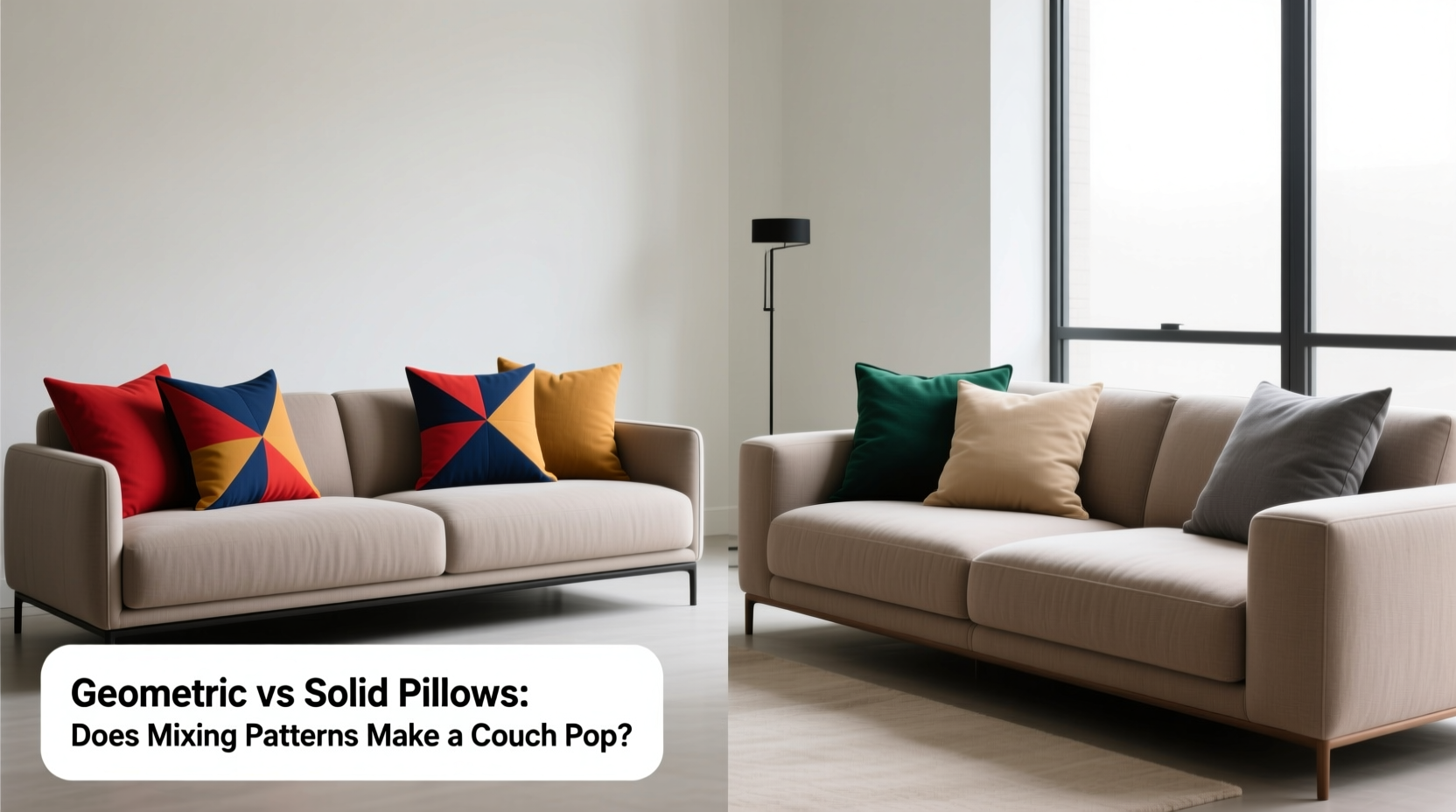
Before assessing whether pattern mixing “makes a couch pop,” it’s essential to understand how our eyes process visual stimuli in a room. Patterns, especially geometric ones, draw attention through repetition, symmetry, and contrast. They act as focal points. Solids, by contrast, provide breathing room—neutral zones that allow the eye to rest.
When used together, geometric and solid pillows create a dynamic rhythm. The geometric pieces inject energy; the solids ground the composition. This push-and-pull mimics natural visual flow, much like how a landscape balances dense forests with open fields.
“Pattern mixing isn’t about randomness—it’s about creating visual conversation. A solid pillow next to a geometric one isn’t just decoration; it’s punctuation in a sentence.” — Lena Torres, Interior Design Consultant, New York
The key lies in proportion. Experts recommend a 60-30-10 rule for successful layering: 60% solid (base colors), 30% secondary pattern (like geometrics), and 10% accent (texture, sheen, or bold contrast). This ratio ensures harmony without monotony.
Geometric vs Solid: Strengths and Use Cases
Each type of pillow serves a distinct purpose in design. Understanding their individual strengths helps determine when—and how—to mix them effectively.
| Type | Visual Impact | Best For | Common Pitfalls |
|---|---|---|---|
| Geometric Pillows | High contrast, directional movement | Drawing attention, adding modern flair | Overpowering small spaces, clashing if scale isn’t matched |
| Solid Pillows | Calm, unifying presence | Creating cohesion, supporting bolder elements | Blandness if overused, lack of interest |
Geometric patterns—such as chevrons, herringbone, or abstract tessellations—are inherently active. They work best when anchored by larger fields of solid color. Conversely, solid pillows lose impact when surrounded only by other solids. Introducing one well-placed geometric piece can instantly “wake up” an otherwise flat arrangement.
A Step-by-Step Guide to Mixing Geometric and Solid Pillows
Mixing patterns successfully isn’t guesswork. Follow this sequence to achieve a polished, intentional look:
- Start with your sofa and wall colors. Determine the dominant hues in your space. Choose solid pillows that either match or complement these tones.
- Select a geometric pattern that shares at least one color with your solids or upholstery. This creates continuity.
- Vary the scale of the geometric print. Pair a large-scale stripe with a smaller diamond pattern to avoid visual competition.
- Incorporate texture. Use materials like velvet, linen, or bouclé on solid pillows to add depth without introducing more patterns.
- Arrange in odd numbers. Groups of three or five feel more natural than even pairs. Place geometric pillows at the ends or center, depending on desired emphasis.
- Step back and assess. View the couch from across the room. If one pillow dominates too aggressively, swap it out.
Real Example: Transforming a Beige Sofa
Consider Sarah, a homeowner in Portland, who struggled with a neutral-toned sectional that felt lifeless. She initially added three identical beige pillows—safe, but dull. After consulting a local designer, she replaced them with two charcoal-gray linen solids and one navy-and-white triangular print pillow.
The change was subtle but transformative. The geometric pillow drew the eye without overwhelming the space. The solids provided a grounding effect, making the pattern appear intentional rather than chaotic. Friends began commenting on how “stylish” her living room looked—proof that thoughtful layering influences perception.
This wasn’t magic. It was strategic use of contrast, color alignment, and balance. The geometric pillow didn’t “pop” on its own—it popped because the solids allowed it to.
Debunking the Myth: Does Mixing Always Work?
The idea that “mixing patterns makes a couch pop” is not universally true. It becomes a myth when applied without context. In poorly executed attempts, mismatched scales, conflicting color temperatures, or excessive variety create visual noise instead of vibrancy.
For instance, pairing a bright zigzag pillow with a floral print and a polka-dot piece—even if all are geometric—can overwhelm. The absence of a unifying element breaks cohesion. Similarly, placing a high-contrast geometric pillow on a busy patterned sofa defeats the purpose.
The truth is, mixing works when guided by intention. It’s not the act of combining patterns that creates impact—it’s doing so with restraint, rhythm, and awareness of the whole room’s aesthetic.
Checklist: Is Your Pillow Mix Working?
- ✅ Do your geometric and solid pillows share at least one common color?
- ✅ Is there a clear visual hierarchy (e.g., one standout pillow, others supportive)?
- ✅ Are textures varied to add depth without relying solely on color or pattern?
- ✅ Does the arrangement look balanced from a distance?
- ✅ Have you avoided using more than two different patterns at once?
- ✅ Do the pillow sizes vary slightly (e.g., 18” and 20”) for organic layering?
Frequently Asked Questions
Can I mix geometric pillows with non-geometric patterns?
Yes, but with caution. Pairing a geometric print with a subtle organic pattern (like small-scale foliage) can work if they share a color palette and differ significantly in scale. Avoid combining multiple busy patterns unless separated by solid buffers.
How many geometric pillows should I use per couch?
Generally, one to two is sufficient for most sofas. A three-seater typically accommodates three pillows; use one geometric and two solids. Larger sectionals may support two geometric pieces, placed strategically at opposite ends or angles.
Are solid pillows boring?
Not at all. Solid pillows are foundational. Their value lies in versatility and calm. When crafted in rich fabrics like wool, silk, or textured cotton, solids contribute tactile interest that rivals visual pattern. Think of them as the supporting cast that lets the lead shine.
Conclusion: Beyond the Myth, Toward Mastery
The belief that mixing geometric and solid pillows automatically makes a couch pop is both true and false—it depends on execution. Like any design principle, it only succeeds when rooted in balance, color theory, and spatial awareness. Used wisely, the contrast between structured geometry and serene solids adds depth, personality, and sophistication to a living space.
Instead of chasing trends, focus on intentionality. Let each pillow serve a purpose. Anchor bold patterns with calming solids. Respect scale and color. And remember: the goal isn’t to follow rules blindly, but to understand them deeply enough to bend them with confidence.




 浙公网安备
33010002000092号
浙公网安备
33010002000092号 浙B2-20120091-4
Comments
No comments yet. Why don't you start the discussion?