
In the evolving world of digital commerce, the idea of attaching verifiable proof to gifts has gained traction. Retailers, tech startups, and sustainability advocates are pushing innovations like blockchain-based gift receipts and encrypted QR codes as solutions to reduce waste, prevent fraud, and enhance post-purchase flexibility. But while these technologies promise transparency and control, a critical question remains: Do recipients actually care?
The answer isn’t straightforward. While digital proof offers tangible benefits—like easier returns, exchanges, or resale—it only matters if the end user values it. Understanding recipient behavior, technological accessibility, and practical utility is essential before businesses invest heavily in one solution over another.
The Rise of Digital Gift Receipts
Traditional paper receipts are increasingly seen as outdated, wasteful, and insecure. They can be lost, damaged, or used for unauthorized returns. As e-commerce grows, so does the demand for digital alternatives that offer better security and usability.
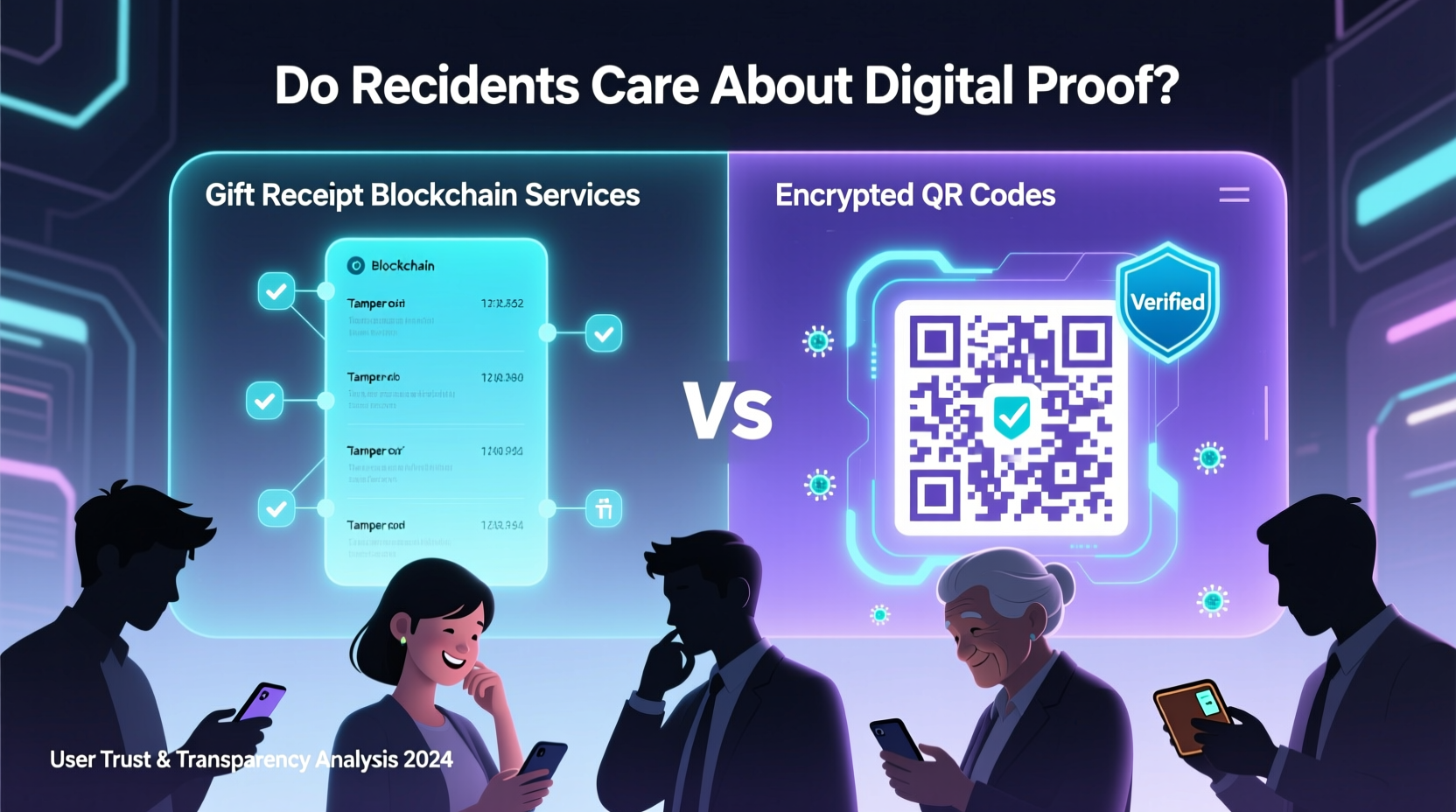
Digital gift receipts aim to solve this by replacing paper with secure, trackable data. Two primary models have emerged: blockchain-based systems and encrypted QR codes. Both claim to provide tamper-proof proof of purchase, but they differ significantly in infrastructure, scalability, and user experience.
Blockchain-Based Gift Receipts: Trust Through Decentralization
Blockchain technology promises immutability, transparency, and decentralization. Applied to gift receipts, it means each transaction is recorded on a distributed ledger, making it nearly impossible to alter or forge.
For example, a luxury brand might issue a non-fungible token (NFT) representing a gift purchase. This NFT contains metadata such as item description, price, date, and sender information. The recipient receives a wallet link or app notification, allowing them to view, exchange, or resell the item using the embedded digital proof.
Advocates argue this creates a new layer of trust. Since blockchain records are time-stamped and cryptographically secured, there's no ambiguity about ownership or authenticity. It also opens doors for secondary markets—imagine receiving a designer handbag as a gift and later selling it with verified provenance.
“Blockchain doesn’t just digitize the receipt; it redefines ownership in the digital age.” — Dr. Lena Patel, Fintech Research Lead at MIT Media Lab
However, adoption barriers remain high. Recipients must understand how to access and manage digital wallets, navigate private keys, and trust unfamiliar platforms. For many, especially older demographics, this complexity outweighs any perceived benefit.
Encrypted QR Codes: Simplicity Meets Security
Encrypted QR codes offer a more pragmatic approach. Instead of relying on decentralized networks, they embed encrypted purchase data into a scannable code. This can be printed on a card, emailed, or displayed in an app.
When scanned, the QR code decrypts via a secure server, revealing details like product info, return window, and exchange options. Unlike public blockchains, access is permissioned—only authorized parties (sender, recipient, retailer) can unlock the data.
This model excels in usability. No wallet setup, no crypto jargon. Just point a phone camera, scan, and view. Retailers like Nordstrom and John Lewis have tested QR-based digital receipts with positive feedback, particularly during holiday seasons when return traffic spikes.
Security depends on encryption strength and backend safeguards. If poorly implemented, QR codes could be reverse-engineered or cloned. But with modern AES-256 encryption and short-lived tokens, risks are minimal compared to lost paper receipts.
Comparative Analysis: Blockchain vs. Encrypted QR Codes
| Feature | Blockchain Services | Encrypted QR Codes |
|---|---|---|
| Data Immutability | High – once recorded, cannot be altered | Moderate – relies on server integrity |
| User Accessibility | Low – requires technical literacy | High – works with standard smartphone cameras |
| Implementation Cost | High – needs infrastructure & integration | Low – compatible with existing POS systems |
| Scalability | Moderate – network congestion can slow transactions | High – instant generation and distribution |
| Recipient Control | Full – self-custody of digital asset | Limited – controlled by issuing platform |
| Sustainability | Variable – some blockchains consume high energy | High – minimal environmental footprint |
The table reveals a fundamental trade-off: blockchain offers superior security and autonomy at the cost of complexity, while QR codes deliver simplicity and broad compatibility with slightly less decentralization.
Do Recipients Actually Care About Digital Proof?
This is the pivotal question. All the innovation in the world means little if users don’t engage.
Recent consumer surveys suggest mixed sentiment. A 2023 PwC study found that 62% of millennials and Gen Z respondents appreciated digital proof for high-value items (e.g., electronics, jewelry), citing easier returns and resale potential. However, only 28% of Baby Boomers expressed interest, with most preferring traditional cards or handwritten notes.
Context also matters. In a gift setting, emotional value often outweighs logistical convenience. Receiving a smartwatch with a blockchain receipt may feel impressive, but if the recipient simply wants to use it—not return or verify it—the feature goes unused.
Moreover, privacy concerns linger. Some consumers are wary of digital trails linking purchases to identities. A blockchain record, while secure, is permanent. An encrypted QR code tied to an email address raises similar questions about data retention.
“I got a gift with a ‘digital certificate’ on Ethereum. I had no idea what to do with it. Ended up just using the item and ignoring the rest.” — Sarah Lin, 34, Seattle
This disconnect between technological capability and user behavior highlights a key insight: digital proof must serve a clear, immediate need to gain traction.
Mini Case Study: The Luxury Watch Gifter
Mark, a 42-year-old executive in London, bought his wife a limited-edition Omega watch for their anniversary. He opted for a blockchain-backed gift receipt offered by the retailer, believing it would add long-term value.
The process was smooth: after purchase, he received a link to a digital vault where the NFT receipt was stored. He forwarded it to his wife along with a personalized message.
She appreciated the gesture but admitted confusion. “I didn’t know if I needed to download an app or keep a password. I just wanted to wear the watch.” Over time, she accessed the receipt twice—once to confirm authenticity when insuring the piece, and again when considering resale two years later.
While the blockchain receipt proved useful eventually, its initial utility was low. A simpler system—like a password-protected QR code linked to customer service—might have achieved the same outcome with less friction.
Actionable Tips for Retailers and Givers
- Educate gently: Don’t assume digital literacy. Use plain language to explain how to access and use the receipt.
- Offer choice: Let givers select between QR code, blockchain, or no digital proof based on the recipient’s tech comfort level.
- Focus on utility: Highlight concrete benefits—“Easy returns within 90 days,” “Resale-ready with proof”—not technical specs.
- Ensure mobile-first design: Most users will access digital proof via smartphones. Optimize for speed, readability, and minimal steps.
- Respect privacy: Allow recipients to delete or anonymize data after use, especially for sensitive purchases.
Step-by-Step Guide: Choosing the Right Digital Proof Method
- Assess the recipient’s tech familiarity: Are they comfortable with apps, logins, or cryptocurrency concepts?
- Evaluate the gift’s value and purpose: High-ticket or collectible items may justify blockchain; everyday gifts suit QR codes.
- Check retailer support: Confirm whether the seller offers both options and which integrates best with their return policy.
- Test the delivery method: Send yourself a sample to ensure the link or QR code works across devices.
- Add a personal note: Embed the digital proof in a thoughtful message to soften the technical aspect.
- Follow up if needed: If the gift involves setup (e.g., wallet creation), offer help without pressure.
FAQ
Can encrypted QR codes be forged?
While no system is 100% immune, modern encrypted QR codes use dynamic tokens and server-side validation to prevent duplication. Each scan can be logged, and access revoked if suspicious activity is detected.
Is blockchain overkill for gift receipts?
Often, yes. Unless the item has long-term collectible value or requires verifiable provenance (e.g., art, watches), simpler solutions like encrypted QR codes provide sufficient security with far better usability.
Do digital receipts help reduce environmental impact?
Yes. Eliminating paper reduces waste and carbon footprint. Digital methods also cut down on reprinting lost receipts and streamline return logistics, further lowering emissions from shipping and processing.
Conclusion: Balancing Innovation With Real-World Needs
Blockchain services and encrypted QR codes both represent progress in how we handle gift receipts. One offers unmatched security and permanence; the other delivers seamless accessibility and broad compatibility. Yet neither succeeds without considering the human element.
Recipients care about digital proof—but only when it enhances their experience, not complicates it. For most, the ideal solution is invisible: secure, easy to use, and immediately helpful when needed. That doesn’t require cutting-edge cryptography; it requires empathy.
Retailers and givers should resist the temptation to default to the most advanced option. Instead, match the technology to the recipient’s needs. Sometimes, the best digital proof is one that feels effortless—one that proves its worth not through technical brilliance, but through quiet reliability.




 浙公网安备
33010002000092号
浙公网安备
33010002000092号 浙B2-20120091-4
Comments
No comments yet. Why don't you start the discussion?