
When crafting delicate ornaments, miniature dioramas, wearable art, or architectural models, lighting isn’t just decorative—it’s structural storytelling. A single misplaced bulb can overwhelm fine details; excessive heat can warp resin, melt thin plastics, or discolor paper. Two lighting solutions dominate this niche: flexible glow wire (often called “electroluminescent wire” or EL wire) and low-voltage LED string lights. But their similarities—soft light, bendability, low power—are superficial. Under the surface, they behave like entirely different materials with distinct physical, electrical, and ergonomic properties. Choosing wrongly means compromised precision, wasted time, or even ruined work. This isn’t about preference—it’s about material compatibility.
Core Differences: Physics, Not Just Aesthetics
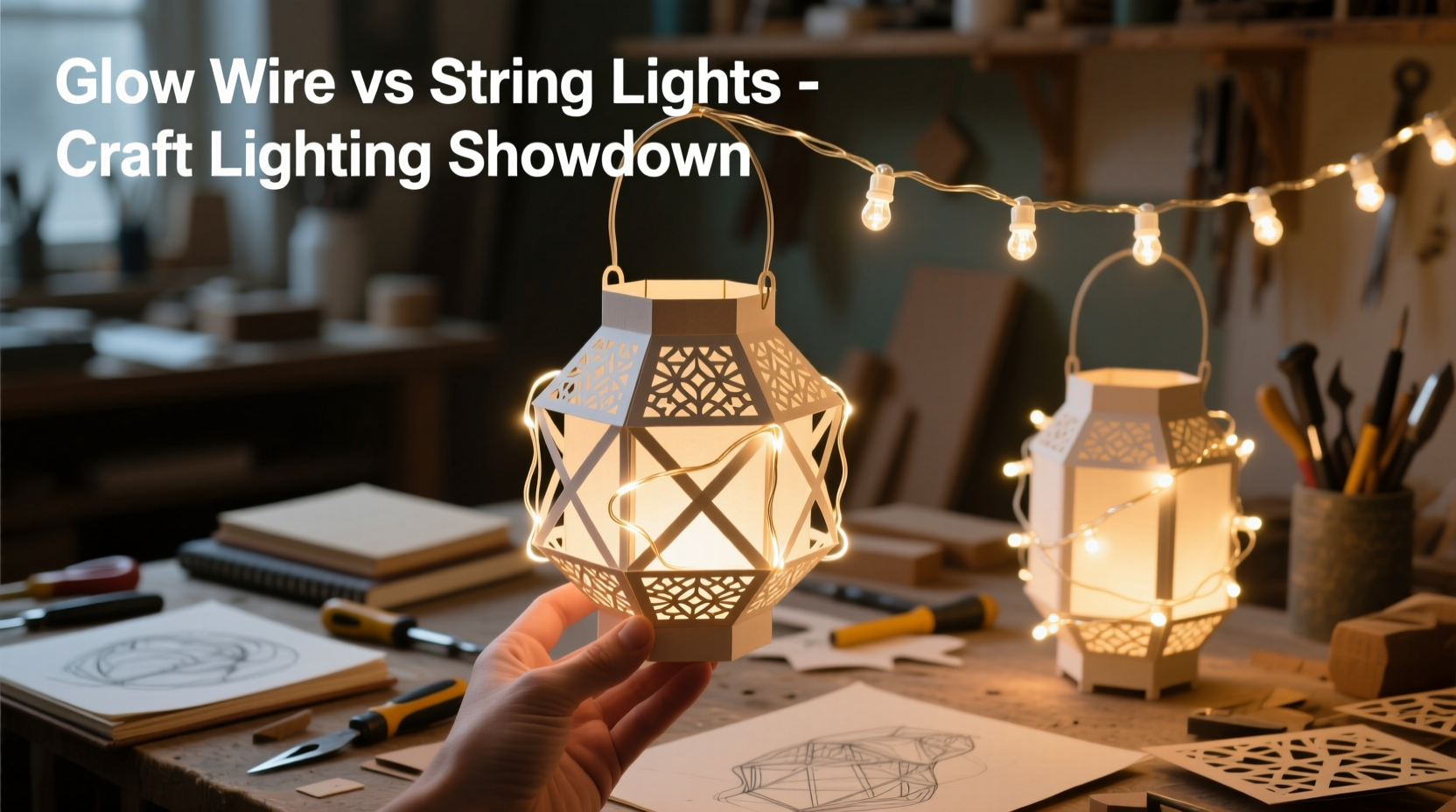
Glow wire and string lights operate on fundamentally different principles—and those differences dictate how they interact with craft substrates, tools, and human hands.
Glow wire is a coaxial cable: a copper core wrapped in phosphor powder, encased in a transparent conductive layer and protective PVC sheath. When alternating current (typically 90–120V AC at 1–2 kHz) is applied, the phosphor emits light uniformly along its entire length. It produces cool, diffuse, 360° omnidirectional illumination with zero heat emission—even after hours of operation. Its flexibility is intrinsic: it bends freely without kinking, memory, or resistance, and holds curves when secured with thread, glue, or micro-clips.
String lights, even the thinnest micro-LED varieties, consist of discrete point sources spaced along insulated copper wire. Each LED emits directional light from a tiny semiconductor chip. While modern versions use flexible silicone jackets and ultra-thin wires (as thin as 0.3mm), they still rely on soldered connections, rigid PCB segments, and thermal management that generates measurable warmth—especially at higher brightness settings or in confined spaces.
This distinction explains why one craftsperson might spend three hours painstakingly coiling glow wire into a lifelike dragon’s spine only to have it glow evenly and stay cool, while another tries the same with micro-string lights and ends up with hotspots, dead LEDs where the wire was bent too tightly, and visible gaps between bulbs that break the illusion.
Performance Comparison: What Matters in Real Craft Work
| Feature | Glow Wire | Micro-LED String Lights |
|---|---|---|
| Bend Radius | 0.5 cm minimum—holds sharp curves, tight spirals, and nested loops without stress or failure | 1.8–3 cm minimum—repeated tight bends risk cracking solder joints or damaging internal wiring |
| Heat Output | None detectable (0°C rise after 8+ hours) | Noticeable warmth (up to 35–45°C at full brightness in enclosed spaces) |
| Light Uniformity | Perfectly continuous—no dots, no gaps, no variation in intensity along length | Discrete points—visible spacing (2–5 cm typical); “strobe” effect in motion-sensitive applications like kinetic sculptures |
| Cut & Customize | Can be cut anywhere with scissors; ends sealed with heat-shrink tubing and reconnected via solderless crimp connectors | Only cuttable at marked intervals (usually every 3 LEDs); requires soldering and waterproofing for each cut end |
| Voltage Safety | Requires inverter (9–12V DC input → high-frequency AC output); inverter itself is safe to handle; wire carries no shock hazard | Typically runs on 5–12V DC; safe voltage, but exposed copper pads or damaged insulation pose short-circuit risks near conductive materials (metal armatures, foil, wet clay) |
| Color Consistency | Single-color per strand; color shift minimal across length and over time (phosphor aging is slow and uniform) | Individual LEDs may vary slightly in hue/brightness; batch inconsistencies common; blue/white LEDs dim faster than red/green |
The table reveals a pattern: glow wire excels where continuity, thermal neutrality, and mechanical forgiveness are non-negotiable. String lights win where localized brightness control, color mixing, or programmable effects (fading, chasing) are required—and where the craft allows for strategic placement around, not through, delicate elements.
Real-World Craft Scenarios: When Each Solution Wins
A Miniature Steampunk Clock (Case Study)
Maria, a prop maker specializing in museum-quality miniatures, built a 1:12 scale brass-and-gear clock for a film set. The challenge? Illuminating the inner gear train without casting shadows or heating the thin laser-cut brass plates (0.3mm thick). She first tried 1.5mm micro-LED string lights, threading them behind gears. Within 20 minutes, two LEDs failed at bend points, and infrared thermography showed localized 38°C hotspots near the escapement wheel—enough to soften the acrylic lubricant she’d used. She switched to 2.3mm EL glow wire, cutting and coiling it into custom arcs that followed gear profiles. Using needle-nose tweezers and archival PVA glue, she embedded the wire *into* recessed grooves milled into the brass. The result: even, cool, shadow-free illumination that remained stable for 72 hours of continuous filming. No recalibration. No thermal distortion. “It behaved like a drawing tool,” she said, “not a circuit.”
Step-by-Step: Installing Glow Wire in a Paper Quilling Sculpture
- Select wire gauge: Use 1.2mm or 2.3mm EL wire for fine quilling (1.2mm fits inside 2mm paper coils; 2.3mm provides brighter output for larger pieces).
- Plan the path: Sketch light flow on your design—avoid crossing wires unless layered with spacers (thin cardstock strips prevent capacitive coupling).
- Cut & seal: Cut wire to exact length using sharp scissors. Slide 12mm heat-shrink tubing over each end before connecting. Apply heat evenly with a heat gun (not open flame).
- Secure without pressure: Use archival wheat starch paste or diluted PVA—not hot glue or epoxy—to adhere wire to paper. Press gently with a bone folder; let dry 30 minutes before powering.
- Power smartly: Use a battery-powered inverter (e.g., 3x AAA) for portability. For displays >4 hours, choose an inverter with auto-shutoff or dimming to extend phosphor life.
This process takes 12–18 minutes for a medium-complexity sculpture. Attempting the same with string lights would require drilling micro-holes for LED placement, managing wire slack, and risking paper burn during soldering—making it impractical for most paper-based work.
Expert Insight: Material Science Meets Craft Practice
“EL wire isn’t ‘just lighting’—it’s a dimensionally stable, thermally inert filament you can treat like embroidery floss or fine wire. Its real advantage isn’t brightness, but predictability. When I teach advanced paper engineering at RISD, we use it to validate structural integrity: if the wire stays lit after complex folding, the substrate hasn’t stressed beyond recovery.” — Dr. Lena Torres, Professor of Material-Based Design, Rhode Island School of Design
Dr. Torres’ observation cuts to the heart of the matter: intricate crafts demand materials that respond predictably to manipulation. Glow wire’s consistent flexural modulus (resistance to bending) and zero thermal expansion mean it doesn’t fight back during assembly. String lights introduce variables—microscopic solder fractures, voltage drop over length, inconsistent LED binning—that compound with each added element in multi-layered work.
What to Avoid: Critical Mistakes That Ruin Precision Projects
- Using standard EL inverters with long wire runs: Voltage drop causes dimming at the far end. For sculptures >3 meters, use a dual-inverter setup or segment the wire with inline connectors.
- Twisting multiple strands together: Creates capacitive coupling—strands may flicker or dim each other. Always separate with 1–2mm spacers or route in parallel channels.
- Exposing cut ends to humidity without sealing: Moisture ingress kills phosphor layers. Seal *both* ends—even unused ones—with UV-cured resin or marine-grade heat-shrink.
- Assuming all “micro” string lights are equal: Cheap variants use nickel-plated copper that oxidizes within days when embedded in acidic materials like untreated wood pulp or certain clays. Look for tinned-copper or silver-plated wire.
- Ignoring inverter noise: Some EL inverters emit audible 2–3 kHz whine. Test near your workspace—if sound matters (e.g., stop-motion sets), choose “silent” inverters or shield with foam-lined enclosures.
FAQ
Can I solder directly to glow wire?
No—and attempting it will destroy the phosphor layer and conductive coating. Glow wire requires specialized crimp connectors designed for coaxial EL construction. Soldering melts the internal structure. Always use manufacturer-recommended connectors and heat-shrink seals.
Do string lights work better for battery-operated wearable crafts?
Not inherently. While many micro-LED strings run on 3V coin cells, their efficiency drops sharply below optimal voltage—causing color shift and rapid dimming. High-quality EL wire with efficient inverters lasts 8–12 hours on the same batteries, with consistent output and zero thermal load against skin or fabric.
Is glow wire fragile under tension?
Yes—but only under sustained pull. It withstands gentle handling, pinching, and embedding, but shouldn’t serve as a structural support. Never hang heavy elements from it. For tension-bearing applications (e.g., suspended mobiles), integrate it alongside stainless steel wire or monofilament.
Conclusion: Choose by Constraint, Not Convention
There is no universal “better” option—only the right tool for the specific physical, thermal, and dimensional constraints of your craft. If your work involves tight curves, heat-sensitive materials (paper, silk, thin plastic, resin, dried botanicals), or requires seamless light flow across organic shapes, glow wire isn’t just preferable—it’s functionally necessary. Its ability to disappear into the form while illuminating it transforms light from an add-on into an integrated material property. String lights retain clear advantages where programmability, high-lumen output in small zones, or RGB color blending are central to the piece—and where the craft allows for mounting hardware, spacing, and thermal buffering. But for true intricacy—where millimeters matter and patience is measured in hours—the consistency, coolness, and compliance of glow wire deliver reliability no string light can match.




 浙公网安备
33010002000092号
浙公网安备
33010002000092号 浙B2-20120091-4
Comments
No comments yet. Why don't you start the discussion?