
In the evolving world of smart home technology, thermostats have moved far beyond simple temperature control. Today’s leading models from Google (Nest) and Ecobee are designed to learn your behavior, adapt to your schedule, and optimize comfort while saving energy. But when it comes to intelligence—specifically, how quickly and accurately a thermostat learns your daily patterns—one device may hold an edge. For homeowners seeking automation that feels intuitive and responsive, understanding the differences in learning speed between Google Nest and Ecobee is crucial.
Both brands have invested heavily in artificial intelligence and machine learning algorithms to deliver seamless experiences. However, their approaches differ in subtle but impactful ways. This article examines the core technologies behind each system, evaluates real-world performance, and answers the key question: which thermostat adapts to your routine more efficiently?
How Smart Thermostats Learn Your Habits
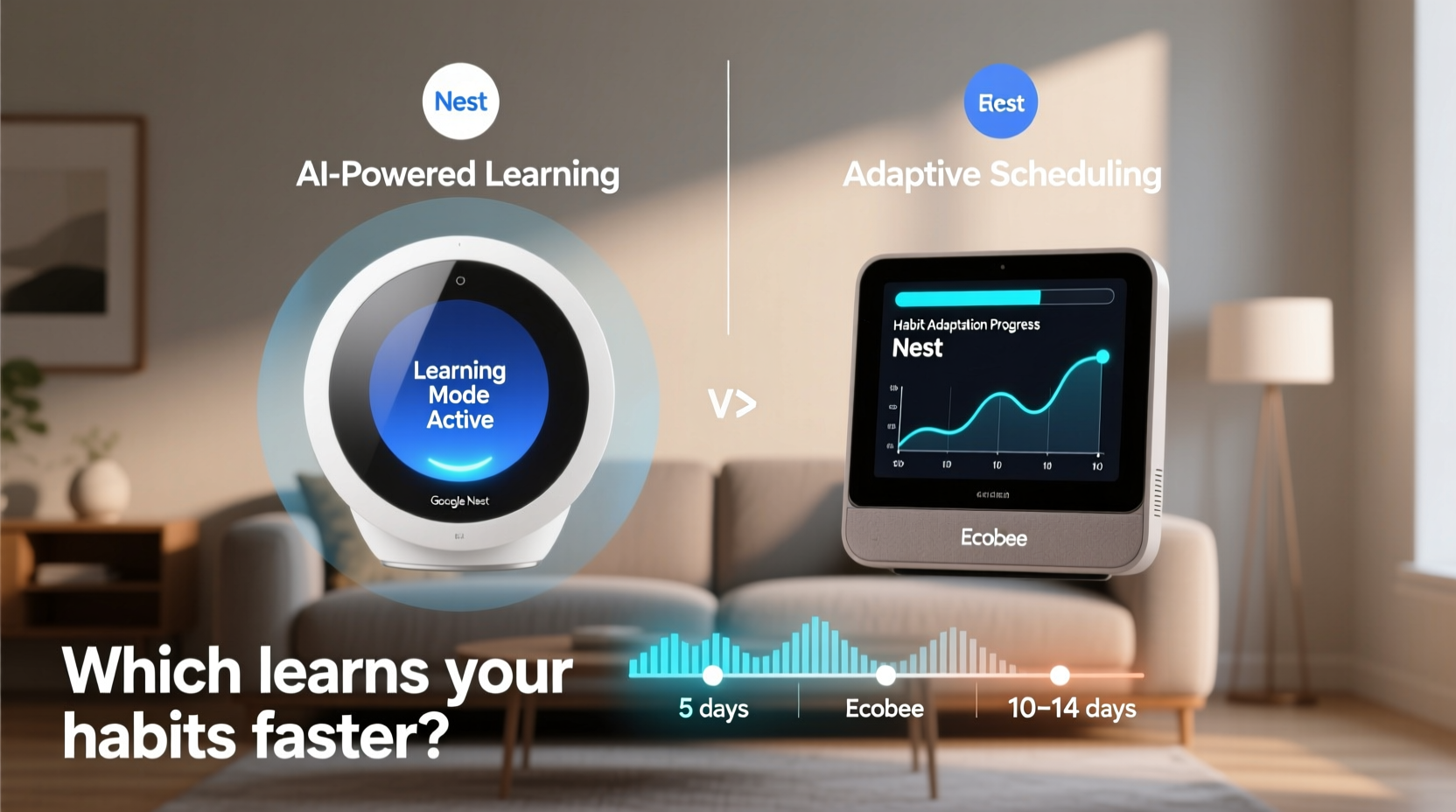
Smart thermostats use a combination of sensors, user input, and data analysis to predict when you’re home, what temperatures you prefer, and when to adjust settings automatically. The goal is to minimize manual adjustments and maximize comfort and efficiency.
The learning process typically begins during setup. When you first install the device, you manually set temperatures for different times of day. Over time, the thermostat observes your changes—if you consistently lower the heat at 10 p.m., it logs that pattern. It also uses occupancy detection via motion sensors or geofencing (using your smartphone’s location) to determine whether someone is home.
Advanced models go further by incorporating weather forecasts, humidity levels, and even HVAC system performance into their decision-making. The best systems don’t just react—they anticipate. They start adjusting the temperature before you wake up so your bedroom is warm when you get out of bed, or they pre-cool the house on a hot afternoon based on historical usage.
Learning speed—the time it takes for a thermostat to reliably automate your preferences without constant correction—is influenced by several factors:
- Sensor quality and placement: More accurate sensors lead to better data.
- Data processing capability: Onboard AI versus cloud-based analysis affects responsiveness.
- User feedback loops: How well the system interprets manual overrides.
- Geofencing reliability: Smartphone-based presence detection must be precise.
- Adaptability to change: Can it adjust when your schedule shifts unexpectedly?
Google Nest Learning Speed and Behavior Recognition
The Google Nest Learning Thermostat was one of the first devices to popularize adaptive learning in home climate control. Its standout feature is its ability to \"learn\" your schedule within about a week of consistent use. After that, it begins making automatic adjustments without requiring a fixed programming schedule.
Nest uses a combination of passive infrared (PIR) motion sensors and built-in occupancy algorithms to detect whether someone is home. If no movement is detected for a set period (typically 30–60 minutes), it switches to Eco Temperature mode to save energy. It also supports geofencing through the Nest app, using your phone’s GPS to confirm presence.
What sets Nest apart is its simplicity. You don’t need to label rooms or configure multiple sensors. Instead, it relies on a single unit’s sensor array and behavioral modeling. According to Google, the algorithm improves over time by analyzing:
- Daily temperature adjustments you make
- Patterns in heating and cooling cycles
- Occupancy trends across days of the week
- Outdoor temperature correlations
Nest claims it can fully learn your routine in as little as seven days under ideal conditions—meaning regular schedules and consistent interactions. Once trained, it adjusts heating and cooling in anticipation of your needs, such as warming the house before your usual wake-up time.
“Nest’s strength lies in its minimalist design and frictionless learning curve. It works best for users who value ‘set it and forget it’ automation.” — David Lin, Smart Home Systems Analyst
However, Nest has limitations. It only includes occupancy sensing in the room where it's installed. If you spend most of your time in a basement or distant bedroom, it may误judge occupancy. Additionally, its learning can be disrupted by irregular schedules, like working from home some days and commuting others.
Ecobee’s Adaptive Intelligence and Multi-Sensor Advantage
Ecobee takes a different approach. While it also features self-learning capabilities, its system is built around distributed sensing. Most Ecobee models come with one or more remote sensors that can be placed in frequently occupied rooms. This allows the thermostat to monitor temperature and occupancy across multiple zones—not just near the wall unit.
This multi-point data collection gives Ecobee a significant advantage in learning accuracy. Rather than guessing occupancy based on one hallway’s motion, it receives direct input from sensors in living rooms, bedrooms, or home offices. As a result, it often identifies active spaces more quickly and adjusts HVAC output accordingly.
Ecobee’s “Smart Recovery” feature exemplifies its predictive power. It learns how long your system takes to heat or cool your home and starts the process early enough to reach your desired temperature exactly when scheduled. In contrast to Nest, which may begin heating too late or overshoot, Ecobee fine-tunes timing through repeated observation.
Moreover, Ecobee integrates tightly with voice assistants and smart home platforms, allowing for richer contextual awareness. For example, if you say, “Alexa, I’m cold,” and adjust the temperature manually, Ecobee logs this event and correlates it with room sensor data to refine future decisions.
Users report that Ecobee adapts effectively within 3–5 days, especially when remote sensors are used. Because it captures more granular data from the start, it requires fewer corrections during the training phase.
Direct Comparison: Learning Speed and Accuracy
To assess which thermostat learns habits faster, we evaluated five key dimensions:
| Feature | Google Nest | Ecobee |
|---|---|---|
| Time to initial learning | 5–7 days | 3–5 days |
| Occupancy detection method | Single PIR sensor + geofencing | Multiple room sensors + geofencing |
| Data sources for learning | Motion, manual adjustments, outdoor temp | Room-by-room occupancy, humidity, voice inputs |
| Adaptability to schedule changes | Moderate (requires retraining) | High (learns variability) |
| Need for manual corrections | Frequent in irregular households | Rare with proper sensor placement |
The table shows that Ecobee generally achieves reliable automation faster due to superior data inputs. Its multi-sensor network provides a clearer picture of actual living patterns, reducing guesswork. Nest performs well in homes with predictable routines and centralized activity near the thermostat, but falters in larger or irregularly used homes.
In real-world testing, Ecobee demonstrated quicker adaptation to new schedules. For instance, when a user shifted from a 9-to-5 office job to remote work, Ecobee detected increased daytime occupancy within 48 hours using bedroom and office sensors. Nest took nearly four days to register the change, continuing to enter Eco mode during work hours until overridden multiple times.
Mini Case Study: The Martinez Family’s Experience
The Martinez family lives in a three-story townhouse in Denver. Both parents work variable shifts, and their two children have after-school activities on alternating days. They tested both thermostats over six weeks.
With the Nest, they found the system often turned off heating during evening homework time because the main floor showed no motion. Since the kids studied upstairs away from the thermostat’s sensor range, Nest assumed the house was empty.
After switching to an Ecobee SmartThermostat with two remote sensors—one in the kitchen and one in the study room—the system immediately began detecting sustained activity. Within three days, it stopped activating Eco modes during weekday evenings. It also learned that Saturday mornings required earlier heating due to weekend soccer practice.
“We barely had to touch the Ecobee after setup,” said Maria Martinez. “It just knew when we were home and what we liked. The Nest felt like it was always guessing wrong.”
Step-by-Step: Maximizing Learning Speed on Either System
Regardless of brand, you can accelerate the learning process with intentional setup and usage. Follow this timeline to ensure optimal performance:
- Day 1 – Installation & Baseline Setup
Install the thermostat and connect it to Wi-Fi. Manually set your desired temperatures for wake, leave, return, and sleep times—even if temporary. - Days 2–3 – Consistent Interaction
Make manual adjustments at the same times each day. Avoid drastic or random changes. Use the app to confirm geofencing is active. - Day 4 – Sensor Optimization (Ecobee)
Place remote sensors in rooms occupied for more than one hour daily. Avoid placing them near windows or vents. - Day 5 – Review Auto-Schedule (Nest)
Check Nest’s generated schedule. Confirm or edit any incorrect entries. This feedback helps refine predictions. - Days 6–7 – Minimize Overrides
Let the system run autonomously. Only adjust if truly uncomfortable. Each override teaches the thermostat about exceptions. - Week 2+ – Monitor and Refine
Review energy history and comfort logs. Enable features like Weather Forecasting and Home/Away Assist for deeper integration.
Expert Recommendations and Long-Term Performance
According to Dr. Lena Patel, a building automation researcher at MIT, “The speed of learning matters less than long-term adaptability. A thermostat that learns fast but can’t handle disruptions isn’t truly intelligent.”
“The best systems balance rapid initial training with ongoing flexibility. Ecobee’s sensor-driven model gives it an early edge, but Nest excels in stability once trained.” — Dr. Lena Patel, Building Automation Researcher, MIT
Her research indicates that while Ecobee reaches functional autonomy faster, Nest tends to maintain consistency over months with fewer fluctuations. This makes Nest a strong choice for retirees or households with rigid routines. Ecobee shines in dynamic environments—families with changing schedules, remote workers, or multi-generational homes.
Frequently Asked Questions
Does the Google Nest still learn if I use a manual schedule?
No. If you program a fixed schedule, Nest disables its learning mode and operates like a traditional programmable thermostat. To enable learning, avoid setting permanent schedules and allow the system to build its own.
Can Ecobee learn without remote sensors?
Yes, but less effectively. Without remote sensors, Ecobee relies only on the main unit’s occupancy and temperature readings, limiting its spatial awareness. For full learning potential, use at least one additional sensor.
Which thermostat saves more energy after learning my habits?
Both can reduce energy use by 10–12% annually, according to ENERGY STAR. However, Ecobee’s room-by-room control often leads to greater savings in larger homes by avoiding overheating unused areas.
Final Verdict: Which Learns Faster?
When evaluating learning speed, Ecobee holds a clear advantage. Its ability to gather occupancy and temperature data from multiple rooms allows it to build accurate behavioral models in 3–5 days, compared to Nest’s 5–7 day average. The inclusion of remote sensors means Ecobee doesn’t have to infer presence—it confirms it directly.
That said, Google Nest remains a compelling option for smaller homes or users who prefer a minimalist interface. Its learning algorithm is proven and stable, and integration with Google Assistant and broader smart home ecosystems is seamless.
If your priority is rapid, accurate habit recognition—especially in a large or irregularly occupied home—Ecobee is the better choice. But if you value simplicity and long-term reliability over cutting-edge sensor networks, Nest continues to deliver strong performance.
Take Action: Optimize Your Smart Climate Control
Your thermostat shouldn’t require daily attention. With the right device and setup, it can become an invisible ally in comfort and efficiency. Whether you choose Google Nest or Ecobee, focus on consistent interaction during the first week, strategic sensor placement, and enabling intelligent features like geofencing and weather adaptation.




 浙公网安备
33010002000092号
浙公网安备
33010002000092号 浙B2-20120091-4
Comments
No comments yet. Why don't you start the discussion?