
Choosing between flagship smartphones isn’t just about specs—it’s about real-world experience, longevity, and how well a device fits into your daily life. The Google Pixel 6 and Samsung Galaxy S21 represent two distinct philosophies in Android design: one rooted in pure software integration and AI-driven photography, the other in hardware versatility and premium build. For users considering a switch from Samsung to Pixel—or vice versa—the decision hinges on more than marketing claims. It’s about understanding where each phone excels and whether those strengths align with your priorities.
Design and Build: Simplicity vs. Refinement
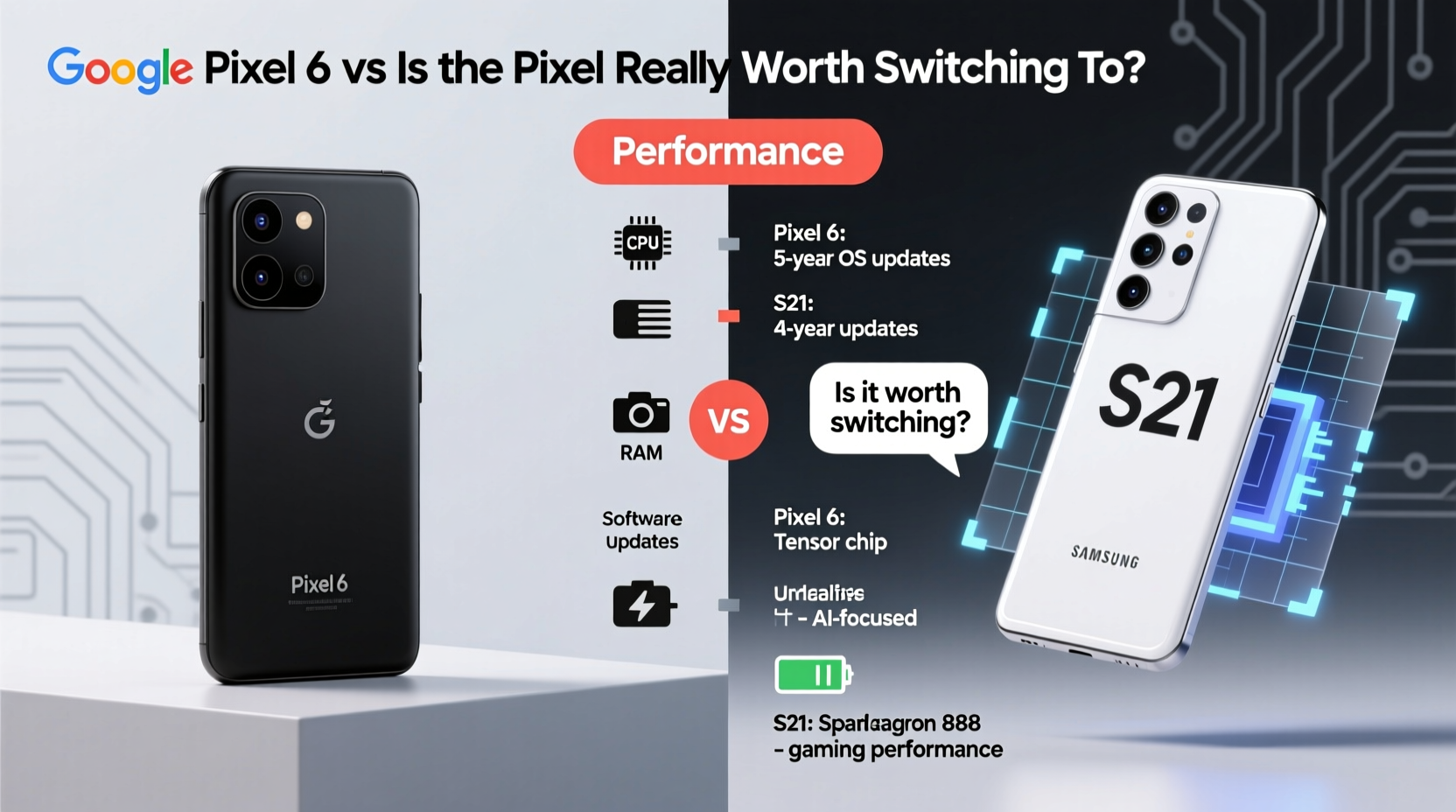
The Galaxy S21 leans into Samsung’s long-standing tradition of sleek, metallic designs with glass backs and contoured frames. Its Armor Aluminum frame and Gorilla Glass Victus offer solid drop resistance, while the subtle curve of the display enhances grip. At 169g, it’s lightweight and comfortable for prolonged use. The design, though familiar, remains polished and professional.
In contrast, the Pixel 6 embraces a bolder aesthetic. Its most striking feature is the horizontal camera bar spanning the back, which divides opinion but undeniably sets it apart. Constructed with an aluminum unibody and recycled materials, the Pixel 6 feels sturdy and eco-conscious. At 207g, it’s noticeably heavier than the S21, which may affect one-handed handling for some users.
Both phones are IP68-rated for dust and water resistance, ensuring durability in everyday scenarios. However, the S21 offers a slight edge in ergonomics, while the Pixel 6 stands out through distinctive design language that reflects Google’s growing confidence in hardware identity.
Display and Usability: Smoothness vs. Brightness
The Galaxy S21 features a 6.2-inch Dynamic AMOLED 2X display with a 120Hz adaptive refresh rate. This means smoother scrolling, faster touch response, and automatic adjustment between 48Hz and 120Hz depending on content—ideal for balancing performance and battery life. Peak brightness reaches around 1300 nits, making it highly visible even under direct sunlight.
The Pixel 6 uses a 6.4-inch OLED display with a flat 90Hz refresh rate. While still smooth, the lower refresh rate is perceptible when switching from a 120Hz screen. Brightness peaks at approximately 1000 nits—not bad, but less effective in extreme outdoor conditions. However, Google’s Natural Light and Reading Mode enhance eye comfort during extended use, particularly at night.
For media consumption and gaming, the S21’s higher refresh rate and superior brightness give it a tangible advantage. But the Pixel 6 compensates with excellent color calibration and software-tuned viewing experiences tailored to Google’s ecosystem.
Camera Performance: Computational Magic vs. Versatility
This is where the debate becomes most compelling. The Galaxy S21 boasts a triple-lens system: 12MP main, 64MP telephoto, and 12MP ultra-wide. It delivers consistent, vibrant photos with strong zoom capabilities up to 3x optical and 30x digital. Samsung’s processing favors saturation and clarity, appealing to users who want punchy social media-ready shots.
The Pixel 6 relies on a dual-camera setup: a 50MP main sensor and a 12MP ultra-wide. There’s no dedicated telephoto lens, but Google leverages its Tensor chip and computational photography to deliver exceptional results. Features like Magic Eraser, Face Unblur, and Real Tone ensure photos look natural across diverse skin tones—an area where Samsung has historically struggled.
“Google’s approach to photography isn’t about more lenses—it’s about smarter processing. The Pixel often captures better dynamic range and low-light detail without user intervention.” — David Kim, Mobile Imaging Analyst at DXOMARK
In low light, the Pixel 6 consistently produces cleaner, more balanced Night Sight images. HDR handling is also superior, preserving highlights and shadows without over-processing. While the S21 offers greater flexibility with zoom, the Pixel 6 wins in overall image consistency and post-capture editing tools.
Performance and Software: Stock Android vs. Feature-Rich Customization
The Pixel 6 runs on Google’s custom Tensor G1 chip—the first self-designed processor built specifically for machine learning and AI tasks. It powers real-time call screening, transcription, and voice typing with remarkable accuracy. Paired with stock Android, the experience is clean, fast, and free of bloatware. Updates arrive instantly, with guaranteed security patches for five years and OS upgrades until 2027.
The Galaxy S21 uses either the Exynos 2100 or Snapdragon 888 (depending on region), both powerful chips capable of handling demanding apps and games. However, Samsung’s One UI adds layers of customization, including DeX mode, multi-window support, and advanced privacy settings. While feature-rich, this can lead to slower update rollouts—typically three major Android upgrades instead of five.
If timely updates and minimal distractions matter, the Pixel 6 is unmatched. For users who rely on multitasking, Samsung DeX, or prefer granular control over their interface, the S21 remains a compelling choice.
Battery Life and Charging: Efficiency vs. Speed
| Feature | Google Pixel 6 | Samsung Galaxy S21 |
|---|---|---|
| Battery Capacity | 4,614 mAh | 4,000 mAh |
| Charging Speed | 21W wired, 20W wireless | 25W wired, 15W wireless |
| Estimated Daily Use | 1.2 days (moderate) | 1 day (moderate) |
| Fast Charging Support | Yes (requires compatible charger) | Yes (charger sold separately) |
The larger battery in the Pixel 6 translates to longer endurance, easily lasting a full day and a half with mixed usage. Adaptive Battery and on-device AI further optimize power consumption based on habits. The S21, while efficient, often requires daily charging under heavy loads, especially when using the 120Hz display.
However, Samsung supports faster peak charging speeds. With a 25W adapter, the S21 reaches 50% in about 30 minutes—slightly quicker than the Pixel 6. Wireless charging is marginally faster on the Pixel, but neither supports ultra-fast wireless standards found in higher-end models.
Mini Case Study: A Photographer Switches from S21 to Pixel 6
Lena, a travel photographer and long-time Samsung user, upgraded to the Pixel 6 after frustration with inconsistent low-light shots on her S21. She initially missed the 3x optical zoom but quickly adapted to using Super Res Zoom combined with Magic Eraser to remove photobombers from landscapes. Over three months, she found herself editing fewer photos thanks to the Pixel’s superior HDR and white balance accuracy. “I used to spend hours fixing colors,” she said. “Now I shoot and share. The time savings alone made the switch worthwhile.”
Checklist: Should You Switch to the Pixel 6?
- ✅ Prioritize clean, bloat-free software with fast updates
- ✅ Value computational photography over optical zoom
- ✅ Want longer software support (up to 5 years)
- ✅ Prefer a unique design with eco-friendly materials
- ✅ Need strong voice recognition and AI-powered assistant features
- ❌ Avoid if you rely heavily on DeX, dual messenger, or high-magnification zoom
Frequently Asked Questions
Can the Pixel 6 compete with the S21 in video recording?
The Pixel 6 records 4K video at 60fps with excellent stabilization and audio focus, but lacks the S21’s 8K recording capability. For most users, the difference is negligible—Pixel videos often look more natural due to better dynamic range and noise reduction.
Is stock Android really better than One UI?
It depends on preference. Stock Android offers simplicity, speed, and immediate updates. One UI provides deeper customization and productivity tools. Users who dislike preinstalled apps and prefer a minimalist interface typically favor Pixel.
Does the lack of a telephoto lens hurt the Pixel 6?
For casual zooming up to 5x, Super Res Zoom performs impressively. Beyond that, quality degrades faster than the S21’s hybrid zoom. If you frequently take distant shots (e.g., wildlife, concerts), the S21 remains the better option.
Final Verdict: Is the Pixel Really Worth Switching To?
The answer depends on what you value most. If you’re drawn to cutting-edge AI, unparalleled photo quality in challenging lighting, and a pure Android experience with long-term support, the Pixel 6 isn’t just worth switching to—it may redefine your expectations of what a smartphone can do.
But if you depend on Samsung-specific features like DeX, enjoy the flexibility of a high-zoom camera, or prefer a lighter, more refined design, the Galaxy S21 still holds its ground as a well-rounded flagship.
Ultimately, the Pixel 6 represents a shift toward intelligence over hardware excess. It proves that thoughtful software, ethical design, and seamless integration can outweigh raw spec sheets. For users ready to embrace a different kind of flagship—one built around usability rather than sheer power—the switch isn’t just justified. It’s refreshing.




 浙公网安备
33010002000092号
浙公网安备
33010002000092号 浙B2-20120091-4
Comments
No comments yet. Why don't you start the discussion?