
When it comes to smartphone photography, two names consistently dominate conversations: Google Pixel and Apple iPhone. The latest contenders—Pixel 8 and iPhone 15—have reignited the debate over which device captures life more faithfully. While marketing claims paint vivid pictures, real-world performance tells a different story. This isn’t just about megapixels or AI buzzwords; it’s about how each phone handles lighting, color accuracy, dynamic range, and usability in everyday scenarios.
The Pixel has long been celebrated for its computational photography prowess, while the iPhone is praised for its consistency and natural tone reproduction. But with both devices now featuring advanced hardware and intelligent processing, does the Pixel 8 still hold a decisive edge? Or has the iPhone 15 closed the gap?
Hardware Showdown: Sensors, Lenses, and Processing
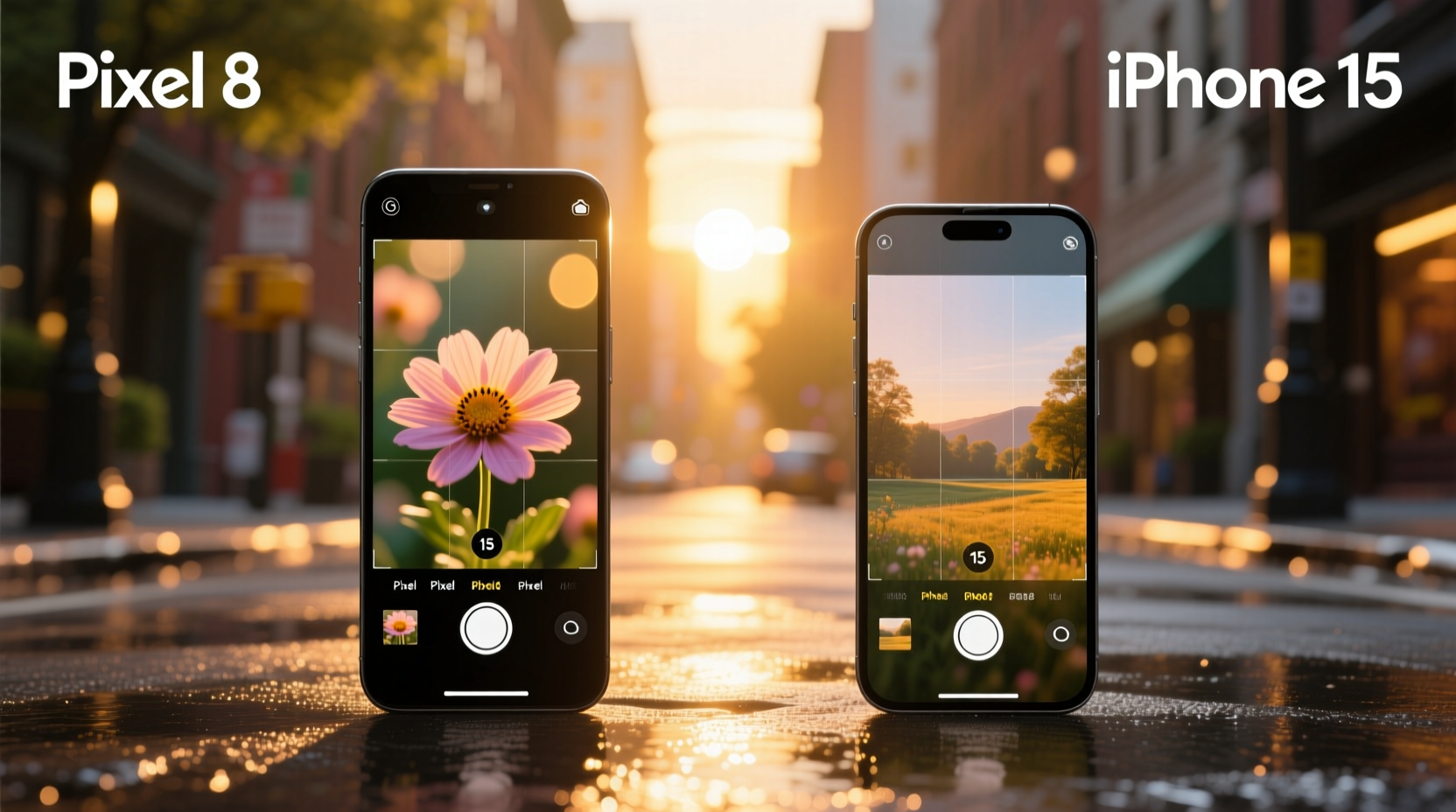
On paper, both phones are well-equipped. The Google Pixel 8 features a 50MP main sensor with larger pixels (1.2µm), an f/1.68 aperture, and Google’s custom Tensor G3 chip optimized for image processing. It also includes a 12MP ultrawide lens and no telephoto—relying instead on Super Res Zoom for digital magnification.
The iPhone 15, meanwhile, sports a 48MP main sensor with pixel binning down to 24MP standard shots, an f/1.6 aperture (the widest ever on an iPhone), and Sensor-Shift Optical Image Stabilization. Its secondary shooter is a 12MP ultrawide, and unlike the base Pixel 8, it lacks a dedicated macro mode but supports 2x optical-quality zoom via pixel cropping.
| Feature | Google Pixel 8 | iPhone 15 |
|---|---|---|
| Main Sensor | 50MP, 1.2µm, f/1.68 | 48MP, 0.8µm (binning to 1.6µm), f/1.6 |
| Ultrawide | 12MP, f/2.2 | 12MP, f/2.4 |
| Telephoto | No optical zoom; up to 7x Super Res Zoom | No periscope, but 2x crop zoom from 48MP sensor |
| Image Processing | Google Tensor G3 + HDRnet, Magic Eraser, Photo Unblur | A16 Bionic + Photonic Engine, Smart HDR 5 |
| Low-Light Performance | Night Sight across all lenses | Night mode on main and ultrawide |
While the specs are close, the key differentiator lies in software execution. Google leans heavily into machine learning for noise reduction, shadow recovery, and tone mapping. Apple prioritizes fidelity and realism, aiming to preserve what your eyes would see rather than enhance beyond recognition.
Photo Quality: Real-World Scenarios Compared
In daylight, both phones produce excellent results. The Pixel 8 tends to boost saturation slightly, especially in greens and blues, giving images a punchy, social-media-ready look. The iPhone 15 maintains more neutral tones, preserving true-to-life colors even if they appear less vibrant at first glance.
Where differences become apparent is in high-contrast scenes. Backlit portraits often see the Pixel recover more detail from shadows, thanks to its aggressive HDR+ algorithm. However, this can sometimes result in an artificial \"glow\" around edges or overly brightened facial features. The iPhone, by contrast, allows shadows to remain darker but keeps highlights under tighter control, avoiding blown-out skies or reflective surfaces.
“Apple’s approach is conservative by design. They’d rather under-process than over-process,” says David Trokey, senior editor at Imaging Insights. “Google takes risks to deliver wow moments—even if not every shot feels natural.”
Night photography remains a Pixel stronghold. Night Sight on the Pixel 8 activates earlier and produces cleaner, brighter images with less visible noise than the iPhone 15’s Night mode. In extremely dark environments—like dimly lit restaurants or city streets after midnight—the Pixel often captures usable detail where the iPhone defaults to a shorter exposure, sacrificing clarity for speed.
Zoom and Ultrawide: Practical Trade-offs
Without a telephoto lens, the Pixel 8 relies entirely on digital zoom. Super Res Zoom performs admirably up to 5x, but beyond that, details soften quickly. The iPhone 15 benefits from its 48MP sensor’s ability to crop into the center for a lossless 2x zoom, making it better suited for distant subjects like concert stages or wildlife at a zoo.
For group photos or landscapes, the ultrawide on the Pixel offers slightly less distortion correction than the iPhone. Barrel distortion is more noticeable at the edges, though Google’s software does a decent job minimizing it. The iPhone applies stronger edge straightening, which some photographers appreciate for architectural shots.
Video Capabilities: A Different Kind of Battle
Photography may favor the Pixel, but video leans toward the iPhone. The iPhone 15 records 4K HDR video at up to 60fps with Dolby Vision support—a feature unmatched in the Android ecosystem. Its stabilization is smoother, particularly when walking or filming from a moving vehicle.
The Pixel 8 supports 4K at 30fps and improved audio focusing with Wind Reduction mode, but lacks Dolby Vision and consistent frame pacing during rapid motion. For vloggers and casual creators, the iPhone delivers more polished output with minimal editing required.
Software Features That Matter
Google integrates AI tools directly into the camera experience. Magic Editor lets you reposition subjects or erase unwanted objects post-capture. Photo Unblur can salvage a shaky shot after the fact. These aren’t just gimmicks—they solve real problems users face daily.
Apple focuses on seamless integration within its ecosystem. Photos sync instantly across devices via iCloud, facial recognition is highly accurate, and Memories automatically creates edited videos with music and transitions. For families or multi-device households, this cohesion enhances usability even if raw photo scores are slightly lower.
Mini Case Study: Travel Photography in Lisbon
Sophia, a travel blogger based in Barcelona, tested both phones during a weekend trip to Lisbon. Her goal was to document street markets, historic trams, and sunset views over the Tagus River—all without carrying extra gear.
Dawn shots at Miradouro de Santa Luzia showed the Pixel excelling in low light, capturing rich textures in cobblestones and warm glows from café lights. However, she noticed slight halos around streetlamps—a telltale sign of over-processing.
Later, shooting fast-moving trams against bright sky, the iPhone preserved highlight detail better. She also preferred the iPhone’s video footage when filming herself narrating her journey; the audio clarity and stabilization made editing faster.
Ultimately, Sophia concluded: “The Pixel got me more shareable stills out-of-the-box. But the iPhone saved me time in post. If I had to pick one for solo travel, I’d go with the Pixel. For collaborative content, the iPhone wins.”
Frequently Asked Questions
Is the Pixel 8 camera better than the iPhone 15 overall?
It depends on your priorities. The Pixel 8 generally captures more detailed still photos, especially in low light, and offers innovative AI editing tools. However, the iPhone 15 provides superior video quality, more natural color science, and better ecosystem integration. Neither is universally “better”—they serve different needs.
Can the iPhone match the Pixel’s Night Sight?
Not quite. While the iPhone 15’s Night mode is competent and fast, it doesn’t push exposure as aggressively as Night Sight. In very dark conditions, the Pixel produces brighter, cleaner images. However, the iPhone avoids some of the ghosting and unnatural brightness artifacts that can appear on Pixel night shots.
Do these phones work well for social media?
Absolutely. The Pixel 8 requires less editing for Instagram due to its vibrant default processing. The iPhone may need minor tweaks in apps like Lightroom, but its consistent output makes batch editing easier. TikTokers will likely prefer the iPhone’s video stability and audio quality.
Action Checklist: Choosing What Works for You
- Evaluate your shooting environment: If you frequently shoot indoors or at night, lean toward the Pixel 8.
- Consider your editing habits: Prefer zero-touch sharing? Pixel’s AI enhancements help. Enjoy fine-tuning? iPhone’s ProRAW and Log video offer more control.
- Assess your ecosystem: If you use Mac, iPad, or AirPods, the iPhone’s seamless sync may outweigh marginal photo gains.
- Test video needs: For vlogging, streaming, or professional clips, the iPhone 15 remains the gold standard.
- Think long-term: Google promises seven years of OS updates for Pixel 8—longer than any iPhone. This ensures future camera improvements via software.
Final Verdict: Is the Camera Really That Much Better?
Yes—but only in specific ways. The Pixel 8’s camera isn’t categorically superior; it’s *different*. It shines brightest when conditions are challenging: dim lighting, backlit scenes, or when creative AI tools can transform a flawed shot into a keeper. Its software-first philosophy continues to redefine what smartphone cameras can do.
The iPhone 15, however, offers reliability, consistency, and unmatched video performance. It may not wow with dramatic enhancements, but it rarely disappoints. For most users, especially those embedded in Apple’s ecosystem, it provides a frictionless photography experience.
Rather than asking which camera is “better,” ask which one aligns with how you live, create, and share. Because in 2024, the best camera isn’t just about megapixels—it’s about fitting seamlessly into your life.




 浙公网安备
33010002000092号
浙公网安备
33010002000092号 浙B2-20120091-4
Comments
No comments yet. Why don't you start the discussion?