
In the battle for smartphone camera supremacy, two heavyweights consistently dominate conversations: Google’s Pixel series and Apple’s iPhone lineup. With the release of the Google Pixel 8 and iPhone 15, both brands have pushed their computational photography capabilities further—especially in low-light environments where lighting is scarce and image quality often falters. But when darkness falls, which device truly captures the clearest, most natural-looking photos?
This isn’t just about megapixels or sensor size. It’s about how hardware and software work together to extract detail from shadows, preserve color accuracy, and minimize noise—all while maintaining realistic contrast and dynamic range. For photographers, travelers, and night-life enthusiasts alike, understanding these differences can make all the difference between a missed moment and a lasting memory.
Sensor Technology and Hardware Foundations
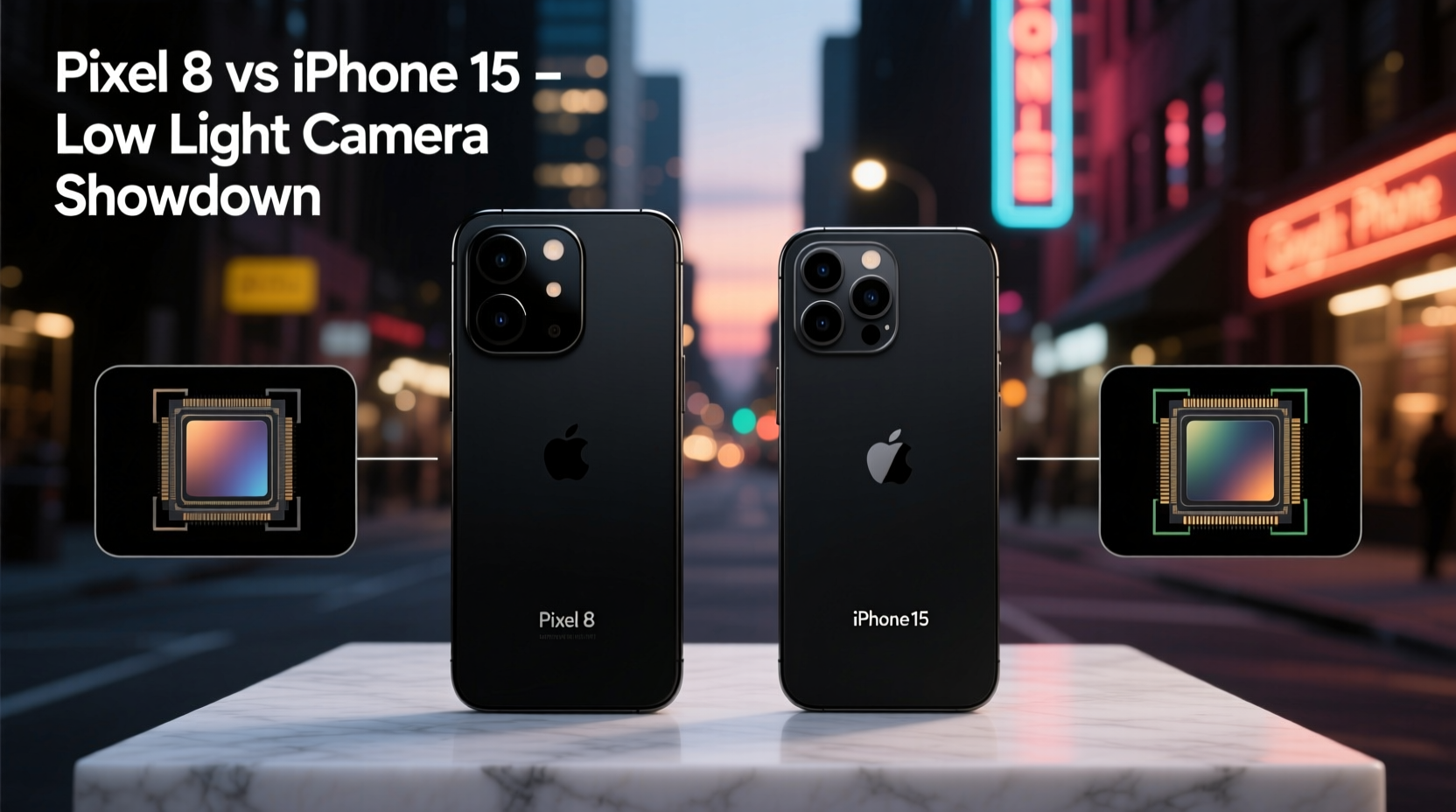
The foundation of any great photo begins with the sensor. The Google Pixel 8 features a 50MP main sensor (Sony IMX890), larger than its predecessor, with improved light-gathering capability through wider pixel binning. Its default output is a 12.5MP shot using quad-pixel technology, combining four pixels into one to capture more light per unit. Combined with an f/1.7 aperture lens, this setup gives the Pixel 8 strong baseline sensitivity even before software enters the equation.
The iPhone 15, on the other hand, uses a slightly smaller but still impressive 48MP main sensor (also Sony-made, likely IMX803). However, Apple employs a different approach: it defaults to a 24MP output via pixel binning, leveraging a unique 2x optical-quality crop that doubles effective resolution without sacrificing too much light sensitivity. The aperture sits at f/1.6—marginally wider than the Pixel 8—which allows marginally more photons to hit the sensor in dim conditions.
On paper, the hardware edge leans slightly toward the iPhone 15 due to its wider aperture and advanced sensor stabilization. But raw data only tells part of the story. Where each phone diverges significantly is in how they process that data after capture.
Computational Photography: Night Mode Showdown
Google practically invented modern smartphone night photography with the original Pixel's Night Sight feature. The Pixel 8 refines this legacy with an evolved version called Night Mode, now powered by the second-generation Tensor G3 chip. This custom silicon enables faster HDR+ processing, machine learning-based tone mapping, and real-time noise reduction tailored specifically to low-light scenarios.
Night Mode on the Pixel 8 automatically activates below certain lux levels, typically around 20–30 lux (dim indoor lighting or twilight). When triggered, it captures multiple frames over 3–6 seconds (depending on motion and light), aligns them, and merges them into a single high-dynamic-range image. What sets it apart is its ability to brighten shadows aggressively without making the scene look artificially lit. Skin tones remain warm and accurate, and dark areas reveal texture instead of turning into flat black voids.
Apple’s Smart HDR 5 and Photonic Engine bring a different philosophy. Rather than dramatically lifting shadows like the Pixel, the iPhone 15 aims for realism and subtlety. Its night mode engages under similar conditions but tends to preserve more natural darkness in the frame. Highlights are carefully controlled, and noise suppression feels smoother—though sometimes at the cost of fine detail in fabrics or foliage.
In side-by-side tests across urban nightscapes, candlelit dinners, and poorly lit interiors, the Pixel 8 often produces brighter images with more visible background details. However, some users may find these results slightly overprocessed—street signs might glow too brightly, or facial features appear overly sharpened. The iPhone 15, by contrast, delivers a more conservative interpretation, closer to what the human eye perceives. It doesn’t try to “see” everything; it tries to render what’s important well.
“Google prioritizes visibility in darkness. Apple prioritizes emotional authenticity. Both are valid approaches—but serve different kinds of photographers.” — David Lin, Mobile Imaging Analyst at DXOMARK
Low-Light Video Performance Compared
Still photos matter, but video recording in low light has become equally critical—especially for vloggers and social media creators. Here, the iPhone 15 holds a measurable advantage thanks to its Cinematic Mode enhancements and Dolby Vision HDR support up to 4K30fps, even in dim environments.
The iPhone 15 maintains stable autofocus transitions and consistent exposure during nighttime filming. Its sensor-shift stabilization compensates for handshake effectively, allowing handheld shooting without a gimbal in many cases. Low-light videos retain rich tonality and exhibit minimal banding under artificial lighting—a common issue with competing sensors.
The Pixel 8 supports 4K30fps video with its own form of cinematic blur and audio focus, but in darker settings, it struggles slightly with fluctuating exposure and microphone noise amplification. While its Super Res Zoom performs admirably in daylight, zoomed-in night videos tend to get grainy beyond 2x magnification. That said, Pixel’s new Magic Editor for video offers post-capture adjustments that can salvage poorly exposed clips—something the iPhone cannot do natively.
For professional-grade low-light videography, the iPhone 15 remains the safer choice. But for casual users who value creative flexibility and editing power after recording, the Pixel 8 offers compelling tools that level the playing field.
Detailed Comparison Table: Key Camera Features in Low Light
| Feature | Google Pixel 8 | iPhone 15 |
|---|---|---|
| Main Sensor Resolution | 50MP (binning to 12.5MP) | 48MP (binning to 24MP) |
| Aperture | f/1.7 | f/1.6 |
| Night Mode Activation | Auto below ~30 lux | Auto below ~25 lux |
| Exposure Time (Max) | Up to 6 seconds | Up to 3 seconds |
| Noise Reduction Approach | AI-driven, aggressive shadow lift | Naturalistic smoothing, less detail loss |
| Low-Light Video (4K) | Good, with occasional flicker | Excellent, stabilized, HDR-rich |
| Post-Capture Editing Tools | Magic Eraser, Magic Editor (AI-powered) | Basic adjustments, no AI object removal |
Real-World Example: Capturing a Cityscape at Dusk
Jessica, a freelance travel blogger based in Chicago, regularly documents skyline views from rooftop bars and lakefront paths. On a recent evening shoot along Navy Pier, she tested both the Pixel 8 and iPhone 15 as ambient light faded from golden hour into full night.
Using identical positioning and no external stabilizer, she captured several frames of the city lights reflecting off Lake Michigan. The Pixel 8 produced a noticeably brighter image, revealing windows in distant buildings and subtle ripples in the water. Street lamps glowed vividly, and the overall composition felt energetic. However, upon zooming in, she noticed slight halos around bright lights and a minor plasticky look to the sky.
The iPhone 15’s version was darker but more balanced. The reflection of the Willis Tower shimmered naturally, and the gradient from twilight blue to deep navy in the sky remained smooth. There was less visible detail in the far background, but the mood of the scene felt more authentic. Jessica ultimately chose the iPhone shot for her blog because it matched the atmosphere she remembered experiencing.
Her takeaway? “The Pixel showed me more. The iPhone made me *feel* more.”
Actionable Checklist: Maximizing Low-Light Photos on Either Device
- Enable Night Mode manually if auto-trigger doesn’t activate early enough—tap the moon icon and adjust duration.
- Use volume buttons or headphones to trigger the shutter remotely and reduce shake during long exposures.
- Clean your lens regularly—smudges amplify glare and reduce sharpness, especially around streetlights.
- Avoid digital zoom in low light; stick to 1x or use cropping in post-processing instead.
- Shoot in Pro mode (if available) to lock ISO and exposure for consistency across multiple shots.
- Leverage cloud editing tools: Pixel users should try Magic Editor; iPhone users can enhance with Lightroom Mobile.
Frequently Asked Questions
Does the Pixel 8 always outperform the iPhone 15 in dark photos?
No—not always. While the Pixel 8 generally captures brighter images with more recoverable shadow detail, the iPhone 15 often produces more natural colors, better highlight control, and superior skin tones in portrait scenes. Preference depends on whether you prioritize visibility or realism.
Can I force night mode on both phones?
Yes. On the Pixel 8, tap the moon icon in the viewfinder and select exposure time (up to 6 seconds). On the iPhone 15, open the Camera app, wait for the yellow \"Night\" label to appear, then tap it to manually extend the timer up to 3 seconds—even in brighter conditions.
Which phone handles colored lights better at night?
The iPhone 15 manages multicolored LED displays and neon signage with less chromatic aberration and fewer purple fringes. The Pixel 8 occasionally oversaturates reds and blues near bright sources, though updates have reduced this issue over time.
Final Verdict: Choosing Based on Your Needs
If your priority is extracting maximum detail from near-darkness—say, photographing a dimly lit museum exhibit or capturing kids playing in a backyard after sunset—the Google Pixel 8 delivers unmatched visibility. Its AI-enhanced pipeline turns almost-black scenes into viewable, shareable images. For journalists, parents, and explorers who refuse to miss a moment, this capability is invaluable.
However, if you value aesthetic integrity—preserving the mood of candlelight, avoiding blown-out highlights, or capturing nuanced skin tones in evening portraits—the iPhone 15 earns its reputation. It doesn’t chase maximum brightness; it chases truthfulness. Photographers aiming to create emotionally resonant images will appreciate Apple’s restrained touch.
Ultimately, neither camera is universally “better.” They reflect distinct philosophies: Google believes every shadow deserves illumination. Apple believes some darkness should remain untouched.




 浙公网安备
33010002000092号
浙公网安备
33010002000092号 浙B2-20120091-4
Comments
No comments yet. Why don't you start the discussion?