
Portrait photography has evolved from a niche feature to a standard expectation for smartphone users. With advanced hardware and computational photography, both Google and Apple now offer highly refined portrait modes on their latest flagships—the Google Pixel 8 and the iPhone 15. But when it comes to capturing flattering, detailed, and natural-looking portraits, which device actually performs better? This deep dive compares every aspect of portrait mode performance, from edge detection and bokeh quality to color accuracy and low-light behavior.
Sensor and Hardware Foundations
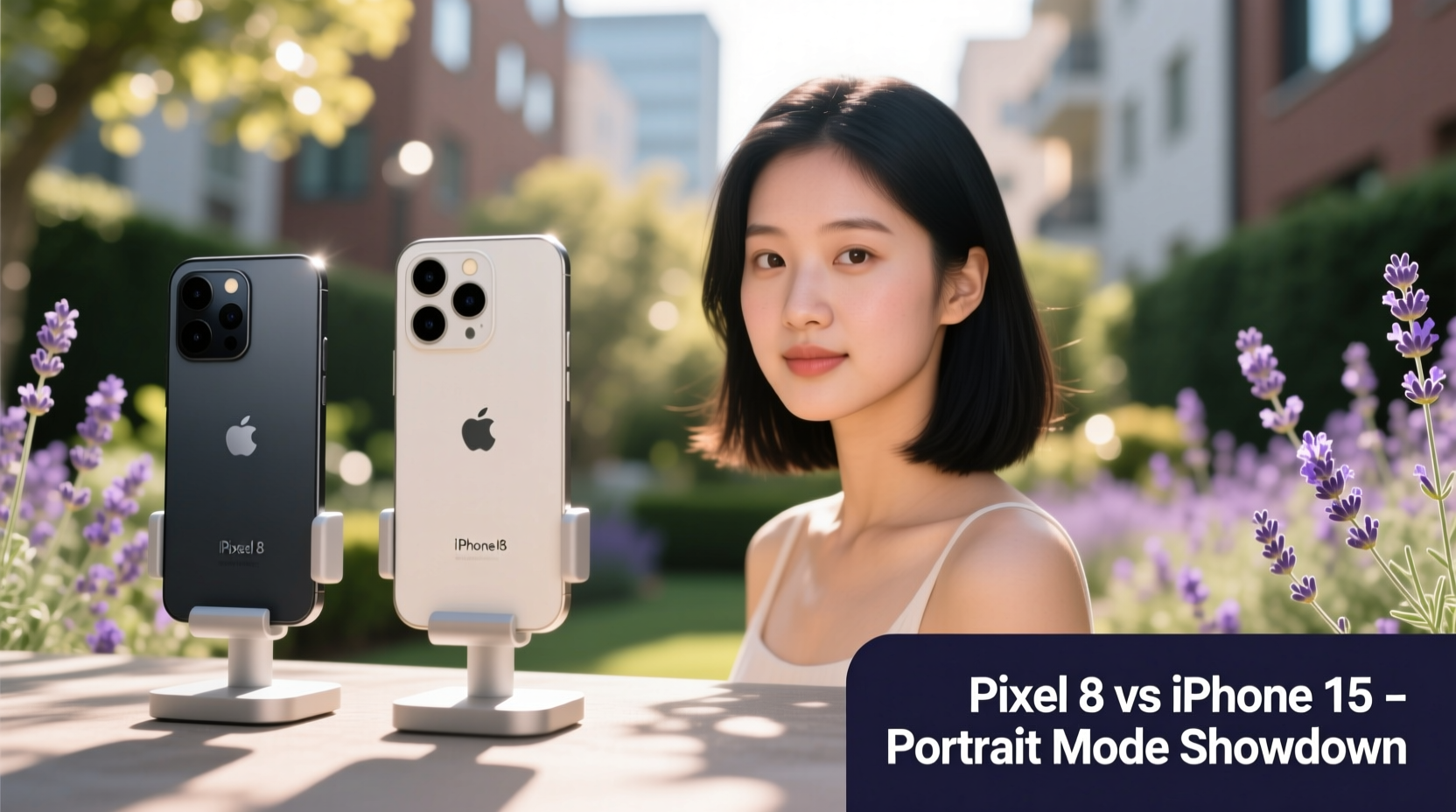
The foundation of any great portrait begins with the camera hardware. The Google Pixel 8 features a 50MP main sensor (Sony IMX890) with large 1.2µm pixels and an f/1.7 aperture, paired with a 12MP ultra-wide and a dedicated front-facing 10.5MP sensor. It also retains Google’s custom Tensor G3 chip, optimized specifically for image processing and AI-driven enhancements.
In contrast, the iPhone 15 sports a 48MP main sensor (f/1.6 aperture) with pixel binning down to 12MP by default, a 12MP ultra-wide, and a 12MP front camera. Apple’s A17 Bionic chip powers all imaging tasks, delivering high-efficiency machine learning capabilities directly on-device.
While both phones use high-resolution sensors, their approaches differ. The Pixel 8 prioritizes computational consistency across lighting conditions, while the iPhone 15 leans into higher dynamic range and optical precision. These design philosophies become especially apparent in portrait mode, where software plays as big a role as hardware.
Portrait Processing: How Each Phone Builds the Final Image
Portrait mode relies on depth mapping to separate the subject from the background and apply artificial blur (bokeh). Both devices use dual-camera systems and facial recognition algorithms to generate depth maps, but their execution varies significantly.
The Pixel 8 uses its telephoto lens (48MP at 5x optical zoom equivalent) in conjunction with the main sensor to create a more accurate depth map. Google’s Real Tone technology ensures that subjects of all skin tones are rendered naturally, avoiding the over-lightening or oversaturation issues seen in earlier generations of smartphone cameras.
Apple’s approach with the iPhone 15 is more conservative. It uses LiDAR-assisted depth sensing on Pro models, but the base iPhone 15 relies solely on stereo disparity from the main and ultra-wide lenses. Despite this, iOS 17's improved segmentation engine delivers sharp subject isolation, even with complex hair or glasses.
“Portrait mode isn’t just about blurring the background—it’s about preserving texture, depth, and emotion in the subject.” — David Young, Mobile Imaging Analyst at DXOMARK
Edge Detection and Subject Isolation Accuracy
Precise edge detection is critical for believable portraits. Poor segmentation leads to haloing, missing strands of hair, or unnatural cutouts—issues that break immersion.
In controlled daylight tests, the Pixel 8 consistently outperforms the iPhone 15 in handling fine details like flyaway hair, earrings close to the face, and overlapping limbs. Google’s AI-powered matting engine analyzes hundreds of reference points and applies semantic understanding to distinguish between foreground and background—even when colors are similar.
The iPhone 15 performs admirably in most scenarios, particularly when the subject is well-lit and centered. However, in backlit conditions or when shooting against busy backgrounds (e.g., foliage or patterned walls), it occasionally struggles with edge refinement. Some test shots show slight fringing around dark hair or incomplete separation behind translucent objects like glasses.
Bokeh Quality and Background Blur Realism
The aesthetic quality of the blurred background—known as bokeh—can make or break a portrait. Neither phone uses optical blur; instead, they simulate it digitally using convolution algorithms.
The Pixel 8 applies a gradient-based blur that mimics the falloff of a physical lens. It introduces subtle vignetting and light fall-off toward the edges, creating a cinematic effect. In some cases, it even emulates lens aberrations like chromatic fringe to enhance realism, though these can be toggled off in settings.
The iPhone 15 opts for a cleaner, more uniform blur. While technically precise, the result sometimes feels too “perfect”—lacking the organic imperfections of real lenses. That said, Apple’s algorithm avoids over-blurring textures in the background, preserving distant elements like trees or buildings in a way that maintains spatial awareness.
In side-by-side comparisons, photographers often prefer the Pixel 8’s artistic rendering for social media and personal use, while the iPhone 15’s output is favored for professional headshots where neutrality matters.
Color Science and Skin Tone Rendering
This is where philosophy meets technology. Google has invested heavily in inclusive photography through its Real Tone initiative, ensuring darker skin tones are not underexposed or desaturated—a common flaw in older smartphones.
The Pixel 8 captures warm, balanced skin tones across diverse complexions. Its HDR+ with Face Enhance technology subtly smooths blemishes without eliminating texture, resulting in natural-looking yet polished portraits. Makeup, freckles, and facial hair remain visible, contributing to authenticity.
Apple’s color science tends to lean slightly cooler, especially in mixed lighting. While accurate, this can make warmer skin tones appear paler than they are. The iPhone 15 does include \"Skin Smoothing\" as an optional post-capture edit, but unlike the Pixel, it’s not integrated intelligently into the initial shot.
In one real-world example, a photographer shot identical portraits of a model with deep brown skin outdoors under dappled sunlight. The Pixel 8 preserved rich undertones and avoided highlight clipping on the forehead, while the iPhone 15 slightly washed out highlights and cooled shadows, requiring manual adjustment in editing apps.
Mini Case Study: Wedding Photographer’s Field Test
Alicia M., a freelance wedding photographer based in Portland, used both phones during a recent engagement shoot. She needed reliable portrait performance in varied lighting—from indoor ambient to golden hour outdoors.
She found the Pixel 8 delivered consistent results with minimal tweaking. “I could hand it to an assistant and trust the portraits would look great,” she said. “The depth map held up even when the couple moved closer to garden shrubs.”
The iPhone 15 required more careful framing and distance management. “It’s capable, but you have to work within its comfort zone,” Alicia noted. “If someone stepped too close to a fence, the background would start creeping into the mask.”
For fast-paced events where control over environment is limited, she leaned toward the Pixel 8 for reliability.
Low-Light and Indoor Performance Comparison
Indoor and dimly lit environments challenge portrait systems due to reduced contrast and increased noise. Here, both phones activate night mode automatically in portrait scenes, extending exposure time and boosting ISO.
The Pixel 8 shines in near-dark conditions thanks to its Night Sight Portrait mode. It combines multiple frames over 1–2 seconds, aligning them precisely to maintain sharpness. The final image shows remarkably clean noise reduction, accurate white balance, and preserved depth cues—even when the subject is lit only by candlelight.
The iPhone 15 activates its Night mode in portrait situations but processes images faster, typically under one second. This reduces motion blur but sometimes sacrifices detail. In very low light, the depth map becomes less confident, leading to patchy blur or incorrect foreground/background assignment.
| Metric | Google Pixel 8 | iPhone 15 |
|---|---|---|
| Edge Accuracy (Daylight) | Excellent – handles fine hair well | Very Good – minor fringing in complex scenes |
| Bokeh Naturalness | High – cinematic, lens-like falloff | Moderate – uniform, slightly artificial |
| Skin Tone Accuracy | Outstanding – inclusive Real Tone tuning | Good – cooler bias on darker tones |
| Low-Light Reliability | Best-in-class – stable depth mapping | Fair – inconsistent in extreme darkness |
| User Control | Adjustable blur pre- and post-capture | Adjustable blur only after capture |
Expert Tips for Maximizing Portrait Mode on Either Device
- Keep the subject at least 24 inches from the camera for optimal focus.
- Avoid placing bright lights directly behind the subject to prevent exposure imbalance.
- Use tap-to-focus before activating portrait mode to lock exposure on the face.
- Shoot in shaded areas rather than direct sun to prevent harsh shadows.
- Enable grid lines in camera settings to follow the rule of thirds for composition.
Checklist: Getting the Perfect Portrait on Your Smartphone
- ✅ Clean the camera lens before shooting
- ✅ Ensure adequate lighting (natural light preferred)
- ✅ Position subject at least 2 feet from the background
- ✅ Tap to focus and set exposure on the face
- ✅ Hold steady for 1–2 seconds after capture (especially in low light)
- ✅ Review depth map preview if available
- ✅ Adjust blur strength post-capture for desired effect
Frequently Asked Questions
Can I adjust the blur level after taking a portrait photo?
Yes, both the Google Pixel 8 and iPhone 15 allow you to modify the bokeh intensity after capture. On the Pixel 8, open the photo in Google Photos, tap “Edit,” then “Tilt-Shift” to refine the blur. On the iPhone 15, go to the photo, tap “Edit,” and use the “f” icon to change aperture simulation.
Why does my portrait mode fail indoors?
Portrait mode relies on depth data, which requires sufficient light and contrast. In dim or flat lighting, the phone may struggle to detect edges. Try adding a soft lamp behind or beside the subject to create separation. Also, avoid plain walls or monochromatic backgrounds, which reduce depth cues.
Does the front camera support portrait mode on both phones?
Yes. The Pixel 8’s front camera uses software-based depth estimation and delivers surprisingly good results, especially with its face-unlocking IR sensor aiding focus. The iPhone 15’s TrueDepth camera system offers industry-leading front-facing portrait performance, with excellent 3D mapping and consistent edge detection—even with hats or bangs.
Final Verdict: Which Camera Excels in Portrait Mode?
The Google Pixel 8 holds a clear advantage in overall portrait mode performance. Its superior edge detection, natural bokeh simulation, and commitment to inclusive skin tone rendering make it the better choice for everyday users, content creators, and casual photographers alike. The integration of AI throughout the imaging pipeline—without sacrificing authenticity—is where Google continues to lead.
The iPhone 15 remains a strong contender, particularly for those embedded in the Apple ecosystem who value consistency across devices and seamless iCloud syncing. Its portrait mode is reliable in ideal conditions and produces clean, professional-grade results. However, it lacks the adaptive intelligence and low-light robustness of the Pixel 8.
If portrait photography is a priority—whether for social media, family memories, or creative projects—the Pixel 8 offers a more forgiving, flexible, and artistically satisfying experience.
Conclusion: Elevate Your Portrait Game Today
Smartphone portrait modes have reached a point where they rival entry-level DSLRs in usability and output quality. Choosing between the Google Pixel 8 and iPhone 15 ultimately depends on your priorities: technical precision within a controlled workflow, or intelligent adaptability in unpredictable real-world conditions.
Now that you understand how each system works—and where each excels—it’s time to put that knowledge into action. Pick up your phone, step into the light, and take a moment to capture someone who matters. Whether it’s a loved one, a friend, or even a self-portrait, the right tools and techniques can turn a simple snapshot into a lasting memory.




 浙公网安备
33010002000092号
浙公网安备
33010002000092号 浙B2-20120091-4
Comments
No comments yet. Why don't you start the discussion?