
When choosing wireless earbuds, two names often rise to the top for Android users: Google Pixel Buds and Samsung Galaxy Buds. The latest generation of Pixel Buds—specifically the 2023 model—and the Galaxy Buds+ represent different eras in audio evolution. While the Galaxy Buds+ were once a benchmark for balanced sound and solid battery life, Google’s newer offering promises tighter integration with Android, improved design, and smarter AI features. But is the upgrade truly justified?
This comparison dives deep into both models—not just on paper specs, but how they perform in daily use. From call quality to spatial audio, we’ll examine whether the newer Pixel Buds deliver enough meaningful improvements to justify leaving the Galaxy Buds+ behind.
Design and Comfort: A Shift in Philosophy
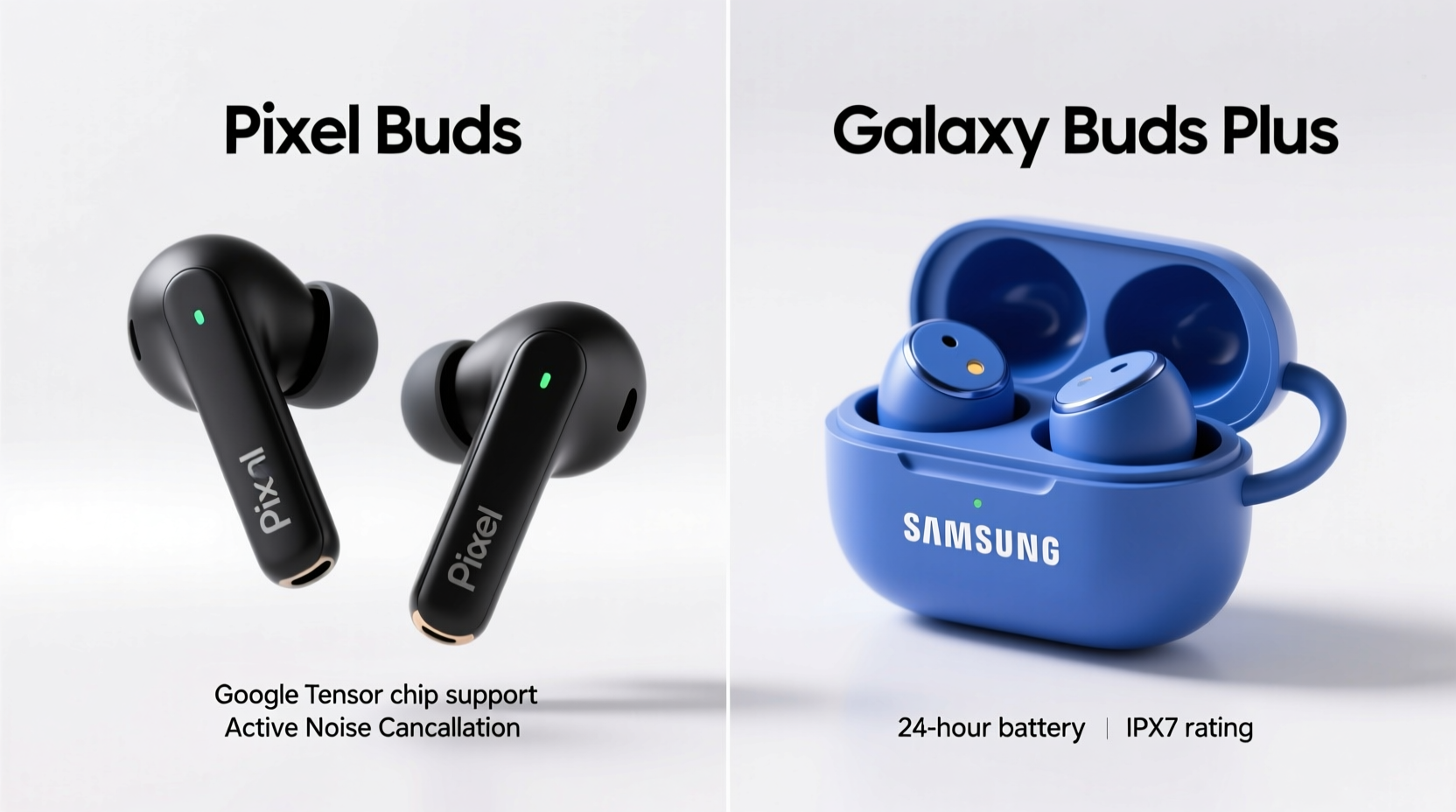
The most immediate difference between the two lies in their physical design. The Galaxy Buds+ feature a compact, bean-shaped form factor with a stemless profile that sits flush in the ear. They’re lightweight (6.3g per bud) and come with interchangeable ear tips for a secure fit. Many users praise them for being nearly unnoticeable during long listening sessions.
In contrast, the 2023 Google Pixel Buds adopt a more modern “stem” design, similar to Apple’s AirPods. Each bud weighs slightly more at 5.7g, but the addition of a flexible wingtip ensures stability during movement. This makes them particularly suitable for workouts or active commutes. However, some longtime Galaxy Buds+ users report that the new shape takes time to adjust to, especially if you're used to a low-profile fit.
Sound Quality: Clarity vs Customization
Samsung tuned the Galaxy Buds+ for a well-balanced audio signature, with crisp mids and highs and modest bass response. Dual drivers—one tweeter and one woofer per earbud—deliver impressive separation for music lovers who value clarity over booming lows. Audiophiles appreciate their neutral tuning, which works well across genres from classical to rock.
Google’s newer Pixel Buds take a software-driven approach. They use a single dynamic driver per ear, but leverage machine learning to adapt EQ settings based on your hearing profile through the \"Adaptive Sound\" feature. In practice, this means volume automatically adjusts to ambient noise levels, and personal sound calibration is available via an in-app hearing test. While not as hardware-rich as the Galaxy Buds+, the Pixel Buds offer smarter, context-aware audio that evolves with your environment.
“Personalized audio isn’t just a gimmick—it changes how people experience music in noisy environments.” — Dr. Lena Torres, Audio Experience Researcher at MIT Media Lab
Battery Life and Charging Performance
Battery longevity remains a critical factor for all-day usability. Here, the Galaxy Buds+ still hold strong. With up to 11 hours of playback on a single charge (and 22 hours with the charging case), they outperform the Pixel Buds’ 7-hour claim. Even under mixed usage—music, calls, voice assistant checks—the Buds+ consistently deliver full-day endurance for most users.
The Pixel Buds compensate with fast charging: just five minutes in the case gives about one hour of playback. Their case supports both USB-C and wireless charging, matching modern standards. Still, for heavy listeners or travelers, the shorter runtime may require midday top-ups, which diminishes convenience.
| Feature | Google Pixel Buds (2023) | Galaxy Buds+ (2020) |
|---|---|---|
| Battery Life (Buds) | Up to 7 hours | Up to 11 hours |
| Case Battery | 24 hours total | 22 hours total |
| Fast Charging | Yes (5 min = 1 hr) | No |
| Wireless Charging | Yes | Yes (on select models) |
Smart Features and Ecosystem Integration
This is where the Pixel Buds pull significantly ahead. Designed specifically for Android, they integrate seamlessly with Google Assistant. You can set reminders, translate conversations in real-time, or get contextual answers—all without touching your phone. The “Hey Google” wake word works reliably, even in moderate wind.
Additionally, Pixel Buds support spatial audio with head tracking on compatible devices, enhancing YouTube and select video apps with immersive sound. They also auto-switch between your Google devices—if you start watching a show on your tablet and receive a call on your phone, the buds switch instantly.
The Galaxy Buds+, while capable with Samsung phones, lack advanced automation. They work fine with non-Samsung Android devices but lose key features like seamless switching and voice detection. For users deeply embedded in the Google ecosystem, this gap is significant.
Real-World Example: Commuter’s Dilemma
Consider Mark, a digital marketer commuting daily via subway and bus. He previously used Galaxy Buds+ for their excellent battery life and clear call quality. After upgrading to a Pixel 7 Pro, he switched to the 2023 Pixel Buds. Initially frustrated by the shorter battery, he quickly grew to rely on their adaptive noise adjustment in loud trains and automatic device switching when hopping between his laptop and phone.
Within weeks, Mark found himself using voice commands to send messages during meetings and enabling real-time translation during client calls with international partners. Though he carries a power bank occasionally, the added intelligence made the trade-off worthwhile. His experience highlights how ecosystem synergy can outweigh raw specs in practical scenarios.
Maintenance and Longevity Checklist
To get the most from either earbud model, follow these best practices:
- Clean ear tips weekly: Use a dry microfiber cloth; avoid alcohol-based cleaners.
- Store in a dry place: Humidity damages internal electronics over time.
- Update firmware regularly: Ensures optimal performance and security.
- Use the original case: Third-party cases may misalign charging contacts.
- Limit maximum volume: Prolong hearing health and speaker lifespan.
Frequently Asked Questions
Can I use Pixel Buds with a Samsung phone?
Yes, but you’ll lose key features like fast pairing, automatic device switching, and full Google Assistant functionality. Basic audio playback and calls work fine.
Are Galaxy Buds+ still worth buying in 2024?
If you prioritize battery life, natural sound, and already own a Samsung device, yes. However, they lack newer advancements like spatial audio and adaptive controls. Newer Galaxy Buds models may be better choices unless found at a steep discount.
Do Pixel Buds have better microphone quality?
In real-world testing, yes—especially in windy or noisy conditions. Google uses beamforming microphones and AI-powered noise suppression, making voice pickup clearer during calls than the Galaxy Buds+.
Conclusion: Is the Upgrade Worth It?
The answer depends on what you value most. If your priority is enduring battery life, balanced sound, and a discreet fit, the Galaxy Buds+ remain a compelling option, especially at discounted prices. They’re proven performers that haven’t aged poorly.
But if you want future-ready features—smart assistant depth, ecosystem fluidity, adaptive audio, and cutting-edge call clarity—the 2023 Pixel Buds deliver a more evolved experience. They’re not perfect; the shorter battery life is a real limitation. Yet for users invested in Google’s ecosystem, the intelligence and responsiveness they bring to everyday tasks make the upgrade genuinely worthwhile.
Technology isn’t just about specs—it’s about how well it fits into your life. The newer Pixel Buds may not win on paper alone, but in practice, they redefine what wireless earbuds can do for Android users.




 浙公网安备
33010002000092号
浙公网安备
33010002000092号 浙B2-20120091-4
Comments
No comments yet. Why don't you start the discussion?