
In 2025, the landscape of home networking has evolved rapidly. Wi-Fi 6E and Wi-Fi 7 are now mainstream, and smart home integration is no longer a luxury—it’s expected. Yet, many households still rely on older mesh systems like Google Wifi and Samsung SmartThings Wifi. Originally launched to simplify home networking and smart device control, both platforms were pioneers in their time. But as technology advances and manufacturer support shifts, consumers face a critical question: do these once-revolutionary systems still deliver value today?
This article examines Google Wifi and Samsung SmartThings Wifi not just on legacy performance, but on long-term viability—focusing on software updates, hardware longevity, compatibility with modern devices, and integration within evolving smart ecosystems.
Historical Context: The Rise and Fall of Consumer Mesh Simplicity
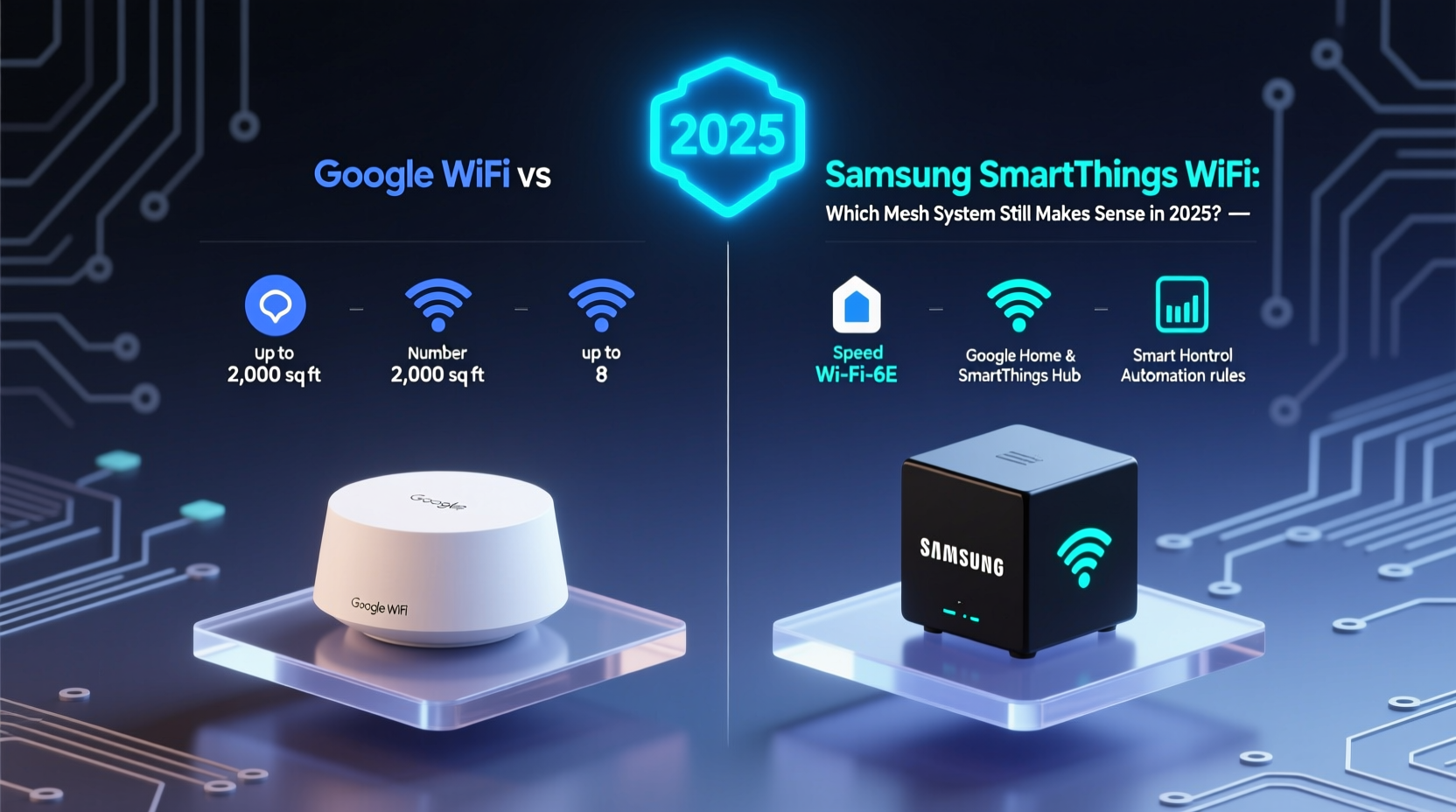
Google Wifi launched in 2016 as a sleek, user-friendly mesh solution designed to eliminate dead zones with minimal setup. Its companion app simplified network management, appealing to non-technical users. It also integrated with Google Assistant, making voice control a selling point. By 2018, Samsung introduced its SmartThings Wifi router, combining a mesh system with a built-in SmartThings hub—positioned as an all-in-one smart home gateway.
Both systems prioritized ease of use over raw performance. They used dual-band Wi-Fi (2.4 GHz and 5 GHz), lacked multi-gig ports, and capped speeds suitable for early gigabit internet plans. At the time, this was sufficient. However, by 2023, Google discontinued the Nest Wifi Pro as its flagship, shifting focus entirely to Wi-Fi 6/6E. Meanwhile, Samsung quietly reduced marketing and firmware updates for SmartThings Wifi, signaling diminished investment.
“Legacy mesh systems from 2016–2019 were designed for simplicity, not scalability. Today’s bandwidth demands expose their limitations.” — Lin Chen, Senior Network Architect at HomeGrid Labs
Performance Comparison in 2025: Speed, Coverage, and Latency
Modern homes run dozens of connected devices: 4K streaming, cloud gaming, video conferencing, security cameras, and multiple IoT sensors. Legacy systems like Google Wifi and SmartThings Wifi struggle under this load due to outdated hardware.
| Feature | Google Wifi (Original) | Samsung SmartThings Wifi | Modern Standard (Wi-Fi 6) |
|---|---|---|---|
| Wi-Fi Standard | Wi-Fi 5 (802.11ac) | Wi-Fi 5 (802.11ac) | Wi-Fi 6/6E |
| Max Link Rate | AC1200 (867 + 400 Mbps) | AC1300 (867 + 433 Mbps) | AX3000+ |
| Ethernet Ports | 1x Gigabit | 1x Gigabit | Often 2.5Gbps+ on newer models |
| Backhaul Type | Wireless-only | Wireless-only | Dedicated radio or Ethernet |
| App Support Status (2025) | Limited; merged into Google Home app | Minimal updates since 2023 | Active development |
| Smart Hub Integration | No native hub | SmartThings Hub built-in | Via separate hubs or Matter support |
The data shows both systems fall short in throughput and backhaul efficiency. Neither supports tri-band architecture, meaning they can’t dedicate a full radio to node communication. This leads to latency spikes during high-traffic periods. Additionally, neither supports WPA3 encryption natively, creating potential security gaps in today’s threat environment.
Smart Home Integration: Where SmartThings Still Holds an Edge
While both systems lag in pure networking performance, Samsung SmartThings Wifi retains one unique advantage: its embedded SmartThings hub. In 2025, this allows direct connection to Zigbee and Z-Wave devices without requiring a separate hub. For users with legacy sensors, door locks, or lighting systems from brands like Philips Hue, Yale, or Aeotec, this can prevent costly replacements.
Google Wifi lacks any built-in smart home radios. It relies entirely on IP-based devices or external hubs like Nest Hub. As Google phases out Works with Nest, migration to Matter-over-Thread is encouraged—but original Google Wifi units don’t support Thread.
However, SmartThings’ advantage comes with caveats. Firmware updates for the SmartThings Wifi router have slowed significantly. Some users report delayed automations or sync failures when managing large device inventories. Samsung now pushes users toward standalone SmartThings Hubs (like the Square) paired with third-party routers, indicating a strategic pivot away from all-in-one hardware.
Real-World Example: The Johnson Family Setup
The Johnsons in Austin, Texas, installed Samsung SmartThings Wifi in 2019 to manage 18 smart devices: lights, thermostats, cameras, and water sensors. By 2024, their internet plan upgraded to 800 Mbps, and they added two AR/VR headsets. Streaming began buffering, and voice commands responded sluggishly.
They tested replacing the main router with an ASUS ZenWiFi Pro (XT12), keeping the SmartThings hub separate. Result: Wi-Fi speed increased by 2.3x, and smart device responsiveness improved despite no changes to the Zigbee network. This hybrid approach gave them modern routing power while preserving smart home functionality.
Firmware and Long-Term Support Outlook
Support lifecycle is perhaps the most critical factor in 2025. Google officially ended feature development for original Google Wifi in 2021, folding it into the Nest ecosystem. Security patches are delivered through the Google Home app, but only for devices registered before 2023. After that, patch frequency dropped to biannual, raising concerns about vulnerability exposure.
Samsung’s situation is more ambiguous. While the SmartThings platform remains active, the router-specific firmware hasn't seen a meaningful update since late 2023. No CVE fixes or protocol upgrades have been issued in over 18 months. Community forums show increasing reports of DNS leaks and DHCP conflicts, especially when paired with IPv6 networks.
- Google Wifi: Last major update – March 2022 (DNS-over-HTTPS support)
- SmartThings Wifi: Last firmware version – v1.3.011 (Dec 2023)
- Neither system supports Matter, the new cross-platform smart home standard
“Devices without regular firmware updates become liability points in your network. Even if they work today, they may compromise your entire ecosystem tomorrow.” — Dev Patel, Cybersecurity Analyst at NetDefense Group
Upgrade Checklist: Is It Time to Move On?
If you're still relying on either system, evaluate your needs with this actionable checklist:
- Check your internet speed: If your plan exceeds 300 Mbps, legacy AC1200 routers will bottleneck performance.
- Count your connected devices: More than 15 active devices strain older processors and memory.
- Review recent outages: Frequent reboots or signal drops indicate hardware fatigue.
- Verify smart home dependencies: Can your Zigbee/Z-Wave devices move to a dedicated hub?
- Assess security posture: Are you running outdated firmware with known vulnerabilities?
- Test latency-sensitive applications: Do video calls or online games suffer from jitter?
If three or more apply, consider upgrading. Modern alternatives like Eero Pro 6E, TP-Link Deco XE200, or Netgear Orbi RBKE963 offer Wi-Fi 6E, multi-gig ports, Thread/Matter support, and robust apps with real-time diagnostics.
Frequently Asked Questions
Can I still use Google Wifi as an access point in 2025?
Yes. You can repurpose Google Wifi units as dumb APs by disabling NAT and DHCP. Connect them via Ethernet to a modern router for extended coverage. This preserves hardware investment while improving network backbone performance.
Does SmartThings Wifi support Wi-Fi 6 or 6E?
No. The hardware uses Wi-Fi 5 chipsets and cannot be upgraded. Samsung never released a Wi-Fi 6 version of the SmartThings Wifi router.
Will Google or Samsung replace these devices for free?
No. Both companies treat these as end-of-life consumer products. No recall, trade-in, or upgrade programs exist. Extended warranties expired by 2024.
Conclusion: Making the Right Choice for 2025 and Beyond
In 2025, neither Google Wifi nor Samsung SmartThings Wifi qualifies as a primary network solution for most homes. Their hardware limitations, declining software support, and lack of next-gen features make them unsuitable for modern connectivity demands. That said, context matters. For small apartments with modest usage, Google Wifi might still function adequately. For smart home enthusiasts invested in Zigbee, SmartThings Wifi offers niche utility—provided risks are managed.
The smarter path is to decouple functions: use a modern Wi-Fi 6E/7 mesh system for networking and a dedicated smart hub (like SmartThings Station or Home Assistant) for device control. This modular approach ensures longevity, security, and adaptability.




 浙公网安备
33010002000092号
浙公网安备
33010002000092号 浙B2-20120091-4
Comments
No comments yet. Why don't you start the discussion?