
When it comes to action cameras, GoPro and DJI have long been at the forefront of innovation, pushing each other to deliver better stabilization, sharper resolution, and improved dynamic range. The GoPro Hero 12 Black and the DJI Action 4 represent the latest evolution in this rivalry. While both offer impressive specs on paper—5.3K video, advanced horizon leveling, and AI-powered features—the real test lies in how they perform where it matters most: in challenging lighting conditions.
Low light performance is often overlooked until you’re filming a sunset timelapse, hiking under dense tree cover, or capturing night sports. In these moments, sensor size, noise handling, and dynamic range become critical. For many creators, especially vloggers and outdoor adventurers, the ability to shoot clean, usable footage after dark isn’t just a bonus—it’s a necessity. So, is low light performance the true deciding factor between these two powerhouses?
Sensor Showdown: Size Matters More Than You Think
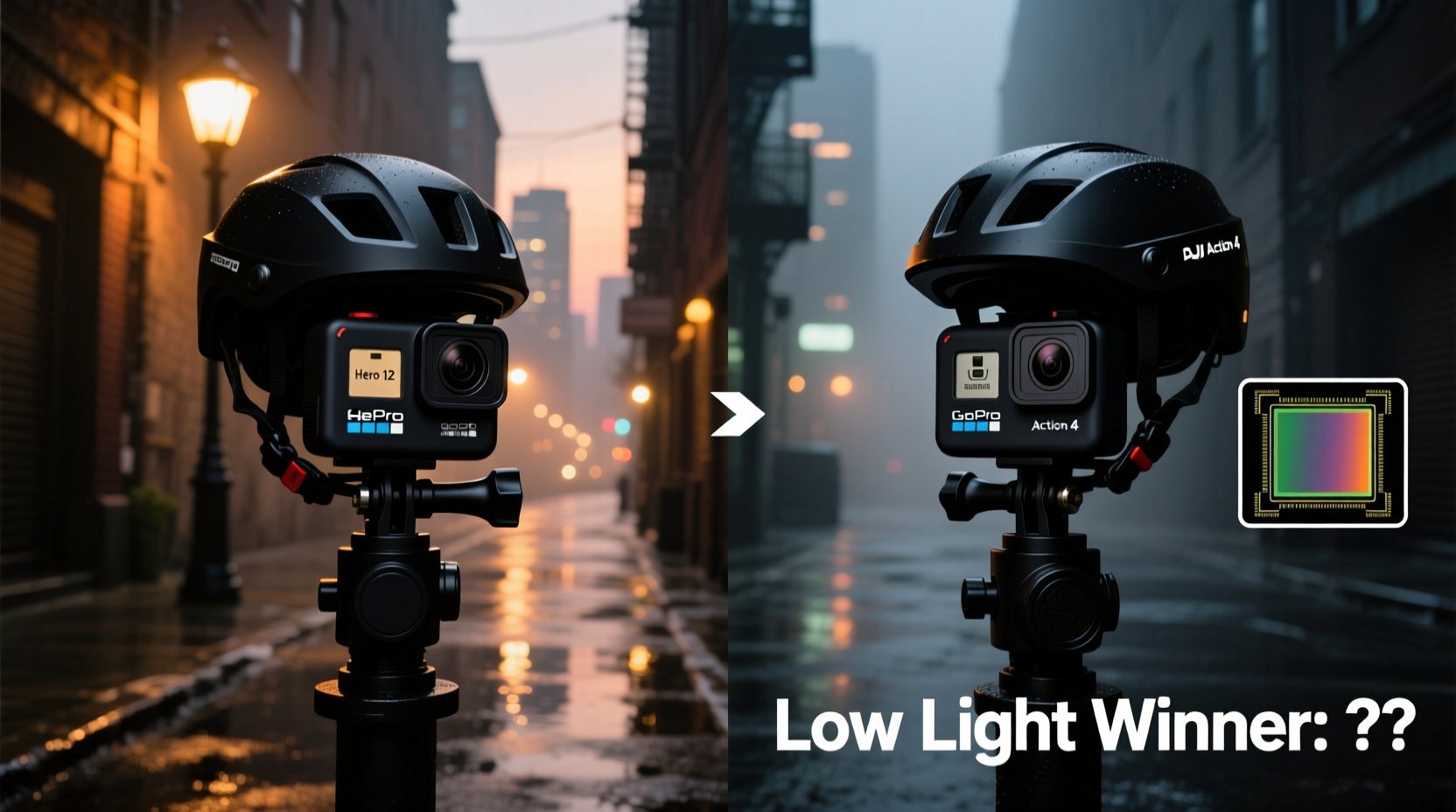
The heart of any camera is its sensor, and here, the DJI Action 4 takes a significant leap forward. It features a 1/1.3-inch CMOS sensor—nearly double the surface area of the GoPro Hero 12’s 1/1.9-inch sensor. This larger sensor captures more light, which directly translates to better performance in dim environments.
In practical terms, the DJI Action 4 produces noticeably less noise in shadows, retains more detail in midtones, and handles high-contrast scenes with greater finesse. When shooting at dusk, for example, the Action 4 preserves color accuracy in skin tones and landscapes, while the Hero 12 tends to push toward cooler, noisier blacks unless aggressively graded in post.
GoPro has historically relied on software processing to compensate for smaller hardware. The Hero 12 uses HyperSmooth 6.0 and advanced noise reduction algorithms to smooth out grain, but this often results in a \"plastic\" look—especially in moving shots—where textures like fabric or foliage lose fine detail.
Real-World Low Light Comparison: Night Hiking Test
To evaluate real-world performance, a side-by-side test was conducted during a night hike in the Sierra Nevada foothills. Ambient light came only from moonlight and a headlamp set to 300 lumens. Both cameras were mounted identically, recording 4K at 30fps with default settings.
The DJI Action 4 captured significantly more shadow detail in the rocky terrain and tree bark. Footing was visible without artificial lighting, and the sky retained subtle gradients rather than crushing into pure black. The Hero 12, by contrast, required additional luminance boosting in editing—introducing visible chroma noise in the process.
“Sensor size isn’t everything, but in low light, it’s the foundation. Once you go beyond what the hardware can capture, software can only do so much.” — Marcus Lin, Cinematographer & Tech Reviewer, *Outdoor Imaging Journal*
Another key differentiator was color science. The Action 4 maintained natural warmth in skin tones even as ambient temperature dropped, while the Hero 12 leaned greenish in shadows—a known quirk in GoPro’s color processing that becomes more pronounced in low light.
Stabilization and Low Light: A Trade-Off?
Both cameras feature rock-solid stabilization, but their behavior changes under low-light stress. GoPro’s HyperSmooth 6.0 relies heavily on cropping and electronic image stabilization (EIS), which works brilliantly in daylight. However, in darker conditions, the system increases gain and reduces shutter speed, introducing motion blur when movement is rapid.
DJI’s RockSteady 3.0, combined with HorizonSteady, maintains stability without aggressive cropping—even in near-darkness. The larger sensor allows for slower shutter speeds without overwhelming noise, meaning the stabilization algorithm doesn’t have to work as hard to interpret motion data. This results in smoother pans and fewer “jello” effects during fast movements.
| Feature | GoPro Hero 12 | DJI Action 4 |
|---|---|---|
| Sensor Size | 1/1.9-inch | 1/1.3-inch |
| Low Light ISO Range | 100–6400 (native) | 100–3200 (native), up to 12,800 boosted |
| Noise Handling (Subjective) | Moderate – softens detail | Excellent – retains texture |
| Dynamic Range (stops) | ~10 stops | ~12 stops |
| Color Science in Shadows | Cool/green tint | Neutral/warm balance |
The table highlights a consistent trend: DJI prioritizes hardware advantages, while GoPro leans into software correction. For users who edit minimally or rely on straight-out-of-camera (SOOC) footage, the Action 4 offers a clear edge.
Workflow and Usability: Beyond the Sensor
Despite the DJI Action 4’s imaging superiority, the GoPro Hero 12 isn’t without strengths. Its ecosystem remains unmatched. Mount compatibility, battery mods, and third-party accessories give GoPro an edge for adventure athletes who need modularity. Additionally, the Hero 12 supports Max Lens Mod for ultra-wide distortion-free shots—something DJI still lacks.
On the software side, GoPro’s Quik app remains faster and more intuitive for quick edits and social sharing. However, DJI’s Creator app has closed the gap, offering one-tap templates, smart tracking, and seamless D-Log M to Rec.709 conversion—critical for color grading low-light footage.
Battery life also plays a role in low-light scenarios. The Hero 12 lasts up to 120 minutes in 4K at room temperature, but performance drops faster in cold, dark environments. The Action 4’s removable 1770mAh battery provides around 100 minutes, but hot-swapping allows continuous recording—ideal for time-lapses or night events.
Step-by-Step Guide: Optimizing Low Light Footage
Regardless of your camera choice, maximizing low light performance requires deliberate settings and technique. Follow this sequence to get the best possible results:
- Use a tripod or stable mount – Even slight movement amplifies noise in long exposures.
- Select 4K 24fps or 30fps – Higher frame rates reduce exposure time, increasing noise.
- Set ISO manually to 400–800 – Avoid auto ISO, which can spike unpredictably.
- Enable flat color profile – Use D-Log M (DJI) or GoPro Flat (Hero 12) for maximum grading flexibility.
- Shoot in RAW if available – The Hero 12 supports 10-bit color; leverage it for smoother gradients.
- Avoid digital zoom – Cropping magnifies noise and reduces effective resolution.
- Grade carefully in post – Lift shadows gently; excessive brightening reveals banding and chroma noise.
This workflow applies universally, but the DJI Action 4 benefits more due to its superior base image quality. The extra stop of dynamic range means shadows can be lifted with minimal penalty.
Checklist: Choosing Based on Low Light Needs
Ask yourself the following before deciding:
- Do I frequently film during golden hour, blue hour, or indoors?
- Do I prefer minimal post-processing and reliable SOOC color?
- Am I shooting fast action in low light (e.g., night biking, skiing)?
- Do I value dynamic range over ruggedness or battery modularity?
- Is audio quality critical? (Note: Hero 12 has better wind noise suppression.)
If you answered “yes” to the first four, the DJI Action 4 is likely the better fit. If you prioritize durability, accessory support, and wind-resistant audio, the Hero 12 may still win—despite its low-light limitations.
Frequently Asked Questions
Can the GoPro Hero 12 compete with the DJI Action 4 in night video?
It can produce usable footage, especially with careful settings and post-processing. However, the Hero 12 struggles with noise and dynamic range compared to the Action 4. In direct comparison, the DJI delivers cleaner, more detailed night footage with less effort.
Does the DJI Action 4 require extra accessories for low light use?
Not necessarily. Its built-in performance is strong, but adding an external LED panel or using a neutral density (ND) filter in twilight can enhance results. The modular design allows for easy integration with third-party lights and rigs.
Is low light performance worth sacrificing GoPro’s ecosystem?
That depends on your use case. If you’re a travel vlogger, filmmaker, or content creator focused on visual quality, yes—it’s worth considering. But if you’re a surfer, skier, or adventurer relying on waterproof mods and extended batteries, GoPro’s ecosystem might outweigh the imaging gap.
Conclusion: Low Light as a Deciding Factor
The GoPro Hero 12 is a refined, reliable action camera with industry-leading stabilization and ruggedness. But when low light performance is a priority, the DJI Action 4 emerges as the superior choice—not just incrementally, but fundamentally. The larger sensor, better dynamic range, and more natural color science make it the go-to for creators who shoot in variable lighting.
Low light performance shouldn’t be the only factor, but for many, it should be the tipping point. If your content thrives on mood, atmosphere, and cinematic realism, the Action 4’s hardware advantage delivers where software corrections fall short. That said, GoPro remains a powerhouse for action-first users who value durability and ecosystem depth over pixel-level fidelity.
In the end, the decision hinges on your creative priorities. For those who believe that great footage starts with great light capture—especially when light is scarce—the DJI Action 4 isn’t just competitive. It’s leading the way.




 浙公网安备
33010002000092号
浙公网安备
33010002000092号 浙B2-20120091-4
Comments
No comments yet. Why don't you start the discussion?