
Every dog owner dreads the moment their pet slips the leash or wanders off during a walk. The peace of mind that comes with knowing your dog’s location can be priceless. With technology offering multiple tracking solutions—most notably GPS trackers and Apple AirTags—the decision isn’t just about functionality, but also cost, reliability, and long-term value. One of the most debated aspects is the recurring subscription fee tied to many GPS devices. Is it truly necessary? Or can an AirTag, which requires no monthly charge, serve just as well?
This article breaks down the core differences between GPS trackers and AirTags for dogs, evaluates the necessity of subscription fees, and helps you decide which option aligns best with your lifestyle, budget, and safety expectations.
How GPS Trackers and AirTags Work Differently
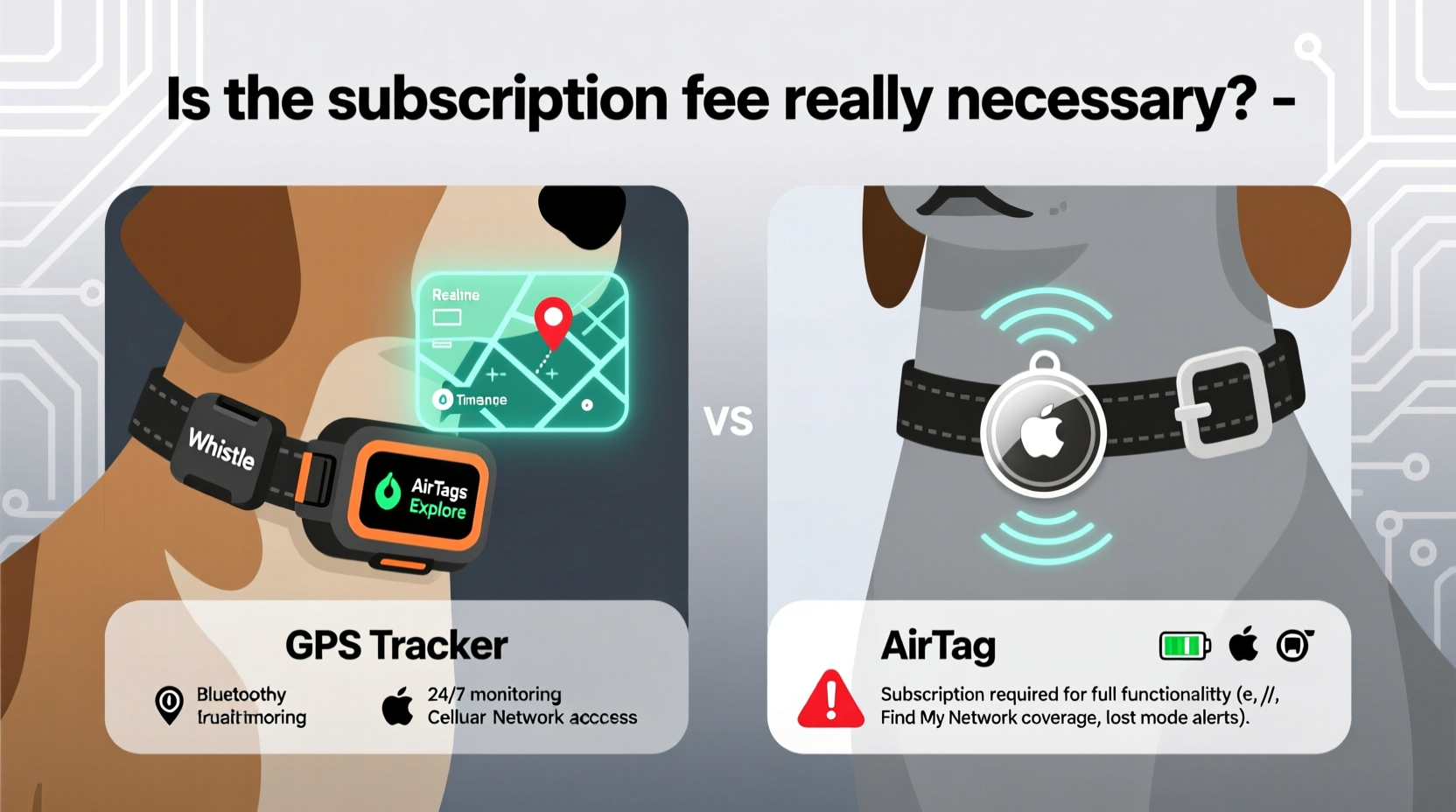
The fundamental distinction between GPS trackers and AirTags lies in how they transmit location data.
GPS trackers use Global Positioning System satellites combined with cellular networks (like LTE-M or 4G) to determine and relay your dog’s exact coordinates in real time. These devices typically include SIM cards or embedded connectivity, allowing them to send updates directly to your smartphone via a dedicated app. This means you can track your dog anywhere there's cell coverage—whether they’re two blocks away or across town.
In contrast, AirTags rely on Bluetooth signals and Apple’s Find My network. An AirTag doesn’t have GPS or cellular capabilities. Instead, it emits a secure Bluetooth signal that nearby Apple devices (iPhones, iPads, Macs) detect and anonymously relay to iCloud. If your dog goes missing, any Apple device within range can help pinpoint the AirTag’s last known location—but only if such devices are present in the area.
This architectural difference leads to significant variations in performance, especially in rural or low-population areas where few Apple users may pass by.
Breaking Down the Costs: Subscription vs Upfront Pricing
One of the biggest pain points for pet owners is the ongoing cost of GPS trackers. Most reputable brands—such as Whistle, Tractive, and Fi—require a monthly or annual subscription ranging from $5 to $15 per month. Over five years, that adds up to $300–$900 in service fees alone.
AirTags, on the other hand, have no subscription. You pay a one-time fee of $29 per tag and attach it to your dog’s collar. That’s it. No recurring charges. On paper, this makes AirTags appear vastly more economical.
But cost-effectiveness depends on what you're paying for. The subscription fee for GPS trackers covers critical services: continuous satellite and cellular data transmission, real-time tracking, geofencing alerts, and often health monitoring features like activity tracking and sleep analysis. Without the subscription, the device becomes useless.
AirTags, while cheaper upfront, lack active tracking. They don’t provide live location updates. Instead, they offer passive location history when someone else’s Apple device detects them. If your dog runs off at night in a sparsely populated area, you might not get a ping for hours—or days.
“Subscription models in pet tech aren’t about locking users in—they fund the infrastructure needed for real-time, independent location tracking. It’s a trade-off between autonomy and affordability.” — Dr. Lena Patel, IoT & Pet Safety Researcher, University of Michigan
Feature Comparison: GPS Tracker vs AirTag
| Feature | GPS Tracker (e.g., Tractive LTE) | AirTag |
|---|---|---|
| Real-Time Tracking | Yes – updates every few seconds | No – relies on opportunistic detection |
| Live Location Map | Yes – view movement in real time | Limited – last seen timestamp only |
| Geofencing Alerts | Yes – notify when dog leaves safe zone | No native support |
| Battery Life | 2–7 days (varies by model) | ~1 year (replaceable CR2032) |
| Water Resistance | Most are IP67 or higher | IP67 rated |
| Subscription Required | Yes ($5–$15/month) | No |
| Works Without Nearby Devices | Yes – uses cellular network | No – needs Apple device proximity |
| Additional Features | Activity monitoring, health insights, lost dog mode | Safety alerts, sound playback, precision finding (on newer iPhones) |
The table highlights a key insight: GPS trackers are full-service monitoring tools, while AirTags function more like digital “breadcrumbs” dependent on crowd-sourced detection.
When an AirTag Might Be Enough (And When It Isn’t)
There are scenarios where an AirTag performs admirably. Consider a dog that occasionally escapes the backyard in a densely populated neighborhood. With thousands of Apple devices nearby, the odds of someone’s iPhone detecting the tag are high. Within minutes, you could receive a location update through the Find My app.
However, if your dog bolts during a hike in a remote forest, the chances of an Apple user passing within Bluetooth range (typically 30–100 feet) are slim. In such cases, an AirTag is effectively blind. A GPS tracker, however, continues transmitting location data via satellite and cellular networks, enabling you to follow your dog’s path even in off-grid locations.
Another limitation: AirTags don’t alert you automatically when your dog leaves a designated area. You must manually check the app. GPS trackers, meanwhile, can send instant push notifications when your dog breaches a virtual boundary—a feature particularly useful for anxious or escape-prone pets.
Mini Case Study: Lost Dog in Suburban Ohio
Mark’s Labrador, Bella, slipped out of the house during a thunderstorm. She wore both a Fi Series 3 GPS tracker and an AirTag clipped to her collar as a backup. The storm caused her to panic and run nearly three miles into a wooded park.
Within 90 seconds, Mark received a geofence alert from the Fi app showing Bella had left the 500-foot radius around his home. He opened the app and saw her moving north in real time. After 20 minutes, she stopped near a creek. He followed the live map, found her, and brought her home safely—all within 45 minutes.
The AirTag didn’t register a location until the next morning, when a hiker passed within range. By then, Bella was already back home. While the AirTag confirmed her eventual location, it played no role in the actual recovery.
This case illustrates a critical point: real-time response matters. For fast-moving situations, GPS trackers with subscriptions provide actionable intelligence. AirTags offer confirmation after the fact.
Is the Subscription Fee Really Necessary?
The answer depends on your priorities.
If you want **proactive, immediate, and independent tracking**—especially for dogs that roam, hike, or live in rural areas—the subscription fee is not just necessary, it’s essential. That recurring cost pays for 24/7 access to cellular networks, server infrastructure, app development, and customer support. It enables life-saving features like live tracking and escape alerts.
On the other hand, if your dog primarily stays in a city or suburban environment with high smartphone penetration, and you’re looking for a low-cost way to increase recovery odds after a loss, an AirTag can be a viable supplement. It’s best used as a secondary tool—not a primary tracker.
Some pet owners opt for a hybrid approach: using a GPS tracker as their main device and attaching an AirTag as a backup. This combines real-time monitoring with the wide reach of Apple’s Find My network, maximizing recovery potential without relying on a single system.
Step-by-Step Guide: Choosing the Right Tracker for Your Dog
- Assess your dog’s risk level: Does your dog have a history of escaping, chasing wildlife, or getting anxious during storms? High-risk dogs need real-time GPS tracking.
- Evaluate your environment: Do you live in a city, suburb, or rural area? Low-population zones reduce AirTag effectiveness.
- Determine your budget: Can you afford a $150 upfront cost plus $7/month indefinitely? If not, consider lower-tier GPS plans or use an AirTag as a stopgap.
- Check battery and durability needs: Active dogs need rugged, waterproof trackers with decent battery life. AirTags win on battery longevity.
- Decide on features: Do you want health monitoring, social sharing of lost alerts, or international coverage? These are exclusive to subscription-based GPS devices.
- Test the app experience: Download the companion apps (e.g., Tractive, Fi, Apple Find My) and compare usability before purchasing.
- Consider redundancy: Use both a GPS tracker and an AirTag for maximum safety—especially for adventurous or high-flight-risk dogs.
Frequently Asked Questions
Can I use an AirTag as my dog’s primary tracker?
Technically yes, but it’s not recommended for high-risk or outdoor-active dogs. AirTags lack real-time tracking and depend on nearby Apple devices, making them unreliable in emergencies or remote areas.
Are GPS tracker subscriptions worth the cost?
For most pet owners seeking peace of mind and active monitoring, yes. The ability to see your dog’s live location, receive escape alerts, and track movements over time justifies the monthly fee—especially compared to the emotional and financial cost of a lost pet.
Do GPS trackers work internationally?
Many do, but coverage depends on the provider. Tractive, for example, offers global coverage in over 175 countries. AirTags can show location abroad—if detected by an Apple device—but won’t actively track across borders without local device density.
Final Verdict: Functionality Over Frugality
The debate between GPS trackers and AirTags ultimately comes down to responsibility. Owning a dog means preparing for worst-case scenarios—not just hoping for the best. While AirTags are clever, affordable, and useful in certain contexts, they are not designed to replace dedicated pet tracking systems.
The subscription fee associated with GPS trackers funds the very features that make them effective: constant connectivity, real-time updates, and proactive alerts. Cutting corners here may save money today but could cost you dearly tomorrow.
That said, technology evolves quickly. Future AirTag iterations may integrate ultra-wideband improvements or limited cellular fallback. Until then, treat AirTags as helpful accessories—not standalone solutions.
If your dog is prone to wandering, spends time off-leash, or lives outside dense urban zones, investing in a subscription-based GPS tracker isn’t just smart—it’s responsible.




 浙公网安备
33010002000092号
浙公网安备
33010002000092号 浙B2-20120091-4
Comments
No comments yet. Why don't you start the discussion?