
Every year, millions of pets go missing. While some find their way home through instinct or kind strangers, many are never reunited with their families. Advances in pet safety technology have given owners powerful tools to prevent permanent loss—but not all tools serve the same purpose. Two of the most effective safeguards are GPS trackers and microchips. Though often discussed as alternatives, they are actually complementary. Understanding how each works—and why relying on just one can leave your pet vulnerable—is critical for responsible pet ownership.
A GPS tracker provides real-time location data, allowing you to follow your pet’s movements like a moving dot on a map. A microchip, meanwhile, is a permanent digital ID implanted under the skin that only becomes useful when scanned by a shelter, vet, or animal control officer. One gives live tracking; the other offers permanent identification. Together, they form a layered defense against pet loss.
How GPS Trackers Work: Real-Time Location Monitoring
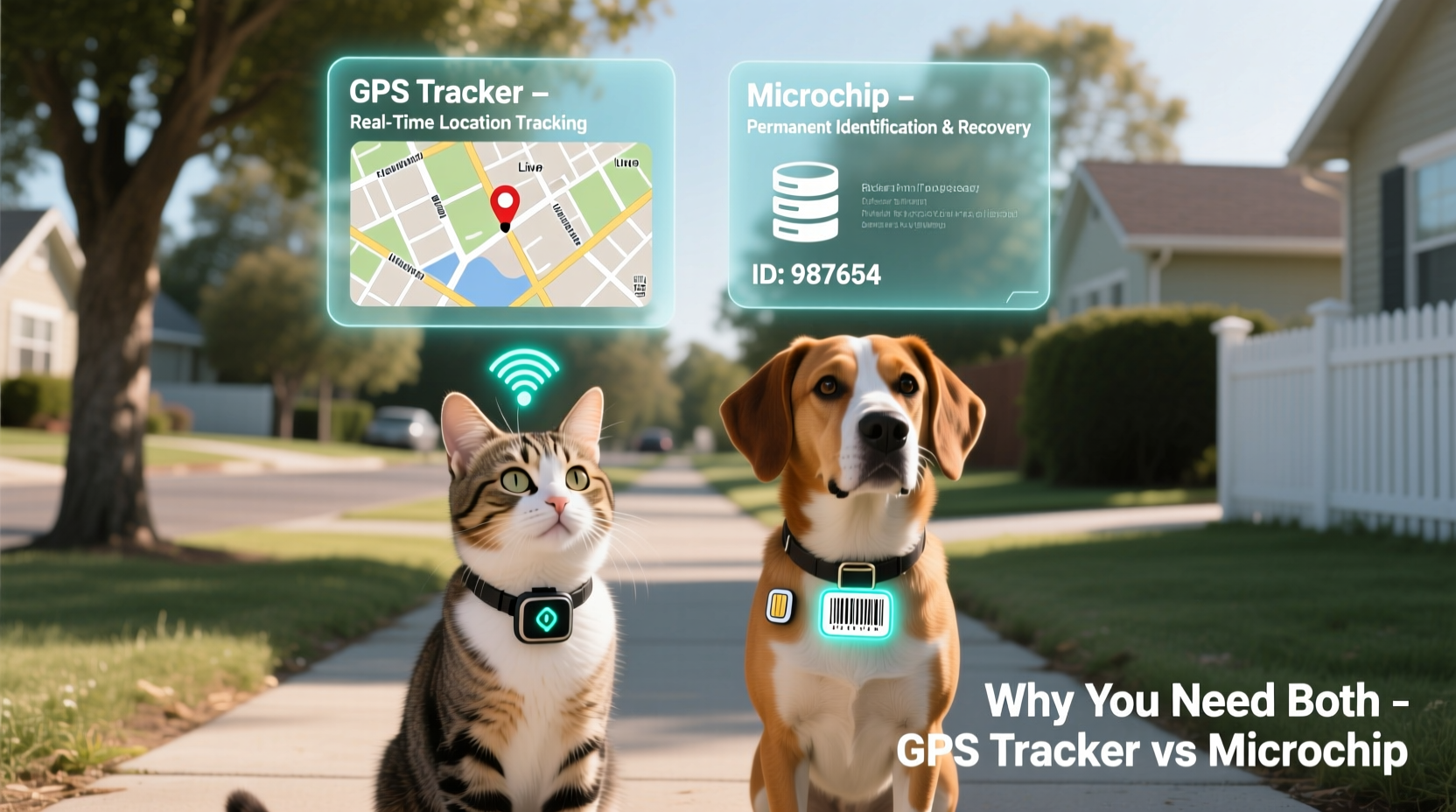
GPS (Global Positioning System) pet trackers use satellite signals and cellular networks to provide live updates on your pet’s whereabouts. These devices typically attach to a collar and connect to a smartphone app, enabling you to monitor your pet’s location 24/7. Most modern GPS collars offer features such as geofencing (alerts when your pet leaves a designated area), movement history, and even activity tracking.
The strength of a GPS tracker lies in its immediacy. If your dog slips out an open gate during a storm, you can see exactly where they are within minutes—potentially allowing you to retrieve them before they cross busy roads or get picked up by a stranger.
However, GPS trackers have limitations. They depend on battery power, cellular signal, and physical attachment to the pet. If the device dies, loses connection, or the collar breaks off, tracking stops. In rural areas with poor network coverage, accuracy may degrade. Additionally, GPS trackers can be removed—intentionally or accidentally—rendering them useless.
How Microchips Work: Permanent Identification
A microchip is a tiny radio-frequency identification (RFID) device about the size of a grain of rice. It is implanted under your pet’s skin, usually between the shoulder blades, in a quick procedure similar to a vaccination. The chip contains a unique ID number linked to your contact information in a secure registry database.
Unlike GPS devices, microchips do not transmit location data. They are passive—they only respond when scanned. This means they require no battery and last the lifetime of the pet. When a lost pet is brought to a veterinary clinic or animal shelter, staff routinely scan for a microchip. If found, they contact the registry, which then notifies the owner.
Microchipping has dramatically increased pet recovery rates. According to the American Veterinary Medical Association (AVMA), microchipped dogs are over twice as likely to be returned to their owners compared to non-microchipped ones. For cats, the difference is even greater—microchipped cats are more than 20 times more likely to be reunited with their families.
“Microchips are the single most reliable method of permanent identification. No amount of advanced tech can replace a chip that stays with the pet for life.” — Dr. Laura Bennett, DVM, American Animal Hospital Association
Yet microchips have their own drawbacks. They only help after the pet has been found and scanned. If your cat hides in a neighbor’s shed for three days, a microchip won’t tell you where they are—you must search manually or wait until someone finds and scans them. Also, if your contact details in the registry are outdated, the chip is ineffective.
Key Differences: GPS Tracker vs Microchip
| Feature | GPS Tracker | Microchip |
|---|---|---|
| Power Source | Battery-powered (requires charging) | No power needed (passive RFID) |
| Location Tracking | Real-time, continuous | None (only ID when scanned) |
| Lifespan | Depends on device durability and usage | Lifetime of the pet (20+ years) |
| Attachment | On collar (can fall off) | Implanted under skin (permanent) |
| Recovery Speed | Immediate (if powered and connected) | Delayed (depends on scanning) |
| Cost | $50–$150 + monthly subscription | $25–$50 (one-time fee) |
| Best For | Active search, prevention, real-time alerts | Permanent ID, post-recovery reunification |
Real-Life Example: Bella the Escaped Beagle
In 2022, a beagle named Bella slipped her leash during a walk in rural Ohio. Her owners had both a GPS collar and a microchip. The GPS tracker immediately sent an alert when she left their pre-set safe zone. Using the app, they traced her movement into a wooded area two miles away. However, the signal dropped after 30 minutes—likely due to thick tree cover and low battery.
They searched the area but couldn’t locate her. Three days later, a local farmer found Bella wandering near his barn and took her to a nearby vet clinic. There, a technician scanned her and found the microchip. The registry had up-to-date contact info, and Bella was returned home within hours.
This case illustrates the synergy between both technologies. The GPS tracker enabled immediate action and narrowed the search radius. The microchip ensured recovery even after the tracker failed. Without either, Bella might still be missing.
Why You Need Both: Layered Protection Strategy
Think of GPS trackers and microchips as layers in a security system. The GPS acts as the alarm and surveillance camera—active, responsive, and preventive. The microchip is the permanent ID badge—always present, always valid, even when everything else fails.
Consider these scenarios:
- Your dog escapes during a thunderstorm. The GPS helps you track them in real time while it's still raining. But if the collar falls off in a creek, the microchip remains.
- A thief steals your pet from your yard. The GPS might help law enforcement track movement initially, but if the device is disabled, only the microchip can prove ownership.
- Your cat wanders off and is found weeks later, malnourished and without a collar. Shelters will scan first—your microchip is the only lifeline.
Relying solely on a GPS tracker risks total failure if the device malfunctions. Relying only on a microchip means losing precious time during the initial escape window. Together, they close the gaps.
Action Plan: How to Implement Both Safeguards
Protecting your pet isn’t a one-time decision—it’s an ongoing commitment. Follow this step-by-step guide to ensure maximum safety.
- Get your pet microchipped by a licensed veterinarian. Confirm the chip is registered in a national database like AKC Reunite, HomeAgain, or Found Animals.
- Verify registration by calling the provider or checking online. Ensure your phone number, address, and email are current.
- Select a reliable GPS tracker based on your pet’s size, lifestyle, and environment. Look for models with strong battery life, real-time updates, and geofencing.
- Test the GPS device weekly. Check battery levels, signal strength, and app functionality.
- Use a durable, breakaway-proof collar for the GPS unit. Consider a secondary collar with ID tags listing your phone number.
- Update both systems annually, or immediately after moving, changing phones, or traveling.
- Inform neighbors and local shelters that your pet is microchipped and GPS-tracked, especially if they’re prone to wandering.
Frequently Asked Questions
Can a GPS tracker replace a microchip?
No. GPS trackers can fail due to dead batteries, poor signal, or detachment. Microchips are permanent and don’t rely on external power or connectivity. They serve different purposes—one tracks, the other identifies.
Do I need a GPS tracker if my pet is microchipped?
Yes, for proactive protection. A microchip only helps after someone finds your pet. A GPS tracker lets you begin searching immediately, increasing the chance of a fast recovery before your pet travels too far.
Are microchips safe? Can they cause health issues?
Microchips are extremely safe. Complications like migration or infection are rare and usually minor. The FDA and AVMA endorse microchipping as a standard practice. The benefits far outweigh the minimal risks.
Checklist: Are You Fully Protected?
- ✅ Pet is microchipped by a professional
- ✅ Microchip is registered with up-to-date contact info
- ✅ GPS tracker purchased and tested
- ✅ GPS app installed and synced to phone
- ✅ Collar is secure and comfortable
- ✅ Emergency contacts added to microchip profile
- ✅ Family members know how to use the GPS app
- ✅ Annual reminder set to verify both systems
Final Thoughts: Don’t Wait Until It’s Too Late
Pet loss is stressful, emotional, and often preventable. Technology has given us unprecedented tools to safeguard our animals—but only if we use them wisely. A GPS tracker without a microchip leaves your pet unidentified if the device fails. A microchip without a GPS tracker delays response during the critical first hours of escape.
The smartest pet owners don’t choose between GPS and microchips. They use both. One gives speed and visibility. The other offers permanence and proof. Together, they form a complete safety net.




 浙公网安备
33010002000092号
浙公网安备
33010002000092号 浙B2-20120091-4
Comments
No comments yet. Why don't you start the discussion?