
Living with ADHD in academic or professional settings often means navigating distractions, time mismanagement, and emotional regulation challenges. While medication and therapy are foundational, knowledge and tools play a crucial role in daily functioning. The right book can reframe your understanding of ADHD, while the right notebook can become an anchor for focus and consistency. This guide brings together authoritative books that deepen insight into ADHD and practical notebooks designed to support executive function in real-world scenarios.
Understanding ADHD: Why Books Matter
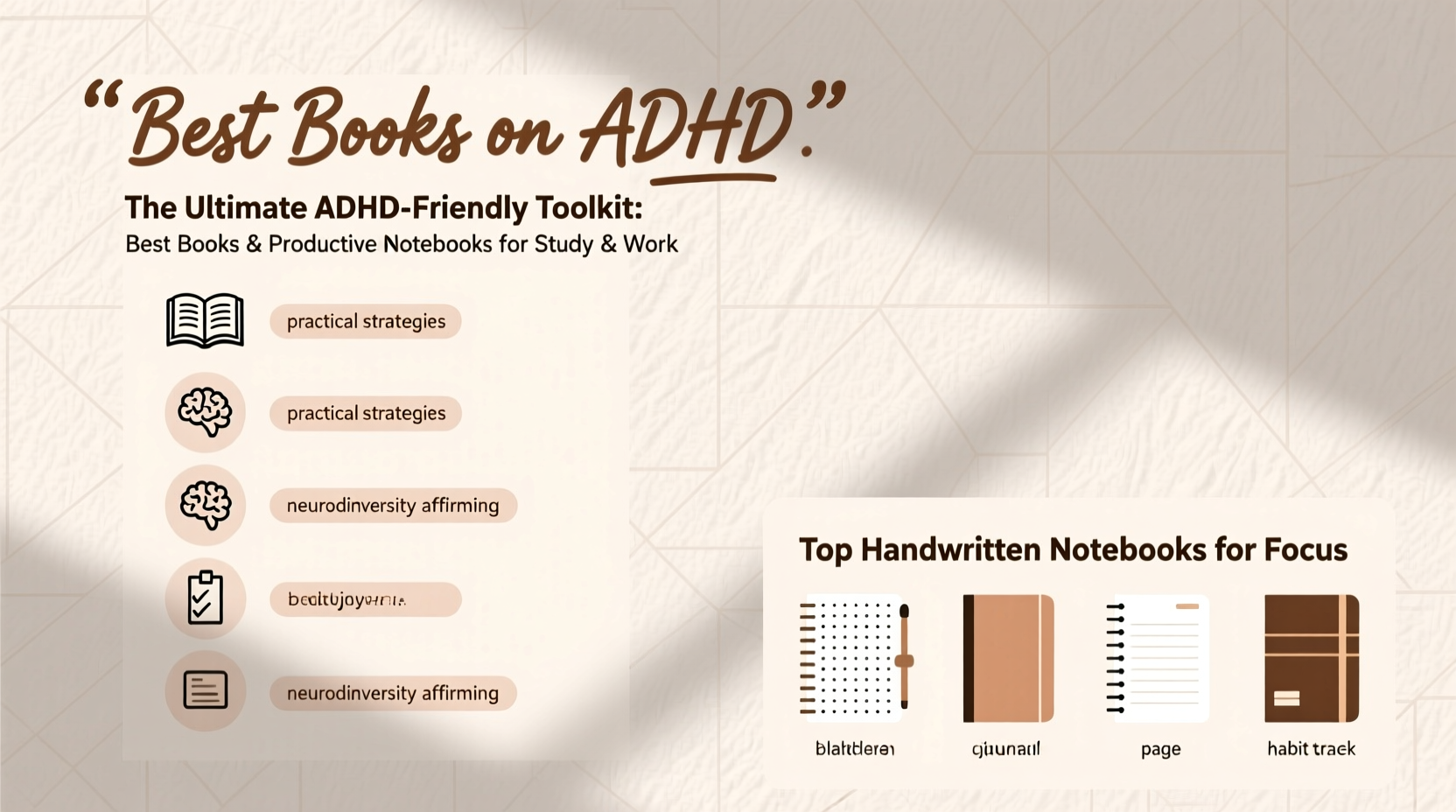
ADHD is not simply about attention deficits—it's a neurodevelopmental condition affecting working memory, impulse control, and task initiation. Misconceptions persist, even among professionals. Reading from experts helps individuals reclaim agency by replacing stigma with science-backed strategies.
Books authored by clinicians, researchers, and lived-experience advocates offer frameworks for managing symptoms without shame. They explain how dopamine regulation impacts motivation, why traditional time management fails for ADHD brains, and how environmental design can compensate for executive dysfunction.
“Understanding your brain isn’t about fixing it—it’s about aligning your environment and habits with how it actually works.” — Dr. William Dodson, ADHD Specialist
Top 5 Recommended Books on ADHD
These books stand out for their clarity, evidence-based approaches, and actionable advice tailored to adults, students, and professionals.
- The Disordered Mind: What Unusual Brains Tell Us About Ourselves by Eric R. Kandel – While not exclusively about ADHD, this Nobel laureate’s exploration of brain disorders provides essential neuroscience context. It helps readers appreciate ADHD as a difference in neural wiring, not a moral failing.
- Driven to Distraction (Revised): Recognizing and Coping with Attention Deficit Disorder by Edward M. Hallowell and John J. Ratey – A cornerstone text. The authors blend clinical expertise with compassionate storytelling, offering relatable examples and practical coping mechanisms. Ideal for newly diagnosed adults.
- ADHD 2.0: New Science and Essential Strategies for Overcoming Distraction and Achieving Success by Hallowell and Ratey – An update reflecting advances in treatment and understanding. Introduces concepts like “interest-based nervous systems” and emphasizes strengths such as hyperfocus and creativity.
- You Mean I’m Not Lazy, Stupid or Crazy?!: A Self-Help Book for Adults with Attention Deficit Disorder by Kate Kelly and Peggy Ramundo – A reader favorite for its candid tone and step-by-step guidance. Covers relationships, workplace accommodations, and self-advocacy with empathy and humor.
- Smart but Scattered: The Revolutionary \"Executive Skills\" Approach to Helping Kids Reach Their Potential by Peg Dawson and Richard Guare – Though aimed at children, this book is invaluable for adults who struggle with planning, organization, and follow-through. The executive skills model applies across ages.
Choosing the Right Notebook for ADHD Management
Notebooks aren't just for jotting down notes—they're cognitive prosthetics. For people with ADHD, the physical act of writing engages motor memory, aiding retention. More importantly, a well-designed notebook reduces decision fatigue by providing structure.
The ideal notebook supports task initiation, time tracking, and emotional regulation. Look for layouts that include daily planning grids, habit trackers, space for brain dumps, and reflection prompts. Spiral binding allows flat opening, critical for quick access during moments of low energy or high distraction.
Key Features of Effective ADHD-Friendly Notebooks
- Daily spreads with hourly blocks for time blocking
- Morning/evening checklists to establish routines
- Priority ranking sections (e.g., “Top 3 Tasks Today”)
- Minimalist design to avoid visual overwhelm
- Durable covers that withstand constant carrying
Comparison: Top Notebooks for Study and Work with ADHD
| Notebook | Best For | Key Features | Why It Works for ADHD |
|---|---|---|---|
| Passion Planner | Long-term goal setting | Yearly → weekly breakdowns, goal mapping, gratitude section | Links daily tasks to big-picture goals—motivates through purpose |
| Erin Condren LifePlanner | Students & multitaskers | Customizable layouts, color-coded tabs, sticker-friendly | Visual cues enhance engagement; reduces boredom-related neglect |
| Boorum & Pease Daily Journal | Professionals needing simplicity | One page per day, lined format, durable binding | Low-pressure entry; easy to maintain consistency |
| DoItNow! Planner by AdhdNerd | Immediate task execution | “Now, Next, Later” layout, urgency matrix, focus timer integration | Designed specifically for ADHD paralysis and procrastination |
| Leuchtturm1917 Weekly Planner | Habit tracking & review | Index, numbered pages, monthly overviews, pocket in back | Promotes accountability and retrospective analysis |
Putting It Into Practice: A Real-Life Example
Sophia, a graduate student diagnosed with ADHD at 24, struggled with completing literature reviews. She’d start strong, then lose momentum within days. After reading ADHD 2.0, she adopted the concept of “body-doubling”—working alongside someone else—and began using the DoItNow! Planner to break assignments into micro-tasks.
Each morning, she wrote her top two priorities and scheduled a 25-minute session with a peer via video call. She used the planner’s “Progress Pulse” section to rate her focus level hourly. Within three weeks, her completion rate improved from 40% to 85%. The combination of expert insight and tactile planning tools transformed her workflow.
Action Plan: Building Your ADHD Support System
Start small and build consistency. Follow this five-step timeline to integrate books and notebooks effectively:
- Week 1: Choose one book and one notebook. Read 10–15 pages daily. Spend 5 minutes each evening journaling takeaways.
- Week 2: Map out your week using the notebook’s planner. Include non-negotiables (meals, sleep, movement) and one priority task per day.
- Week 3: Identify one recurring challenge (e.g., missed deadlines). Flip to the relevant chapter in your book and apply one suggested strategy.
- Week 4: Review your progress. Did the notebook reduce mental clutter? Did the book shift your self-perception? Adjust tools as needed.
- Ongoing: Rotate books every 4–6 weeks. Experiment with different notebook formats quarterly to prevent stagnation.
Frequently Asked Questions
Can digital planners work as well as physical notebooks?
Some individuals with ADHD thrive on digital tools like Notion or Todoist, especially when gamification or reminders are involved. However, many find that handwriting boosts retention and reduces screen-induced distraction. Try both and assess which sustains consistent use.
Are there books specifically for women with ADHD?
Yes. Women with ADHD: Embracing Our Differences by Patricia Quinn and Linda Pinksy addresses hormonal influences, societal expectations, and diagnostic disparities. It’s particularly helpful for those whose symptoms were overlooked in childhood.
How do I stop abandoning my planner after a few days?
Abandonment often stems from over-complexity. Start with a minimalist notebook and commit to recording only one thing per day—like your main accomplishment. Build the habit first; refine the system later.
Final Thoughts: Tools Are Just the Beginning
Knowledge and organization don’t cure ADHD—but they equip you to navigate it with greater confidence. The books listed here offer validation and science-backed strategies. The notebooks provide scaffolding for thoughts that might otherwise scatter. Together, they form part of a larger ecosystem of support that includes therapy, community, and self-compassion.
Your brain isn’t broken. It’s different. And with the right resources, you can turn perceived weaknesses into strategic advantages. Pick one book. Open one notebook. Write one sentence. That’s where momentum begins.




 浙公网安备
33010002000092号
浙公网安备
33010002000092号 浙B2-20120091-4
Comments
No comments yet. Why don't you start the discussion?