
When it comes to styling tools, attachments often seem like minor accessories—interchangeable parts you can swap without consequence. But when it comes to blow dryers, two of the most common attachments—the hair volumizer blower and the diffuser dryer—serve fundamentally different purposes. Choosing between them isn’t just about preference; it’s about understanding your hair type, texture, and desired outcome. The right attachment can transform your styling routine, while the wrong one might leave you battling flat roots or frizzy curls.
The debate isn't just cosmetic. Stylists and trichologists agree that improper heat distribution and airflow can damage hair over time. So, does the attachment really make that big of a difference? The answer is a resounding yes—but only if you're using the right one for your hair's needs.
Understanding the Mechanics: How Attachments Shape Your Style
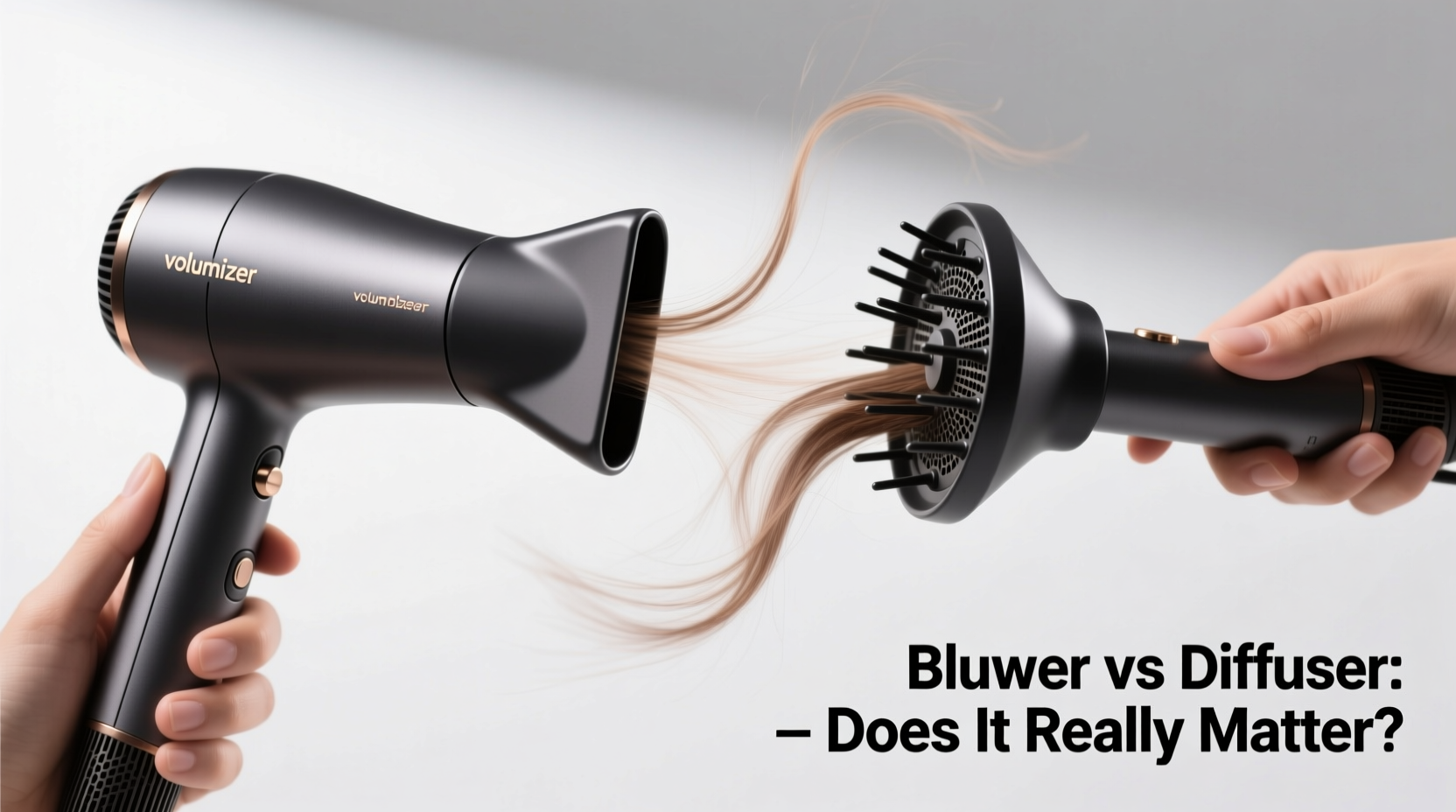
Blow dryer attachments are not mere add-ons—they’re precision tools designed to manipulate airflow, heat concentration, and drying technique. The core distinction lies in how they direct air and interact with hair strands.
A **volumizer blower** (also known as a concentrator nozzle) narrows the airflow into a focused stream. This allows targeted drying, especially at the roots, which lifts hair from the scalp and creates lift. It’s ideal for smoothing cuticles, reducing frizz on straight or wavy hair, and achieving sleek finishes.
In contrast, a **diffuser dryer** spreads airflow over a wider area using prongs or fingers that separate curls gently. Instead of forcing air in one direction, it disperses heat evenly, minimizing disruption to natural curl patterns. This reduces tangling and prevents puffiness, making it essential for curly, coily, or textured hair types.
Performance Comparison: Volumizer vs Diffuser
| Feature | Volumizer Blower | Diffuser Dryer |
|---|---|---|
| Best For | Straight, fine, thin, or flat hair seeking volume | Curly, wavy, coily, or thick textures |
| Airflow Type | Focused, directional stream | Wide, dispersed flow |
| Heat Distribution | Concentrated (risk of overheating if misused) | Even, gentle diffusion |
| Styling Outcome | Smooth finish, root lift, polished look | Defined curls, reduced frizz, enhanced shape |
| Drying Time | Faster due to concentrated airflow | Slower but more controlled |
| Risk of Frizz | Low on straight hair, high on curls if misapplied | Minimized when used correctly |
Real-World Impact: A Mini Case Study
Consider Sarah, a 32-year-old with shoulder-length, wavy hair prone to frizz. She’d been using a standard blow dryer with a concentrator nozzle, aiming for a “salon-smooth” look. Despite her efforts, her waves turned into undefined puff within hours. After consulting a stylist, she switched to a diffuser and adjusted her technique—bending forward, scrunching sections as she dried. Within two weeks, her hair had more definition, less frizz, and held its shape longer.
On the other hand, Mark, who has fine, straight hair that flattens by midday, struggled with limpness even after blow-drying. He started using a volumizer attachment, directing airflow upward at the roots while lifting sections with a round brush. His hair maintained lift for nearly twice as long, and he reduced reliance on volumizing sprays.
These examples highlight a key truth: the attachment must match both hair type and styling goal. Misalignment leads to frustration and suboptimal results.
“Choosing the right dryer attachment is like selecting the correct brush for a painting. The same canvas yields vastly different outcomes based on the tool.” — Lena Torres, Celebrity Stylist & Educator
Step-by-Step Guide: Maximizing Results with Each Attachment
Using a Volumizer Blower for Lift and Smoothness
- Towel-dry hair until damp (not dripping).
- Apply a heat protectant serum or spray.
- Attach the volumizer nozzle to your dryer.
- Divide hair into sections, starting at the nape.
- Point the nozzle downward along the hair shaft to smooth cuticles.
- At the crown, angle the dryer upward and use a round brush to lift roots.
- Use short bursts of cool air at the end to set volume.
Using a Diffuser Dryer for Curl Definition
- After washing, apply leave-in conditioner and curl cream.
- Gently scrunch out excess water with a microfiber towel.
- Attach the diffuser and set dryer to low/medium heat and speed.
- Bend forward and place sections of hair into the diffuser bowl.
- Hover the diffuser near the scalp, allowing roots to dry first.
- Scrub gently at the roots to encourage lift, then let ends dry naturally.
- Minimize touching during drying to prevent frizz.
Expert Tips and Common Mistakes
- Mistake: Using a concentrator on soaking-wet curls—it disrupts pattern formation and increases frizz.
- Mistake: Holding the diffuser too far away—reduces effectiveness and prolongs drying time.
- Pro Tip: Cool shot button resets the hair’s shape after heat exposure—use it at the end of every session.
- Pro Tip: Clean your diffuser regularly. Built-up product residue restricts airflow and reduces efficiency.
- Myth: Diffusers don’t work on short hair. Modern compact diffusers are excellent for pixie cuts and bobs with texture.
FAQ: Common Questions Answered
Can I use a diffuser if I have straight hair?
Yes—if you want to add softness, body, or slight wave. While it won’t create curls, a diffuser can enhance movement and reduce flatness when used on lower heat. Avoid over-drying, as straight hair may become limp if exposed to prolonged moisture agitation.
Is a volumizer attachment bad for curly hair?
Generally, yes—if used improperly. The focused airflow can break up curl clumps and cause frizz. However, some stylists use a low-heat volumizer briefly at the roots to boost lift before diffusing the lengths. Caution and minimal contact are key.
Do all dryers fit all attachments?
No. Attachments are often brand-specific or require adapters. Check compatibility before purchasing third-party nozzles or diffusers. Universal fittings exist but may not provide a secure seal, affecting performance.
Final Checklist: Choosing the Right Tool
- Identify your hair type: straight, wavy, curly, coily, fine, thick?
- Determine your primary goal: volume, smoothness, curl definition, frizz control?
- Assess your current blow dryer’s compatibility with attachments.
- Invest in a quality diffuser if you have curls or waves—even aftermarket ones can improve results.
- Practice proper technique: patience and consistency matter more than the tool alone.
- Never skip heat protection—attachments manage airflow, not thermal damage.
Conclusion: Match the Tool to the Hair, Not the Trend
The difference between a volumizer blower and a diffuser dryer isn’t subtle—it’s transformative. One shapes polish and precision; the other nurtures texture and individuality. The attachment you choose should reflect your hair’s biology, not social media trends or what came bundled with your dryer.
Understanding this distinction empowers better decisions—not just about tools, but about care. Whether you're chasing sleek sophistication or embracing natural volume, the right attachment makes the process faster, safer, and more effective. Stop guessing. Start matching. Your hair will respond with healthier shine, longer-lasting styles, and fewer bad hair days.




 浙公网安备
33010002000092号
浙公网安备
33010002000092号 浙B2-20120091-4
Comments
No comments yet. Why don't you start the discussion?