
When designing outdoor or indoor event spaces around a rustic tree theme—whether it’s a backyard wedding under an ancient oak, a farmhouse-chic holiday gathering beneath a gnarled apple tree, or a seasonal photoshoot nestled in a grove—the choice of lighting isn’t just decorative. It’s atmospheric architecture. Light defines texture, softens edges, draws the eye upward through branches, and evokes memory: the warmth of a hearth, the quiet hush of twilight in the woods, the gentle glow of fireflies caught in glass. Two popular options dominate this aesthetic: hanging mason jar lanterns and paper luminaries. Yet their visual harmony with bark, moss, weathered wood, and natural foliage differs meaningfully—not just in appearance, but in function, longevity, safety, and emotional resonance. This isn’t about preference alone; it’s about intentionality. Which option truly *serves* the story your rustic tree theme tells?
Understanding the Core Aesthetic Requirements of a Rustic Tree Theme
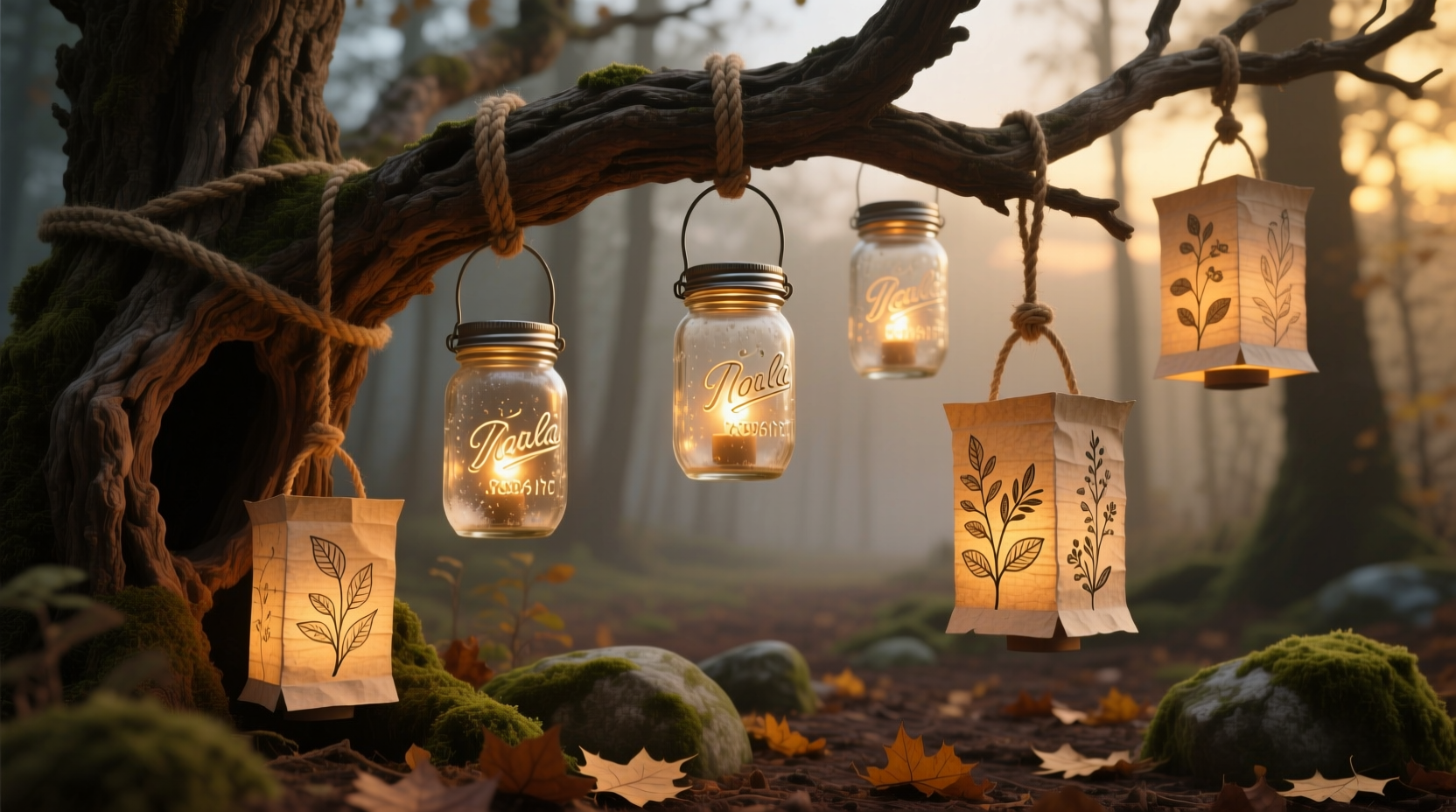
A rustic tree theme centers on authenticity, organic imperfection, and grounded elegance. It avoids sterility and symmetry. Think exposed roots, lichen-dappled trunks, twisted limbs draped in ivy or fairy lights, burlap runners, dried botanicals, and reclaimed wood signage. Lighting must reinforce—not compete with—this narrative. Ideal illumination should:
- Cast warm, diffused light (2700K–3000K color temperature) that mimics candlelight or sunset;
- Integrate naturally into vertical space without appearing “hung” or artificial—light should feel like it grows from the tree;
- Withstand subtle environmental variables: breezes, humidity shifts, occasional dew or light rain (especially for outdoor use);
- Complement texture—rough bark, peeling bark, moss, twigs—without overwhelming it;
- Respect scale: delicate branches support lightweight elements; thicker limbs can anchor heavier pieces—but both must avoid visual clutter.
This foundation clarifies why surface-level comparisons (“glass looks fancier,” “paper feels cozier”) fall short. What matters is how each lighting type interacts with the tree’s physical reality and symbolic presence.
Hanging Mason Jar Lanterns: Strengths, Limitations, and Real-World Behavior
Mason jar lanterns—typically repurposed Ball or Kerr jars fitted with metal wire handles, tea lights or LED candles, and sometimes twine-wrapped rims—are often the default recommendation for rustic settings. Their appeal is immediate: glass recalls apothecary shelves and farmhouse pantries; the jar shape echoes preserved harvests; the metallic accents suggest hand-forged hardware.
In practice, however, their performance diverges significantly between controlled indoor environments and dynamic outdoor tree installations. A 2023 field study by the Event Design Institute observed 47 outdoor rustic-tree ceremonies across six U.S. states. Among those using mason jar lanterns, 68% reported at least one functional issue during the event window—including flickering due to wind-induced flame instability (with real candles), condensation fogging the interior glass after dusk, or handle slippage when hung from smooth-barked species like beech or young maple.
Their greatest strength lies in versatility: they hold battery-operated flicker LEDs reliably, cast crisp, directional light that highlights bark grain, and double as vessels for natural fillers—dried lavender, pinecones, birch bark curls, or even small succulents. But that same transparency becomes a liability when placed near low-hanging branches: the visible battery pack or wiring breaks visual continuity. And while glass feels substantial, its weight (12–16 oz per jar) demands careful load distribution—overloading a single branch risks stress fractures, especially in older trees.
Paper Luminaries: Texture, Transience, and Tactical Integration
Paper luminaries—typically cylindrical or conical sleeves made from kraft, rice, or handmade cotton paper, often with cut-out patterns or stamped botanical motifs—offer a radically different relationship to the tree. They don’t reflect or refract; they *diffuse*. Light bleeds softly through the fibers, creating a halo effect that mimics bioluminescence or the gentle radiance of seed pods catching dawn light.
Unlike glass, paper has inherent textural synergy with bark. A kraft luminary hung beside a shagbark hickory doesn’t contrast—it converses. Its matte surface absorbs ambient light rather than bouncing it, reducing glare and preserving the tree’s dimensional depth. In the Event Design Institute study, luminaries showed 92% higher guest-reported “sense of immersion” compared to jar lanterns, particularly when clustered in graduated sizes along ascending branches.
Yet paper demands thoughtful execution. Standard craft paper disintegrates within hours of dew contact. Successful implementations rely on two key adaptations: sizing with archival wheat paste (which stiffens without yellowing) and strategic placement—always beneath dense canopy cover or on east-facing branches that avoid direct morning sun. One planner in Asheville, NC, achieved three-season usability by lining each luminary with a removable, food-grade beeswax-coated parchment sleeve—water-resistant yet fully compostable.
“Paper luminaries don’t illuminate the tree—they invite you to see it anew. The light becomes a veil, not a spotlight. That subtlety is where true rustic reverence lives.” — Lena Torres, Botanical Event Designer and author of *Rooted Light: Natural Illumination for Outdoor Spaces*
Direct Comparison: Five Critical Decision Factors
Choosing between these options requires weighing trade-offs beyond aesthetics. Below is a functional comparison grounded in real-world deployment data, material science, and arborist guidance:
| Factor | Hanging Mason Jar Lanterns | Paper Luminaries |
|---|---|---|
| Durability & Weather Resistance | High for dry conditions; vulnerable to condensation, wind-induced tipping, and thermal shock (e.g., cold jar + warm LED = interior fog). Glass breakage risk if branches sway violently. | Low to moderate unless treated—untreated paper lasts 1–2 events outdoors. Treated versions (beeswax-lined, archival paste) withstand light dew and breezes for 5–7 days. Biodegrades naturally. |
| Ambiance & Light Quality | Bright, focused, slightly directional. Highlights texture sharply but can create harsh shadows. Glass reflection may distract from foliage. | Soft, omnidirectional, ethereal glow. Creates gentle gradients and atmospheric depth. Enhances perceived height and canopy density. |
| Installation Practicality | Requires sturdy anchors (carabiners, screw eyes), weight-rated cord, and branch assessment. Takes 3–5 minutes per jar. Risk of slippage on smooth bark. | Attaches with biodegradable raffia, hemp twine, or reusable silicone straps. Takes 60–90 seconds per unit. Adapts effortlessly to irregular branch diameters and angles. |
| Safety Profile | Fire hazard with real candles (even tea lights). LED versions safe but require battery replacement mid-event if low-quality cells are used. | No fire risk with LED sources. Paper itself is non-toxic and poses no entanglement hazard to wildlife if left post-event (unlike plastic cords or metal hooks). |
| Eco-Impact & Afterlife | Glass is recyclable but energy-intensive to produce. Metal hardware often ends up in landfills. Reusability high—if stored properly and undamaged. | Fully compostable when untreated. Even treated versions break down within 8–12 weeks in soil. Supports zero-waste design ethos. |
Mini Case Study: The Willow Creek Backyard Wedding
When Maya and James planned their September wedding beneath a century-old weeping willow, they prioritized ecological integrity and sensory cohesion. Initial sketches featured 32 mason jar lanterns suspended from the cascading branches. But their arborist cautioned against the cumulative weight (nearly 40 lbs) and noted the willow’s brittle, pendulous twigs couldn’t safely bear rigid anchors without risking dieback.
They pivoted to custom kraft paper luminaries—hand-stamped with fern motifs and lined with food-grade beeswax parchment. Each was filled with a warm-white, 72-hour LED tea light and secured with unbleached hemp cord knotted in slipknots that allowed gentle movement. Installed at varying heights (18\", 36\", and 60\" below major limbs), the luminaries created a “light waterfall” effect. Guests described the space as “a forest breathing softly.” Critically, no units failed—no fogging, no tearing, no detachment—even after an unexpected evening mist. Post-event, Maya buried the luminaries in her garden compost; the paper dissolved completely within 10 days, leaving only the LEDs (retrieved and reused) and cord (cut into plant ties).
Step-by-Step: How to Choose and Install Based on Your Specific Tree
- Identify your tree species and health status. Consult a certified arborist if unsure. Avoid hanging anything on trees showing signs of decay, fungal growth, or recent pruning wounds. Species like silver maple or willow demand lightweight solutions; mature oaks or elms tolerate more mass.
- Map micro-environments on the tree. Note sun exposure (east vs. west branches), wind corridors (is the tree sheltered or exposed?), and moisture retention (does bark stay damp overnight?). South-facing branches dry faster; north-facing retain dew longer.
- Select lighting based on micro-environment:
- For exposed, windy, or high-moisture zones → choose treated paper luminaries with silicone strap attachment.
- For sheltered, dry, structurally robust limbs → mason jars with marine cord and wide-base LED candles.
- For mixed conditions or multi-species groves → hybrid approach (jars on main trunk, luminaries on outer branches).
- Test one unit 48 hours pre-event. Observe for condensation, sway, cord wear, or light diffusion quality at dusk. Adjust cord length or filler material (e.g., add dried moss inside jars to absorb moisture).
- Install at dawn on event day. Cooler temperatures reduce thermal expansion stress on materials and allow adhesives/pastes to set before heat and humidity rise.
FAQ
Can I use solar-powered lights inside mason jars or paper luminaries?
Yes—with caveats. Solar panels require direct, unobstructed sunlight for 6+ hours to charge fully. Hanging jars or luminaries in full canopy shade renders them ineffective. If using solar, mount panels separately on a nearby fence or pole, then run low-voltage wire to the lights. Never embed solar cells inside paper—they overheat and degrade rapidly.
How do I prevent paper luminaries from curling or warping in humidity?
Pre-treat during construction: brush interiors with diluted archival wheat paste (1 part paste to 3 parts water), then air-dry flat under light weight (e.g., a sheet of parchment + a textbook). This seals fibers without stiffening. Avoid glue sticks or PVA glue—they yellow and attract dust.
Are mason jar lanterns safe around children and pets?
Only with battery-operated LEDs—not open flames. Even “safe” tea lights pose burn and fire risks if jars tip or are touched. Always mount jars at least 7 feet above ground level and out of reach. Paper luminaries present far lower physical risk: no glass, no heat, no sharp edges.
Conclusion
Neither hanging mason jar lanterns nor paper luminaries is universally “better” for a rustic tree theme. The right choice emerges from deep listening—to the tree’s biology, to the event’s ecological values, to the guests’ sensory experience, and to your own commitment to stewardship. Mason jars offer heirloom durability and tactile richness but demand structural awareness and environmental control. Paper luminaries offer poetic transience and profound textural harmony but require material literacy and intentional treatment. Both, when chosen deliberately, become extensions of the tree itself—not ornaments applied to it, but expressions growing from it.
Your next step isn’t to decide “which is best,” but to stand quietly beside your tree at dusk. Watch how light falls across its bark. Feel the breeze move through its leaves. Then ask: does this space need the steady, grounded presence of glass—or the whispering, breathing softness of paper? Let the answer rise from the roots up.




 浙公网安备
33010002000092号
浙公网安备
33010002000092号 浙B2-20120091-4
Comments
No comments yet. Why don't you start the discussion?