
Every traveler has a story—suitcases tossed off carts, stacked under heavy cargo, or dropped from conveyor belts. If you’ve ever opened your bag to find a shattered camera lens, cracked tablet, or dented perfume bottle, you know the frustration of trusting your belongings to airline handling. The choice between hard and soft luggage isn’t just about style or weight—it’s about protection. So, which type truly safeguards fragile items when subjected to the unpredictable treatment of baggage handlers?
The answer isn’t as straightforward as “hard shells are stronger.” While rigid cases offer undeniable structural resistance, soft bags bring flexibility and shock absorption into play. Understanding how each performs under real-world stress is essential for anyone carrying delicate electronics, heirlooms, or professional gear.
How Luggage Is Treated During Transit
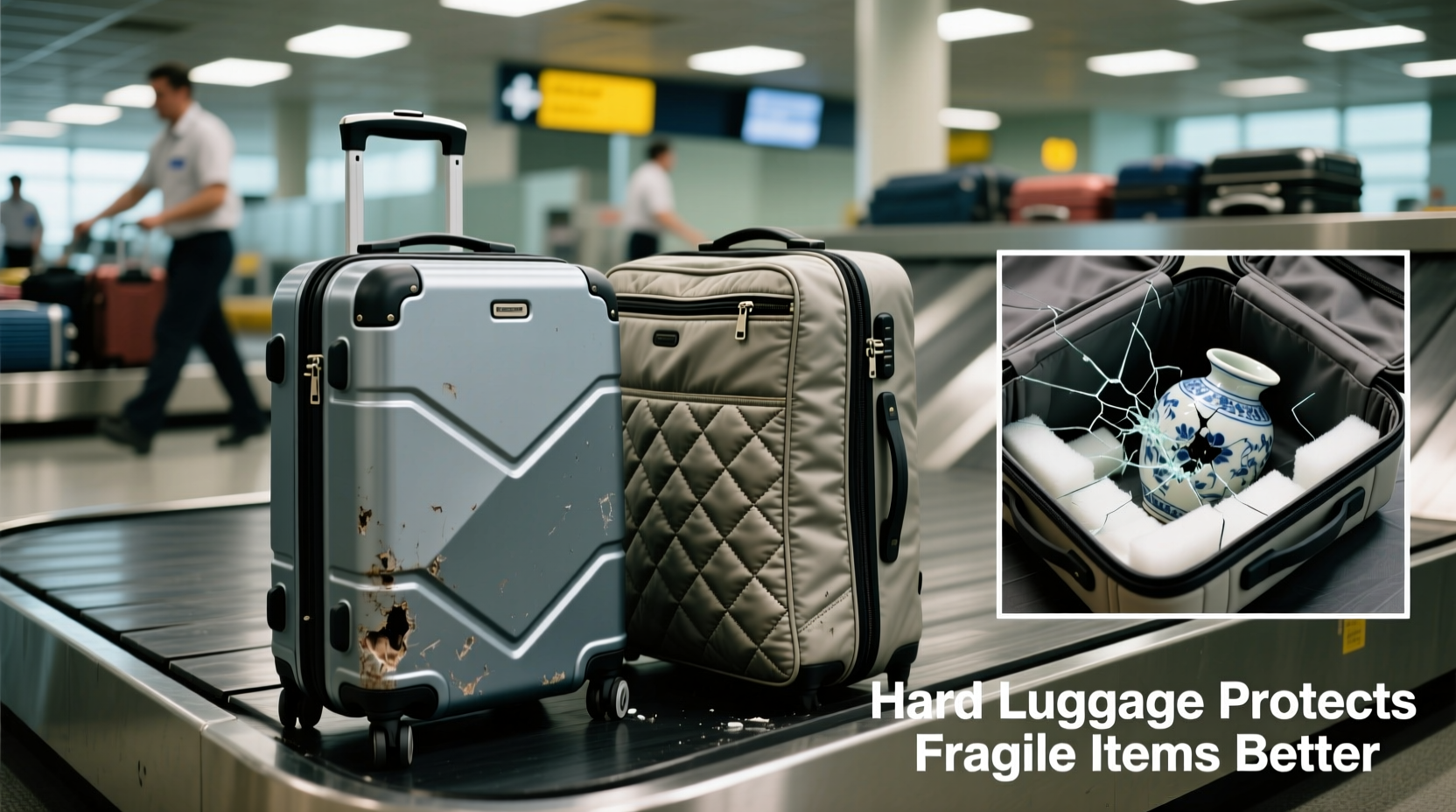
Airport baggage systems are designed for efficiency, not gentleness. Suitcases routinely endure drops from heights up to four feet, compression under stacks of heavier luggage, and impacts against metal rails and conveyor edges. According to a 2023 IATA report, an average checked bag experiences 5–7 significant impacts during a single journey, with peak forces reaching over 40 Gs in extreme cases.
Baggage handlers, though trained, operate under time pressure. They often prioritize speed and volume, meaning suitcases may be dragged, thrown, or carelessly loaded. This reality makes impact resistance and internal cushioning critical factors in luggage selection—especially for fragile contents.
“From our durability testing, we see that both hard and soft luggage fail differently. Hard cases resist punctures but transfer more force inward; soft bags absorb shocks but can deform and crush contents.” — Dr. Lena Torres, Materials Engineer at TravelGear Labs
Hard Luggage: Strengths and Limitations
Hard-shell luggage, typically made from polycarbonate, ABS plastic, or composite materials, is marketed for its durability and sleek appearance. Its primary advantage lies in its rigidity.
- Impact Resistance: Hard shells resist punctures, crushing, and sharp objects. A suitcase dropped on concrete is far less likely to rupture than a fabric alternative.
- Water Resistance: Most hard cases are fully sealed, protecting contents from rain, spills, or accidental immersion on wet tarmacs.
- Shape Retention: Unlike soft bags, hard luggage maintains its form even under heavy stacking, preserving internal space.
However, rigidity comes with trade-offs. When a hard case hits the ground, the energy from the impact doesn’t dissipate—it transfers directly to the contents inside. Without proper padding, this can result in broken screens, cracked lenses, or fractured glassware.
In crash tests conducted by Consumer Gear Review (2022), polycarbonate suitcases protected bulky items well but showed higher rates of internal damage to small, rigid objects like smartphones and tablets when dropped from airline-standard heights.
Soft Luggage: Flexibility as a Defense Mechanism
Soft-sided luggage, usually constructed from ballistic nylon, polyester, or ripstop fabrics with internal frames, behaves very differently upon impact. Instead of resisting force, it absorbs and disperses it.
The layered construction—outer fabric, foam lining, inner mesh compartments—acts like a shock absorber. When dropped or crushed, the material compresses slightly, reducing the peak force transmitted to contents. This is particularly effective for irregularly shaped or sensitive items.
- Shock Absorption: Fabric and foam layers cushion falls better than rigid plastics.
- Expandability: Many soft bags feature zippered expansion panels, allowing extra space for souvenirs without overstressing seams.
- Weight Savings: Soft luggage is generally lighter than hard-shell equivalents, leaving more allowance for personal items.
Yet soft luggage isn’t invincible. It’s vulnerable to tears, moisture penetration, and punctures from sharp objects. Over time, zippers and stitching can degrade, especially if the bag is consistently overloaded. And while it handles drops well, sustained pressure—like being buried under multiple heavy bags—can still crush flat-packed devices.
Comparative Protection: Real-World Performance Table
| Factor | Hard Luggage | Soft Luggage |
|---|---|---|
| Impact Resistance (External) | Excellent – resists cracks, dents, punctures | Fair – susceptible to tears and abrasions |
| Shock Absorption (Internal) | Poor to Moderate – transfers force inward | Good – fabric and foam dampen impact |
| Crush Protection (Stacking) | Excellent – maintains shape under load | Moderate – may compress, risking flat items |
| Water Resistance | High – seamless shells repel liquids | Low to Moderate – fabric may absorb moisture |
| Best For Fragile Items | When packed with padding; ideal for bulky, rigid objects | When using internal cushioning; better for lightweight, shock-sensitive gear |
Mini Case Study: Photographer’s Cross-Country Trip
Mark R., a professional travel photographer, regularly flies with two DSLR bodies, five lenses, filters, and memory cards. On a recent trip from New York to San Francisco, he tested two packing methods.
Trip 1: He used a premium hard-shell roller with custom foam inserts. Upon arrival, his 70–200mm lens showed no external damage, but the internal focusing ring was misaligned—likely due to force transmission through the rigid case during a rough unloading process.
Trip 2: He switched to a reinforced soft luggage model with padded camera insert and added bubble wrap around each lens. Though the exterior showed scuff marks and a minor tear near the handle, all equipment functioned perfectly post-flight.
Mark concluded: “The soft bag didn’t look as pristine, but my gear survived better. The flexibility absorbed what the hard shell transferred directly to the lenses.”
Maximizing Protection: A Step-by-Step Guide
No luggage type guarantees 100% safety. The key is optimizing your packing strategy based on your bag type and the fragility of your items. Follow this sequence for best results:
- Assess Your Contents: Identify which items are most fragile—electronics, glass, ceramics, etc. Prioritize their protection.
- Choose the Right Bag Type: For high-value, shock-sensitive gear (e.g., cameras, laptops), soft luggage with good padding may outperform hard cases. For heavy, bulky trips with risk of crushing, hard shells excel.
- Use Internal Protection: Wrap fragile items in clothing, bubble wrap, or padded cases. Never rely solely on the suitcase’s exterior.
- Distribute Weight Evenly: Place heavier items at the bottom, fragile ones in the center, surrounded by soft buffers like sweaters or towels.
- Fill Empty Spaces: Use rolled socks, scarves, or inflatable packing cubes to prevent shifting during transit.
- Label Clearly: Add “Fragile” stickers and consider TSA-approved locks to deter unnecessary handling.
- Track Your Bag: Use a GPS-enabled tracker (e.g., Apple AirTag, Tile) to monitor location and detect rough handling via motion logs.
Expert Tips for Protecting Fragile Items
Checklist: Are You Ready to Protect Your Fragile Items?
- ☐ Identified all fragile contents in your luggage
- ☐ Chosen luggage type based on item sensitivity and trip length
- ☐ Packed fragile items in protective cases or wraps
- ☐ Centered delicate items within the suitcase, surrounded by soft materials
- ☐ Eliminated empty spaces to prevent movement
- ☐ Added “Fragile” and “This End Up” labels
- ☐ Secured zippers with locks or cable ties
- ☐ Placed GPS tracker inside the bag
- ☐ Considered carrying the most valuable items onboard
FAQ: Common Questions About Luggage and Fragile Protection
Is polycarbonate luggage better than soft-sided for fragile items?
Not necessarily. Polycarbonate resists external damage well but transmits impact force inward. Without internal padding, it may offer less protection for delicate electronics than a well-padded soft bag. The material matters less than how you pack.
Can I make hard luggage safer for fragile items?
Yes. Use custom foam inserts, padded dividers, or wrap items in clothing. Some travelers use shock-absorbing materials like closed-cell foam sheets or gel padding inside hard cases to reduce force transfer.
Do baggage handlers really throw luggage?
While not standard procedure, luggage is often dropped from waist height onto carts or conveyor belts. Security and airline audits confirm that bags experience forces equivalent to being dropped 3–4 feet during normal handling. Intentional abuse is rare, but mechanical handling is inherently rough.
Conclusion: Matching Luggage to Your Needs
The debate between hard and soft luggage isn’t about declaring a universal winner—it’s about matching protection to purpose. Hard shells provide excellent defense against punctures and crushing, making them ideal for long trips with heavy loads or in environments with rough terrain. Soft luggage, with its superior shock absorption and flexible structure, often delivers better outcomes for sensitive electronics and lightweight fragile items.
Ultimately, the suitcase is only part of the equation. How you pack, what internal protections you use, and whether you keep the most valuable items with you are far more decisive than shell material alone.
If you're traveling with irreplaceable heirlooms, professional gear, or expensive gadgets, don’t leave protection to chance. Evaluate your luggage choice not by looks or brand, but by how well it integrates with smart packing practices. Your camera, laptop, or grandmother’s vase deserves more than hope.




 浙公网安备
33010002000092号
浙公网安备
33010002000092号 浙B2-20120091-4
Comments
No comments yet. Why don't you start the discussion?