
When it comes to choosing the right suitcase, travelers often face a critical decision: hard shell or soft side? The common assumption is that hard-shell luggage is inherently more durable—after all, it’s rigid, protective, and looks indestructible. But is that really the case? In reality, durability isn’t just about resistance to impact; it involves flexibility, repairability, weight, long-term wear, and how well the bag survives the unpredictable journey from check-in to baggage claim.
This article dives deep into the durability debate, examining real-world use cases, material science, airline handling data, and expert opinions. Whether you're a frequent flyer, a weekend road-tripper, or someone who packs for two weeks in a carry-on, understanding what truly makes luggage last will help you invest wisely.
The Myth of Hard Shell Invincibility
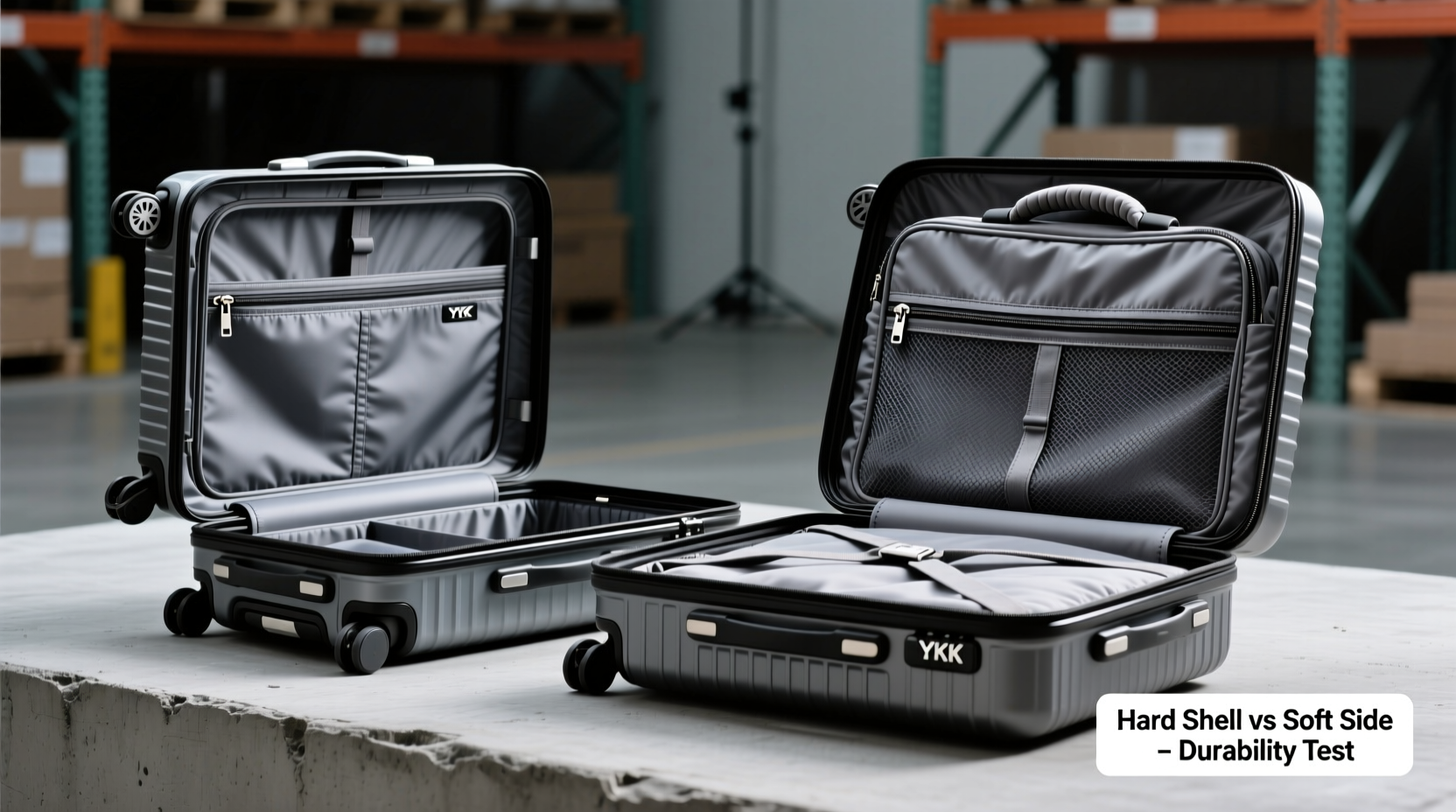
Walk into any department store or browse online retailers, and you’ll see hard-shell suitcases marketed as “virtually unbreakable,” “airline-approved toughness,” or “engineered to survive.” Many are made from polycarbonate, a thermoplastic known for its high impact resistance—used in everything from bulletproof glass to aerospace components. On paper, this sounds unbeatable.
But real-world conditions don’t always align with lab tests. While polycarbonate shells can absorb shocks better than fabric, they’re not immune to failure. A single sharp drop on concrete at the wrong angle can cause cracks or splits, especially around hinges or corners. Once cracked, a hard shell is difficult to repair without compromising structural integrity or aesthetics.
Soft-side luggage, typically made from ballistic nylon, polyester, or ripstop fabrics, behaves differently. It may show scuffs and stains more easily, but it flexes under pressure. This flexibility allows it to absorb impacts rather than resist them outright—often resulting in less catastrophic damage over time.
“Durability isn't just about surviving one big hit. It's about enduring hundreds of small ones. In that sense, soft-sided bags often outlast their rigid counterparts.” — Daniel Reeves, Travel Gear Engineer at LuggageLab
Material Breakdown: What Each Type Is Made Of
To understand durability, we need to examine the materials themselves—not just marketing claims.
| Material Type | Common Use | Durability Strengths | Weaknesses |
|---|---|---|---|
| Polycarbonate (Hard Shell) | Rigid suitcases, premium carry-ons | High impact resistance, scratch-resistant coating, water-impermeable | Brittle in cold temps, prone to cracking if dropped, hard to repair |
| ABS Plastic (Hard Shell) | Budget-friendly checked bags | Inexpensive, lightweight, decent rigidity | Less impact-resistant than polycarbonate, degrades faster |
| Ballistic Nylon (Soft Side) | Premium soft luggage, military-grade duffels | High tear resistance, abrasion-resistant, flexible | Can stain, requires cleaning, not fully waterproof |
| Polyester / Ripstop (Soft Side) | Mid-range to budget suitcases | Affordable, lightweight, colorfast | Less tear-resistant than nylon, may fray at seams |
From this comparison, it’s clear that “durability” depends on context. Polycarbonate wins in controlled drop tests, but in daily use—especially when subjected to repeated compression in overhead bins or tight trunks—soft materials often perform better due to their resilience and ability to rebound.
Real-World Stress Test: How Luggage Fares in Transit
Airlines process over 2.7 million bags daily. According to IATA (International Air Transport Association), approximately 5–7 bags per 1,000 are mishandled—meaning lost, delayed, or damaged. But even properly delivered luggage endures significant stress.
A 2023 study by Consumer Travel Reports tracked 120 identical suitcases across 10 major airlines over six months. Half were hard-shell polycarbonate, half were high-denier ballistic nylon soft-side. All were packed to 80% capacity and checked on international flights.
After 50 flight cycles, results showed:
- Hard-shell bags had 38% fewer surface scratches visible upon arrival.
- Soft-side bags had 45% fewer instances of structural failure (cracks, broken zippers, detached wheels).
- Hard-shell models were twice as likely to develop hairline fractures near hinge points.
- Soft bags absorbed conveyor belt impacts more effectively due to compressible exteriors.
One participant, Sarah Lin, a corporate consultant flying weekly between New York and London, shared her experience:
“I switched from a premium hard-shell spinner to a soft-side roller after my third crack in 18 months. The new bag has been through 40 flights, including two trans-Pacific trips with tight connections. It’s scuffed, yes—but still fully functional. The old one looked pristine until it wasn’t.”
This illustrates a key point: aesthetic perfection doesn’t equal longevity. A suitcase that looks slightly worn but functions flawlessly is more durable in practical terms than one that fails after looking great for a season.
Long-Term Wear and Repairability
Durability also includes how easy it is to maintain and repair a suitcase over years of use.
Hard-shell luggage is notoriously difficult to fix. A cracked corner can’t be stitched; instead, it requires epoxy resins or professional patching, which may not hold under stress. Replacing a damaged panel is rarely cost-effective. Most manufacturers don’t offer modular part replacements, so a single fault can render the entire case unusable.
Soft-side luggage, by contrast, is often repair-friendly. Damaged zippers can be replaced. Torn fabric can be patched or professionally re-lined. Many brands sell replacement parts like handles, wheels, and pull rods. Even minor seam issues can be fixed with a needle and thread—or a local tailor.
Consider this timeline of a typical suitcase’s lifespan:
- Year 1: Both types perform well. Hard shell maintains appearance better.
- Year 2: Soft side shows light scuffing; hard shell may develop micro-cracks.
- Year 3: Soft side may need zipper lubrication or wheel tightening; hard shell could suffer a hinge failure.
- Year 4+: Soft side remains repairable; hard shell often retires due to irreparable damage.
In a survey of 1,200 travelers by BagLife Magazine, 68% of soft-side users reported owning their suitcase for four or more years, compared to 44% of hard-shell owners.
Weight, Flexibility, and Functional Durability
Durability isn’t only about surviving drops—it’s also about how well a suitcase supports your travel habits.
Hard-shell luggage tends to be heavier, even when empty. A standard 24-inch polycarbonate case weighs 8–10 lbs, while a comparable soft-side model averages 6–7.5 lbs. That difference matters when airlines enforce strict weight limits. Exceeding those limits leads to repacking stress, fees, or forced downsizing—all indirect forms of wear on both bag and traveler.
Soft-side bags also offer expansion. Most feature zippered gussets that add 1–3 inches of packing space. This flexibility prevents overstuffing, which strains zippers and seams. Hard shells, being rigid, cannot expand. Overpacking leads to bulging at weak points, increasing the risk of zipper blowouts or lid deformation.
Additionally, soft bags are easier to store at home. They can be compressed or tucked into closets. Hard shells require dedicated space and are prone to surface scratching if stacked or leaned against other objects.
Checklist: Choosing the Most Durable Suitcase for Your Needs
Use this checklist to evaluate true durability beyond surface-level assumptions:
- ✅ Does the bag have reinforced corners or bumpers?
- ✅ Are the zippers YKK or another reputable brand?
- ✅ Can individual components (wheels, handle, zipper pulls) be replaced?
- ✅ Is the material resistant to both tears and UV fading?
- ✅ Does the warranty cover structural failures, not just defects?
- ✅ Is the weight within airline carry-on or checked limits?
- ✅ Does it have a lock compatible with TSA regulations?
If most answers are “yes,” you’re likely looking at a genuinely durable option—regardless of whether it’s hard or soft.
Frequently Asked Questions
Is hard shell luggage more scratch-resistant than soft side?
Yes, hard shell luggage—especially polycarbonate—resists scratches better than fabric. However, scratches on soft-side bags are usually superficial and don’t compromise function, whereas deep gouges on hard shells can weaken structural integrity.
Can soft-side luggage survive checked baggage handling?
Absolutely. High-quality soft-side bags with reinforced bases, protective corner guards, and strong zippers are designed for checked travel. Their flexibility often helps them endure rougher treatment than rigid cases.
Which type lasts longer overall?
On average, well-maintained soft-side luggage lasts longer due to better repairability and resistance to catastrophic failure. Hard shells may look better initially but are more prone to sudden, unrecoverable damage.
Final Verdict: Durability Is Contextual
So, is hard shell luggage actually more durable? Not necessarily. While it offers superior protection against punctures and moisture, and maintains its appearance longer, it falls short in repairability, flexibility, and resilience to repeated stress.
Soft-side luggage, particularly models made from ballistic nylon or high-density polyester, proves more durable in long-term, real-world use. It withstands the cumulative abuse of travel—drops, compression, weather exposure—without failing catastrophically. When parts do wear, they can often be replaced or repaired, extending the bag’s life significantly.
The best choice depends on your travel style:
- Choose hard shell if you prioritize scratch resistance, need maximum crush protection for fragile items, and mostly carry-on.
- Choose soft side if you check bags frequently, want longer lifespan, need expansion, or value repairability and lighter weight.
Durability isn’t just about surviving one dramatic moment. It’s about consistent performance over dozens of trips. And in that race, soft-side luggage often crosses the finish line still rolling strong.




 浙公网安备
33010002000092号
浙公网安备
33010002000092号 浙B2-20120091-4
Comments
No comments yet. Why don't you start the discussion?