
When you're navigating the tight quarters of airport terminals and crowded overhead bins, the size and shape of your carry-on matter more than you might think. One of the most common questions travelers face is whether hard shell or softside luggage performs better in overhead compartments. While both styles have loyal followings, the real answer depends on more than just personal preference—it comes down to design, compressibility, airline standards, and how you pack.
This guide breaks down the structural differences between hard shell and softside luggage, evaluates their real-world performance in overhead bins, and provides actionable insights so you can make an informed decision before your next flight.
Understanding Overhead Bin Dimensions and Airline Standards
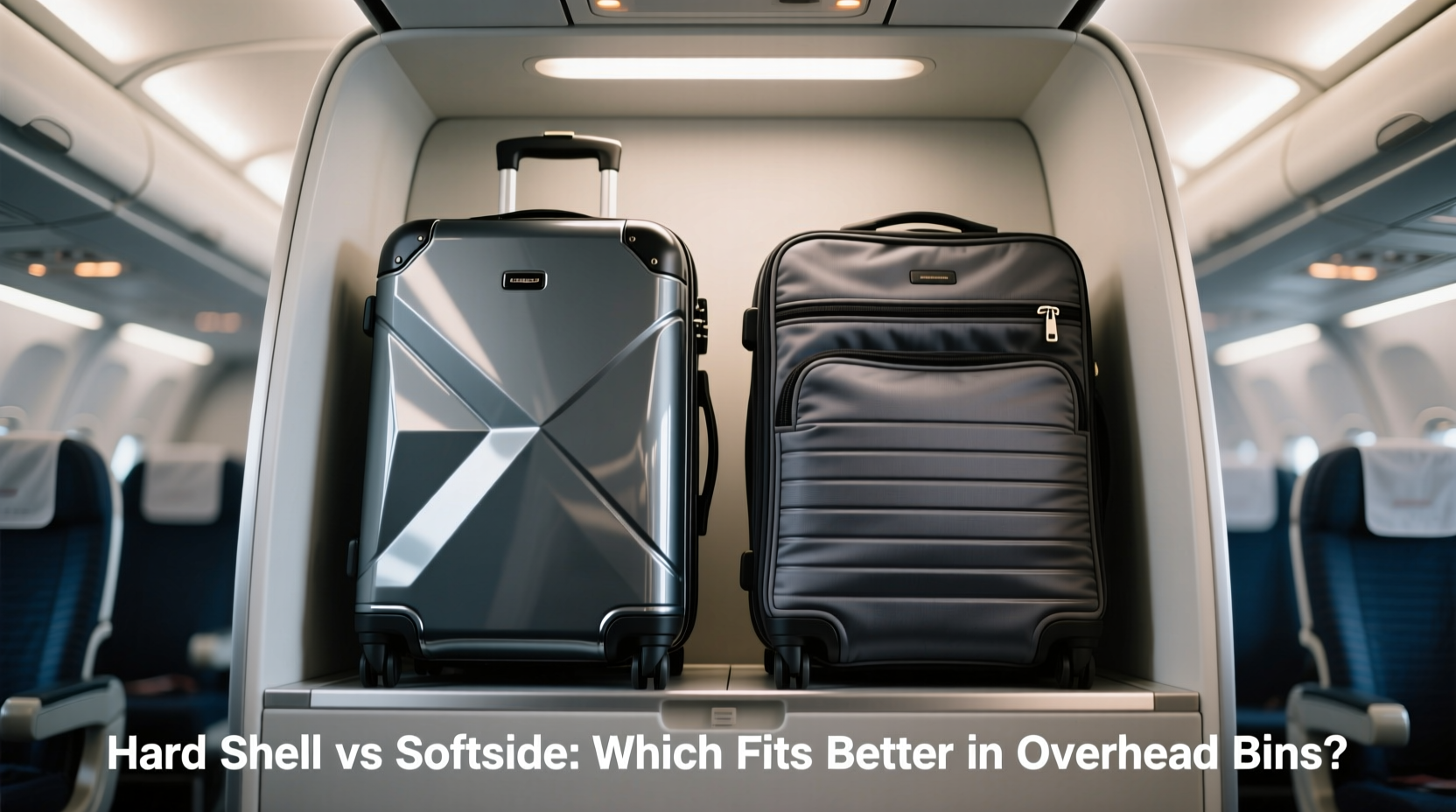
Aircraft vary significantly across airlines and models, meaning overhead bin sizes are not standardized globally. Most domestic U.S. carriers like Delta, American, and United specify a maximum carry-on size of 22 x 14 x 9 inches (including handles and wheels), but actual bin dimensions differ by aircraft type.
For example:
- Newer Boeing 737 MAX planes feature larger bins that accommodate standard-sized bags with minimal squeezing.
- Regional jets like the Embraer E175 often have smaller bins, where every inch counts.
- International carriers such as Lufthansa or Air Canada may enforce stricter limits, especially on transatlantic flights.
The key takeaway: even if your bag meets the listed size requirements, its rigidity or ability to conform under pressure can determine whether it fits smoothly—or causes delays at the cabin door.
Structural Differences: Hard Shell vs Softside
To understand which suitcase fits better, it’s essential to compare construction materials and design features.
| Feature | Hard Shell Luggage | Softside Luggage |
|---|---|---|
| Material | Polycarbonate, ABS plastic, or composite | Nylon, polyester, ballistic weave, or fabric blends |
| Rigidity | Firm, non-compressible structure | Flexible, slightly compressible sides |
| Expansion | Limited or none; some models expand 1–2 inches | Commonly expands 2–4 inches via zipper gusset |
| Shape Retention | Holds exact form; no give | May bulge or shift when overstuffed |
| Durability | Resists punctures but can crack on impact | Scratches easily but resists cracking |
Hard shell cases maintain a consistent rectangular profile, making them predictable—but inflexible. Softside bags, while potentially exceeding nominal dimensions when packed loosely, offer slight compression that can be advantageous during boarding.
“On regional flights with limited bin space, I’ve seen passengers squeeze soft bags into bins simply by pressing down on the top. That’s impossible with rigid shells.” — Mark Tran, Flight Attendant with 12 years of experience on major U.S. carriers
Real-World Fit Performance: Case Study from a Frequent Traveler
Sarah Kim, a digital marketing consultant based in Chicago, travels over 100,000 miles annually for client meetings. For two years, she alternated between a polycarbonate hard shell carry-on and a lightweight softside spinner to test overhead bin compatibility.
Her findings were revealing:
- On mainline flights (Boeing 757s and Airbus A320s), both bags fit without issue.
- On American Eagle regional jets, her hard shell required gate-checking three times due to lack of bin space, while the softside version was always accepted—even when slightly overpacked.
- During a trip to Europe, Ryanair staff insisted on checking her hard shell despite meeting published dimensions, citing “shape irregularity” near the handle. The soft bag passed inspection.
Sarah concluded: “The soft bag isn’t necessarily smaller, but it adapts. When bins are full, that little bit of squish makes all the difference.”
Compression and Packing Flexibility: Why Softside Often Wins
One of the biggest advantages softside luggage has in overhead bin scenarios is compressibility. Even if two bags share identical listed dimensions, the softside model can often be gently pressed or angled into tighter spaces.
This flexibility stems from several factors:
- Yield under pressure: Fabric panels can temporarily deform without damage, allowing the bag to fit into oddly shaped gaps.
- Top-loading compression straps: Many soft bags include external straps that let you cinch down the volume after packing.
- Expandable design: While expanded mode may exceed limits, zipping it closed reduces volume on demand—ideal for last-minute adjustments pre-boarding.
In contrast, hard shell suitcases cannot be compressed. If the outer dimensions don’t fit, they won’t go in—no exceptions. This rigidity protects contents better but sacrifices adaptability.
When Hard Shell Fits Better: Niche Advantages
Despite softside dominance in tight-fit scenarios, there are situations where hard shell luggage performs equally well or better:
- Predictable loading: On wide-body aircraft (e.g., Boeing 777, Airbus A350), bins are larger and more uniform. A rigid bag slides in cleanly without needing adjustment.
- Stacking efficiency: Airlines with bin dividers benefit from uniformly shaped hard cases, reducing wasted space.
- No accidental overexpansion: Soft bags left unzipped or improperly secured can balloon during transit, causing issues mid-flight or upon retrieval.
Additionally, some newer hybrid designs combine a semi-rigid frame with flexible side panels, offering a middle ground between protection and adaptability.
Step-by-Step Guide: Choosing the Right Carry-On for Overhead Bin Success
Follow this sequence to select the best luggage type based on your typical travel patterns:
- Assess your most frequent routes. Do you fly mostly regional jets or large commercial planes? Regional flyers benefit more from softside flexibility.
- Check airline-specific carry-on policies. Some carriers (e.g., Southwest) are generous; others (JetBlue, Spirit) measure bags strictly at the gate.
- Measure your current bag accurately. Include wheels, handles, and protruding pockets. Many “carry-on compliant” bags exceed 45 linear inches.
- Test compressibility. Press down on the top of your soft bag—if it gives slightly, it has bin-fitting advantage.
- Consider weight distribution. Heavier hard shells may be harder to lift into bins, especially for shorter travelers.
- Evaluate contents. If carrying fragile items (cameras, electronics), hard shell offers superior protection—even if it means occasional gate checks.
Checklist: Before You Board with Your Carry-On
- ✅ Bag dimensions (including wheels/handles) are within airline limits
- ✅ Softside bag is fully zipped and compression straps engaged
- ✅ No external items (umbrellas, duty-free bags) hanging off the sides
- ✅ Weight is under 22 lbs to avoid gate weighing
- ✅ Handle retracts smoothly and doesn’t add extra height
- ✅ You’ve prioritized overhead bin access over checked baggage fees
Expert Insight: What Flight Crews Recommend
Flight attendants witness hundreds of boarding cycles each month and develop strong opinions about what works—and what doesn’t.
“We’d rather see ten soft bags than five hard ones on a full regional flight. Hard cases don’t nest together well and create air pockets in the bin. Soft bags settle and maximize space.” — Lisa Nguyen, Senior Flight Attendant, Alaska Airlines
Another common observation: passengers with hard shell luggage are more likely to argue when asked to gate-check, despite clear space constraints. This friction slows down boarding—a problem airlines actively try to minimize.
Frequently Asked Questions
Can a hard shell suitcase be carried on any flight?
Not guaranteed. Even if your bag meets published size limits, actual bin availability varies by aircraft. Smaller planes may require gate-checking regardless of compliance. Always verify the aircraft type before departure.
Do softside bags get damaged more easily in overhead bins?
They’re more prone to surface scuffs and minor tears, but modern fabrics like ballistic nylon are highly durable. Internal lining and structured frames in premium soft bags also protect contents effectively. Damage risk is generally low compared to the benefit of improved bin fit.
Is there a luggage type that combines the best of both worlds?
Yes—hybrid luggage. These models feature a hard front panel (for protection) and soft, compressible sides (for flexibility). Brands like Samsonite, Delsey, and Travelpro offer hybrids designed specifically for frequent flyers who want durability and bin compatibility.
Final Verdict: Which Fits Better?
For sheer overhead bin compatibility, softside luggage holds a measurable advantage. Its ability to compress slightly, conform to irregular spaces, and adapt during crowded boarding makes it the smarter choice for travelers who frequently board regional jets, budget airlines, or peak-hour flights.
That said, hard shell luggage remains ideal for those prioritizing item protection, clean aesthetics, and resistance to punctures. It performs reliably on larger aircraft and suits minimalist packers who stay well under size limits.
The deciding factor isn’t just material—it’s context. If maximizing bin success rate is your goal, softside wins. If protecting expensive gear matters more than occasional gate checks, go hard shell.




 浙公网安备
33010002000092号
浙公网安备
33010002000092号 浙B2-20120091-4
Comments
No comments yet. Why don't you start the discussion?