
Outdoor enthusiasts often assume that “waterproof” means impenetrable protection and “breathable” translates to staying dry from the inside. But in practice, especially under sustained effort or extreme weather, these promises can fall apart. The gap between marketing claims and real-world performance is widest when comparing hardshell and softshell jackets—two categories designed for very different purposes. Understanding where and why these materials fail is critical for anyone relying on their gear in mountainous terrain, persistent rain, or fast-paced backcountry travel.
The truth is, not all waterproof fabrics perform equally, and breathability is highly conditional. Some hardshells deliver exceptional protection but trap moisture when you're working hard. Others claim high breathability ratings yet fail under pressure. Meanwhile, softshells offer comfort and mobility but often lack true waterproofing. This article breaks down the science, exposes misleading claims, and gives you the tools to make informed decisions based on actual use—not labels.
Understanding Hardshell Jackets: Protection First
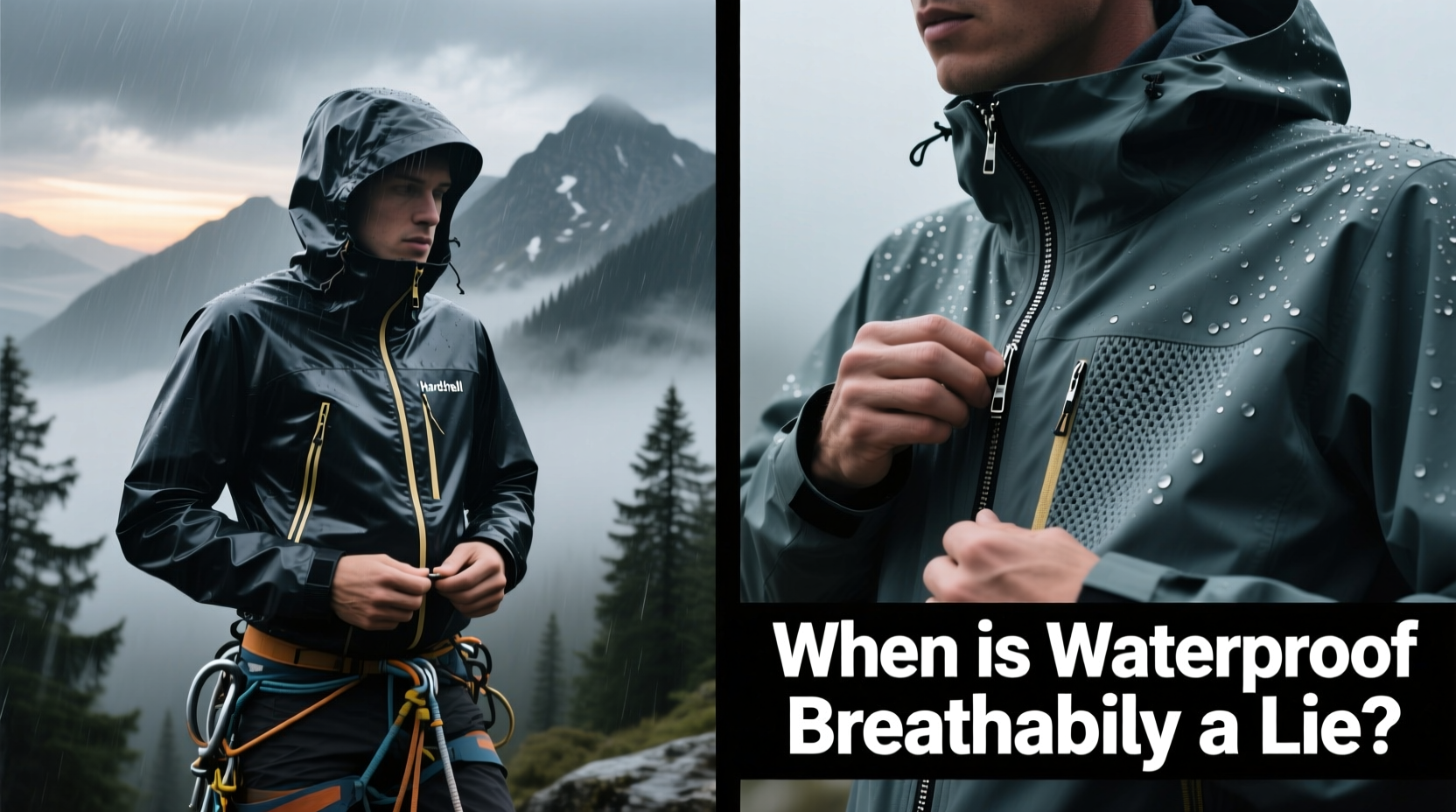
Hardshell jackets are engineered for maximum defense against the elements. Constructed with tightly woven face fabrics and laminated membranes like Gore-Tex, eVent, or proprietary PU coatings, they’re built to withstand driving rain, snow, and wind. Their primary design goal is to keep water out—no matter what.
These jackets typically feature fully taped seams, storm flaps over zippers, adjustable hoods, and minimal stretch. Breathability is included in the specs, but it's often secondary to waterproof integrity. Most hardshells use either a 2-layer (2L), 2.5-layer (2.5L), or 3-layer (3L) construction:
- 2-layer: Outer fabric + membrane, with a separate liner. Bulky but durable, often used in budget models.
- 2.5-layer: Adds a protective coating over the membrane to reduce abrasion. Lightweight and popular in hiking shells.
- 3-layer: Membrane sandwiched between outer fabric and a bonded inner liner. Most durable and breathable, favored by alpinists and guides.
Despite their reputation, not all hardshells breathe well. Breathability depends on humidity gradients, activity level, and environmental conditions. When external humidity is high (e.g., fog, light rain), the moisture differential drops, reducing vapor transfer through the membrane. In such cases, sweat accumulates inside—even in a \"highly breathable\" jacket.
Softshell Jackets: Comfort Over Coverage
Softshell jackets prioritize flexibility, warmth, and comfort. Made from brushed, stretch-woven fabrics with DWR (durable water repellent) finishes, they resist light rain and wind reasonably well. However, most are not truly waterproof—only water-resistant.
They excel in variable conditions where mobility and insulation are key: ski touring on clear days, scrambling in mixed weather, or trail running in drizzle. Because they lack a rigid membrane, softshells allow superior airflow and stretch. Many integrate fleece backing for added warmth, eliminating the need for mid-layers in moderate climates.
But here’s the catch: softshells saturate under prolonged exposure. Once the DWR wears off or the fabric “wets out,” moisture seeps through, and internal sweat has no escape route. Unlike hardshells, they don’t have a hydrophobic barrier to block liquid ingress. So while they feel drier during low-output activities, they can leave you damp during long hikes or storms.
“Softshells are fantastic for dynamic movement in mild weather, but they’re not a substitute for a proper hardshell when the sky opens.” — Lars Madsen, Mountain Guide & Gear Tester, UIAGM Certified
When Is “Waterproof Breathability” a Lie?
The term “waterproof and breathable” is one of the most misunderstood in outdoor apparel. While technically accurate under lab conditions, real-world performance often tells a different story. Here’s where the promise breaks down:
1. High External Humidity
In muggy forests, coastal fog, or monsoon seasons, the air outside is already saturated. Since breathability relies on moving moisture from high humidity (inside) to low humidity (outside), the system stalls. Even the best membranes can't push vapor into an environment that’s already wet.
2. Sustained Physical Exertion
During uphill climbs or fast-paced skiing, your body produces far more sweat than the jacket can expel. Most breathable fabrics manage 10,000–25,000 g/m²/24hr (MVTR rating), but heavy exertion can exceed this. Result? Condensation builds up inside, making you feel clammy despite staying “dry.”
3. Fabric “Wetting Out”
Even hardshells suffer if the outer fabric loses its DWR treatment. Once the face fabric absorbs water, it creates a cold, damp layer against your skin and blocks breathability. No membrane works efficiently if the outer surface is soaked.
4. Poor Design or Fit
A jacket may have a top-tier membrane, but if it lacks ventilation options (like pit zips), fits too tightly, or doesn’t seal at cuffs and hem, moisture gets trapped. Breathability isn’t just about fabric—it’s about system design.
5. Misleading Marketing Claims
Manufacturers often cite lab-tested MVTR (moisture vapor transmission rate) numbers without context. A jacket rated at 20,000 g/m²/24hr sounds impressive, but that test assumes ideal temperature and humidity differences. Real trails rarely offer such conditions.
Comparing Performance: Hardshell vs Softshell
| Feature | Hardshell Jacket | Softshell Jacket |
|---|---|---|
| Water Resistance | Excellent (20,000mm+ hydrostatic head) | Fair to Good (5,000–10,000mm) |
| Breathability (MVTR) | Moderate to High (10,000–25,000 g/m²/24hr) | High (natural airflow, no membrane barrier) |
| Wind Resistance | Excellent | Good (varies by weave density) |
| Durability | High (especially 3L constructions) | Moderate (abrasion-prone outer) |
| Mobility & Stretch | Limited (unless articulated) | Excellent (inherent stretch) |
| Weight | Moderate to Heavy | Light to Moderate |
| Best For | Prolonged rain, alpine climbing, winter storms | Active use in mild/wet conditions, layering |
| Weakness | Condensation buildup, bulk, cost | Saturates in heavy rain, less protection |
This comparison reveals a fundamental trade-off: hardshells win in protection but lose in comfort during high-output activities. Softshells offer freedom and warmth but falter when the weather turns severe.
Real-World Scenario: The Alpine Traverse That Exposed the Myth
Consider Alex, an experienced hiker attempting a multi-day alpine traverse in the Pacific Northwest. Forecast: 70% chance of rain, temperatures between 4°C and 10°C. He packed a lightweight 2.5-layer hardshell, marketed as “ultra-breathable,” and wore it over a merino base and light fleece.
On day one, steady drizzle began. The jacket kept him dry—initially. But as he ascended a steep ridge, his breathing deepened, and sweat started accumulating. Despite the jacket’s 20,000 g/m²/24hr rating, condensation formed inside. By summit, his back was soaked—not from rain, but from trapped vapor.
He removed the shell briefly to cool down, only to get rained on. Putting it back on felt worse: the cold, damp interior chilled him instantly. Later, he learned the outer fabric had lost its DWR after two prior washes, causing “wetting out” and further blocking breathability.
Meanwhile, another hiker wearing a softshell stayed comfortable during the climb—but only until horizontal rain hit on day two. Without a waterproof membrane, her jacket soaked through within 20 minutes. She had to retreat early.
Neither solution worked perfectly. The hardshell failed at breathability; the softshell failed at waterproofing. The lesson? Conditions dictate performance—and no single jacket excels in every scenario.
How to Choose the Right Shell: A Practical Checklist
Selecting between hardshell and softshell shouldn’t be based on hype. Use this checklist to match your needs with reality:
- Assess the forecast: Will you face sustained rain or just light showers? If >50% chance of heavy precipitation, go hardshell.
- Evaluate activity intensity: High-output (ski touring, trail running)? Prioritize ventilation and consider layering with a softshell or using a hardshell with pit zips.
- Check DWR condition: Re-treat the outer fabric annually with a non-detergent reviver (e.g., Nikwax TX.Direct) to prevent wetting out.
- Look for design features: Pit zips, helmet-compatible hoods, and adjustable cuffs improve real-world performance more than MVTR numbers.
- Consider layering: Softshells work best as mid-layers under a hardshell in wet-cold environments.
- Test before relying: Wear the jacket on shorter outings first. See how it handles sweat and rain before committing to a big trip.
Frequently Asked Questions
Can a softshell be made waterproof?
Some hybrid softshells incorporate thin membranes (e.g., Polartec NeoShell) to boost water resistance. These bridge the gap but still don’t match hardshell performance in sustained rain. They’re better described as “weather-resistant” rather than waterproof.
Why does my hardshell feel clammy even when it’s not raining?
Clamminess usually means moisture buildup due to poor ventilation or high humidity. It doesn’t mean the jacket is defective—just that breathability is limited by environmental conditions. Open pit zips, reduce layering, or switch to a more breathable model if this happens frequently.
Do all hardshells eventually lose waterproofness?
The membrane itself rarely fails. What degrades is the DWR on the outer fabric. Once the face fabric wets out, the jacket feels damp and stops breathing. Regular re-waterproofing restores performance. Fully taped seams and quality construction ensure longevity.
Conclusion: Rethink the Hype, Respect the Conditions
The idea that any jacket can be both completely waterproof and perfectly breathable is a convenient fiction—one that sells products but misleads users. Hardshells protect well but struggle with internal moisture under exertion. Softshells breathe easily but surrender to serious weather. Neither is universally superior.
The smart approach is strategic layering and honest assessment of conditions. Carry a hardshell for storms, use a softshell for mobility in mixed weather, and never rely solely on marketing claims. Maintain your gear, understand its limits, and adapt your system to the environment.




 浙公网安备
33010002000092号
浙公网安备
33010002000092号 浙B2-20120091-4
Comments
No comments yet. Why don't you start the discussion?