
In the colorful world of children’s playthings, two categories often dominate toy shelves: beloved comfort items like Hello Kitty plush toys and purpose-built educational toys designed to teach letters, numbers, or problem-solving skills. Parents frequently face this choice—should they prioritize fun or function? The answer isn’t as simple as picking one over the other. While educational toys are explicitly marketed for cognitive growth, emotional development fostered by plush companions like Hello Kitty can be just as foundational to a child’s ability to learn.
This article explores how both types of toys contribute uniquely to childhood development, backed by developmental psychology, real-world observations, and expert insights. Rather than declaring a winner, we’ll uncover how each supports different aspects of learning—and how they might work best together.
The Role of Emotional Security in Learning
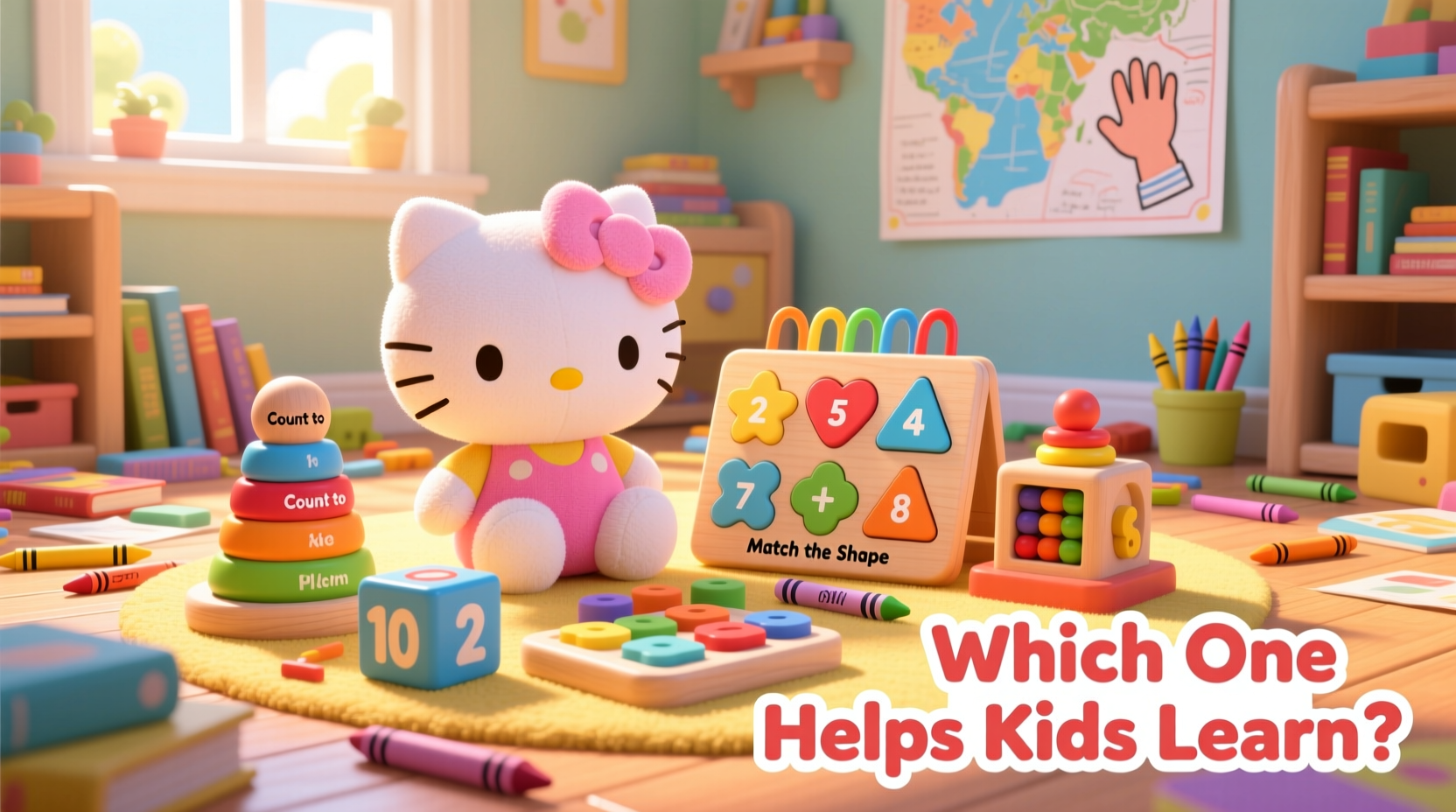
Before a child can focus on counting blocks or recognizing shapes, they must feel safe and emotionally regulated. This is where comfort toys like the Hello Kitty plush come into play. For many children, these soft, familiar figures serve as transitional objects—items that provide consistency and reassurance during times of stress or change.
Psychologist Donald Winnicott first introduced the concept of transitional objects, explaining that items like blankets or stuffed animals help children navigate the separation between self and caregiver. When a child feels secure, their brain is more receptive to new information. Anxiety or emotional distress, on the other hand, activates the amygdala—the brain’s fear center—which can inhibit higher-level thinking and memory formation.
“Emotional security isn't separate from learning—it's the foundation of it. A child who feels safe is far more likely to engage with new challenges.” — Dr. Lena Torres, Child Development Specialist, University of Michigan
Cognitive Benefits of Educational Toys
Educational toys—such as alphabet puzzles, building blocks, math games, or STEM kits—are engineered to stimulate specific cognitive skills. These include fine motor coordination, pattern recognition, language acquisition, logical reasoning, and early literacy or numeracy.
For example, stacking rings improve hand-eye coordination and introduce concepts of size and sequence. Magnetic tiles encourage spatial reasoning and creativity. Phonics-based games reinforce letter-sound relationships critical for reading readiness.
A 2020 study published in Early Childhood Research Quarterly found that children who regularly played with construction-based educational toys scored higher on spatial visualization tests by age five—skills strongly linked to later success in science and engineering fields.
However, effectiveness depends heavily on context. An educational toy left unused in a corner offers no benefit. Engagement matters more than ownership. Children learn best when they are intrinsically motivated and playing with guidance or interaction from caregivers.
Key Cognitive Skills Developed by Common Educational Toys
| Type of Toy | Skill Developed | Age Range (Ideal) |
|---|---|---|
| Alphabet Puzzles | Letter Recognition, Vocabulary | 3–5 years |
| Building Blocks | Spatial Reasoning, Problem-Solving | 2–7 years |
| Counting Bears | Math Concepts, Sorting | 3–6 years |
| Interactive Storybooks | Listening, Language Fluency | 2–5 years |
| Science Kits | Hypothesis Testing, Observation | 6+ years |
Social and Imaginative Growth Through Pretend Play
While educational toys often target individual cognitive gains, plush toys like Hello Kitty open doors to rich imaginative and social play. When a child assigns roles, voices, and stories to their plush friends, they're practicing narrative structure, empathy, and perspective-taking—all crucial components of emotional intelligence.
Pretend play involving dolls or stuffed animals allows children to reenact real-life scenarios (going to school, visiting the doctor) or invent entirely new worlds. In doing so, they experiment with cause-and-effect, conflict resolution, and emotional expression. These aren’t distractions from learning—they are forms of experiential learning.
Consider a four-year-old hosting a “tea party” for her Hello Kitty collection. She sets places, assigns personalities, manages turn-taking, and resolves disagreements (“No, Kitty, you can’t have two cupcakes!”). This scenario integrates language development, social rules, and self-regulation—all while feeling like pure fun.
“When children use toys to simulate social interactions, they’re rehearsing life skills. That’s not frivolous—it’s essential development.” — Dr. Amira Chen, Developmental Psychologist, Stanford Center for Early Learning
Case Study: Emma and Her Hello Kitty Crew
Emma, a shy 4-year-old starting preschool, struggled with separation anxiety. Each morning ended in tears. Her parents introduced a routine: Emma would bring her favorite Hello Kitty plush, whom she named “Miss Kitty,” to school in a special backpack.
At first, Miss Kitty stayed in the cubby. But within weeks, Emma began including her in circle time, giving her opinions during discussions (“Kitty likes frogs too!”). Gradually, Emma used pretend conversations with Kitty to express her own feelings. By mid-year, she was initiating play with peers—often using Kitty as a bridge.
Meanwhile, Emma also engaged with classroom educational toys—letter mats and counting beads—but showed deeper engagement when those activities were framed through storytelling. For instance, she’d help Kitty “find the missing letter” or “count fish for dinner.”
The lesson? Emotional connection enhanced cognitive participation. Hello Kitty wasn’t replacing learning—she was enabling it.
Do’s and Don’ts: Balancing Comfort and Cognitive Toys
- DO allow emotional attachments to plush toys without judgment.
- DO integrate educational concepts into imaginative play (e.g., “Let’s count how many cupcakes Kitty needs!”).
- DO rotate toys periodically to maintain interest and prevent overload.
- DON’T dismiss pretend play as “just playing”—it’s serious developmental work.
- DON’T overcrowd playtime with structured learning at the expense of free exploration.
- DON’T assume only labeled “educational” toys have value.
FAQ: Addressing Common Parent Concerns
Can a plush toy really help my child learn?
Yes—indirectly but significantly. While a plush toy won’t teach multiplication tables, it supports emotional regulation, language development through storytelling, and social skills via role-play. These are prerequisites for academic learning.
Are educational toys worth the investment?
They can be—if they match your child’s developmental stage and interests. Open-ended toys (like blocks or art supplies) tend to offer longer-term value than single-function gadgets. Pair them with interaction; toys alone don’t teach—engagement does.
My child only wants their Hello Kitty. Should I be worried?
Not necessarily. Strong attachments are normal, especially between ages 2 and 6. As long as your child engages with others, explores varied activities, and shows curiosity, the attachment is likely healthy. If concerns persist, consult a pediatric developmental specialist.
How to Combine Both Worlds Effectively
The most powerful approach isn’t choosing between Hello Kitty and educational toys—it’s integrating them. Try these strategies:
- Narrate learning moments: Turn counting practice into a story. “Hello Kitty has six strawberries. If she eats two, how many are left?”
- Use plush toys as play partners: Invite your child to teach their plushie how to spell their name or sort colors. Teaching reinforces understanding.
- Create themed play stations: Set up a “Kitty School” where stuffed animals are students and your child is the teacher using flashcards or puzzles.
- Encourage journaling or drawing: Ask your child to draw what Kitty did today. This builds writing readiness and creative expression.
This blend honors both emotional needs and cognitive goals. It recognizes that children don’t compartmentalize learning the way adults sometimes do. For them, joy and education are intertwined.
Conclusion: Learning Is Holistic—So Should Be Toy Choices
The debate between Hello Kitty plush and educational toys reflects a false dichotomy. True learning isn’t limited to measurable outcomes like reciting the alphabet or solving equations. It includes feeling safe, expressing emotions, inventing stories, and navigating social dynamics—all of which plush toys actively support.
Educational toys provide valuable tools for skill-building, but their impact multiplies when children are emotionally ready to engage. Conversely, comfort toys gain educational depth when caregivers use them as springboards for conversation, creativity, and gentle instruction.
Rather than asking which toy helps kids learn more, ask how each contributes to a richer, more balanced developmental environment. The goal isn’t to pick sides—it’s to build a play ecosystem where emotional safety and intellectual growth thrive together.




 浙公网安备
33010002000092号
浙公网安备
33010002000092号 浙B2-20120091-4
Comments
No comments yet. Why don't you start the discussion?