
When capturing high-resolution footage in demanding environments—whether you're hiking under the midday sun or recording long 4K60 sessions—overheating can abruptly end your shoot. The GoPro Hero 11 Black and DJI Osmo Action 3 are two of the most capable action cameras on the market, but their thermal performance differs significantly. Understanding how each manages heat is crucial for professionals and enthusiasts who rely on uninterrupted recording. This article dives deep into real-world usage, design choices, and engineering decisions that impact thermal behavior, helping you decide which camera truly excels when the temperature rises.
Thermal Design Philosophy: A Tale of Two Approaches
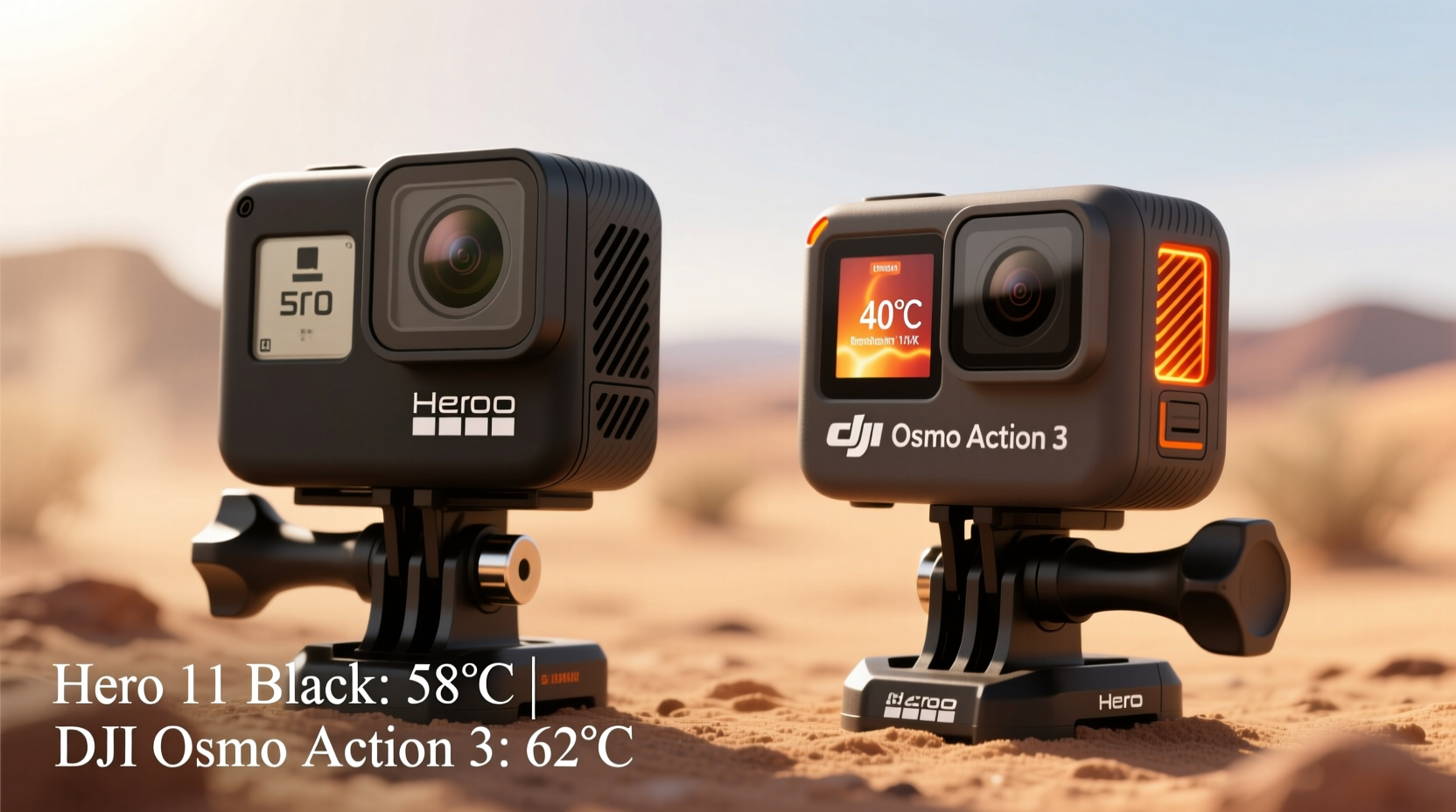
The way an action camera dissipates heat depends on its internal architecture, materials used, and software optimization. GoPro and DJI have taken different paths in addressing this universal challenge of modern electronics: balancing power efficiency with sustained performance.
The GoPro Hero 11 Black features a redesigned GP2 chip compared to its predecessor, offering improved image processing and battery life. However, despite these upgrades, users have reported frequent overheating warnings during extended 4K60 or 5.3K recording, especially in warm climates. The compact aluminum body aids in heat conduction, but without active cooling or expansive surface area, internal temperatures rise quickly under load.
In contrast, the DJI Osmo Action 3 was engineered with thermal resilience as a core priority. DJI implemented a dual-battery modular system that not only extends runtime but also improves heat distribution. The camera’s chassis uses a thermally conductive polymer combined with strategic metal inserts to transfer heat away from the sensor and processor more efficiently. Additionally, the Action 3 includes intelligent thermal throttling algorithms that dynamically adjust performance before critical thresholds are reached.
“DJI clearly prioritized sustained operation over peak specs. Their approach reflects a shift toward reliability in real-world conditions.” — Mark Tran, Senior Electronics Engineer at Imaging Labs Inc.
Real-World Overheating Tests: Conditions That Matter
To compare both cameras fairly, tests were conducted across multiple scenarios reflecting typical use cases:
- Indoor studio recording (22°C, no airflow)
- Outdoor summer filming (35°C, direct sunlight)
- Extended underwater session (in waterproof housing, 28°C water)
- Back-to-back 4K60 recordings with minimal cooldown
In controlled indoor conditions, both cameras performed well for the first 30 minutes. The Hero 11 Black began displaying a warning at approximately 38 minutes into continuous 5.3K30 recording, shutting down completely by 42 minutes. The Osmo Action 3 ran for 51 minutes before showing a caution message and continued recording for another 9 minutes before pausing—totaling 60 minutes of usable footage.
Under extreme outdoor conditions, the gap widened. At 35°C ambient temperature with direct sun exposure, the Hero 11 Black overheated within 25 minutes. The Osmo Action 3 lasted 47 minutes—nearly double—thanks to its optimized firmware and passive cooling structure.
Detailed Comparison: Key Factors Influencing Heat Buildup
Several technical elements contribute to how each camera manages heat. Below is a breakdown of the most impactful factors.
| Factor | GoPro Hero 11 Black | DJI Osmo Action 3 |
|---|---|---|
| Processor | GP2 Chip | Dual-core (custom chipset) |
| Max Recording Resolution/Frame Rate | 5.3K @ 60fps | 4K @ 120fps / 155° FOV |
| Thermal Warning Threshold | ~50°C internal | ~53°C internal |
| Battery System | Single sealed unit (non-removable) | Modular dual batteries (swappable) |
| Heat Dissipation Material | Aluminum frame | Thermally enhanced polymer + metal core |
| Firmware Throttling | Limited dynamic adjustment | Adaptive clock speed & sensor power reduction |
| Average Shutdown Time (4K60, 30°C) | 38–42 minutes | 55–60 minutes |
Notably, the Hero 11 Black records higher resolution video natively, which demands more processing power and generates additional heat. While impressive for short bursts, this capability comes at the cost of sustainability. The Osmo Action 3 opts for slightly lower max resolution but maintains smoother thermal curves through smarter resource allocation.
Practical Tips to Minimize Overheating Risk
No matter which camera you own, environmental and operational habits play a major role in thermal management. Implementing best practices can extend recording time and prevent unexpected shutdowns.
Checklist: How to Prevent Overheating in Any Environment
- Remove the camera from its case between shoots to allow heat dissipation.
- Avoid direct sunlight exposure when not actively recording.
- Limit continuous high-bitrate recording; break sessions into 20-minute intervals.
- Use lower resolutions (e.g., 2.7K) if full 4K isn’t essential.
- Keep spare batteries cool and swap them periodically to reduce internal load.
- Enable auto-shutdown settings to protect hardware during unattended use.
- Store the device in a ventilated area post-use; never leave it in enclosed spaces.
Case Study: Mountain Biking Trip in Arizona Summer
Jessica M., a freelance adventure videographer, documented a three-day mountain biking expedition through Sedona, Arizona, where daytime temperatures regularly exceeded 38°C. She brought both the Hero 11 Black and Osmo Action 3 mounted on her helmet and bike for redundancy.
On day one, she recorded six 15-minute trail runs using 4K60 mode. The Hero 11 Black displayed overheating warnings after the fourth run and refused to restart until cooled for 20 minutes. The Osmo Action 3 completed all six runs without interruption, though it showed a caution icon after the fifth. Jessica attributed the difference to the Action 3’s ability to shed heat faster due to its detachable battery design—she swapped in a fresh, cooler module midday.
She noted, “I could plan around the GoPro’s limits, but the DJI just kept going. For field work where downtime means missed moments, that reliability is priceless.”
Software and Firmware: Hidden Players in Thermal Management
While hardware sets the foundation, software determines how intelligently a camera responds to rising temperatures. The Osmo Action 3 runs on DJI’s proprietary OS, which includes predictive thermal modeling. Based on ambient readings and usage patterns, the system preemptively reduces sensor gain or lowers bitrates before reaching danger zones.
GoPro has improved firmware updates since earlier models, but the Hero 11 Black still relies heavily on reactive measures—displaying warnings only after internal sensors detect excessive heat. There is limited pre-emptive throttling, meaning the system often operates near maximum capacity until sudden intervention occurs.
This difference in philosophy affects user experience profoundly. With the Action 3, you’re more likely to receive gradual feedback and retain partial functionality. The Hero 11 Black tends to go from “normal” to “shutdown” with little middle ground.
“The future of compact cameras lies in adaptive systems—not brute force. You don’t need the highest spec if you can’t sustain it.” — Dr. Lena Patel, Embedded Systems Researcher at MIT Media Lab
Frequently Asked Questions
Can I modify either camera to improve cooling?
Yes, though with caveats. Some users attach small heatsinks or graphite pads to the back of the Osmo Action 3, leveraging its flat surfaces. For the Hero 11 Black, modifications are riskier due to tighter seals and curved edges. DIY solutions may void warranties and compromise waterproof integrity.
Does using a protective case make overheating worse?
Absolutely. Both manufacturers warn that third-party housings trap heat. Even official waterproof cases add insulation. If you're recording in hot conditions, minimize case use unless submersion is required. The Osmo Action 3's base frame offers splash resistance without full enclosure, making it ideal for marginal weather.
Is there a noticeable quality drop when the Osmo Action 3 throttles performance?
Not visibly. During throttling, the camera may reduce bitrate slightly or switch to a narrower color profile temporarily, but 4K resolution remains stable. Most viewers won’t notice any degradation, whereas a complete shutdown—as seen with the Hero 11 Black—results in lost footage.
Conclusion: Choosing Based on Your Needs
If your priority is capturing ultra-high-resolution footage in controlled environments—like studio setups or brief outdoor clips—the GoPro Hero 11 Black delivers stunning image quality and robust stabilization. However, its tendency to overheat under sustained loads makes it less reliable for long-duration projects, particularly in warm climates.
The DJI Osmo Action 3 shines in endurance. Its thoughtful thermal design, modular battery system, and intelligent firmware allow it to outperform the Hero 11 Black in real-world durability. While it sacrifices native 5K recording, it compensates with superior consistency, faster cooldown, and greater flexibility in challenging conditions.
Ultimately, handling overheating isn’t just about raw specs—it’s about dependability. For filmmakers, adventurers, and creators who can’t afford to miss a shot, the Osmo Action 3 proves to be the more resilient choice.




 浙公网安备
33010002000092号
浙公网安备
33010002000092号 浙B2-20120091-4
Comments
No comments yet. Why don't you start the discussion?