
Unusually high engine revolutions per minute (RPMs) are more than just a nuisance—they can signal underlying mechanical or electronic problems in your vehicle. Whether you're noticing higher-than-normal idle speeds, erratic revving, or sustained high RPMs during driving, ignoring these signs can lead to reduced fuel efficiency, increased wear on engine components, and even catastrophic failure. Understanding the root causes and knowing how to methodically troubleshoot them is essential for maintaining performance, safety, and longevity of your car.
Understanding Normal vs. Abnormal RPM Behavior
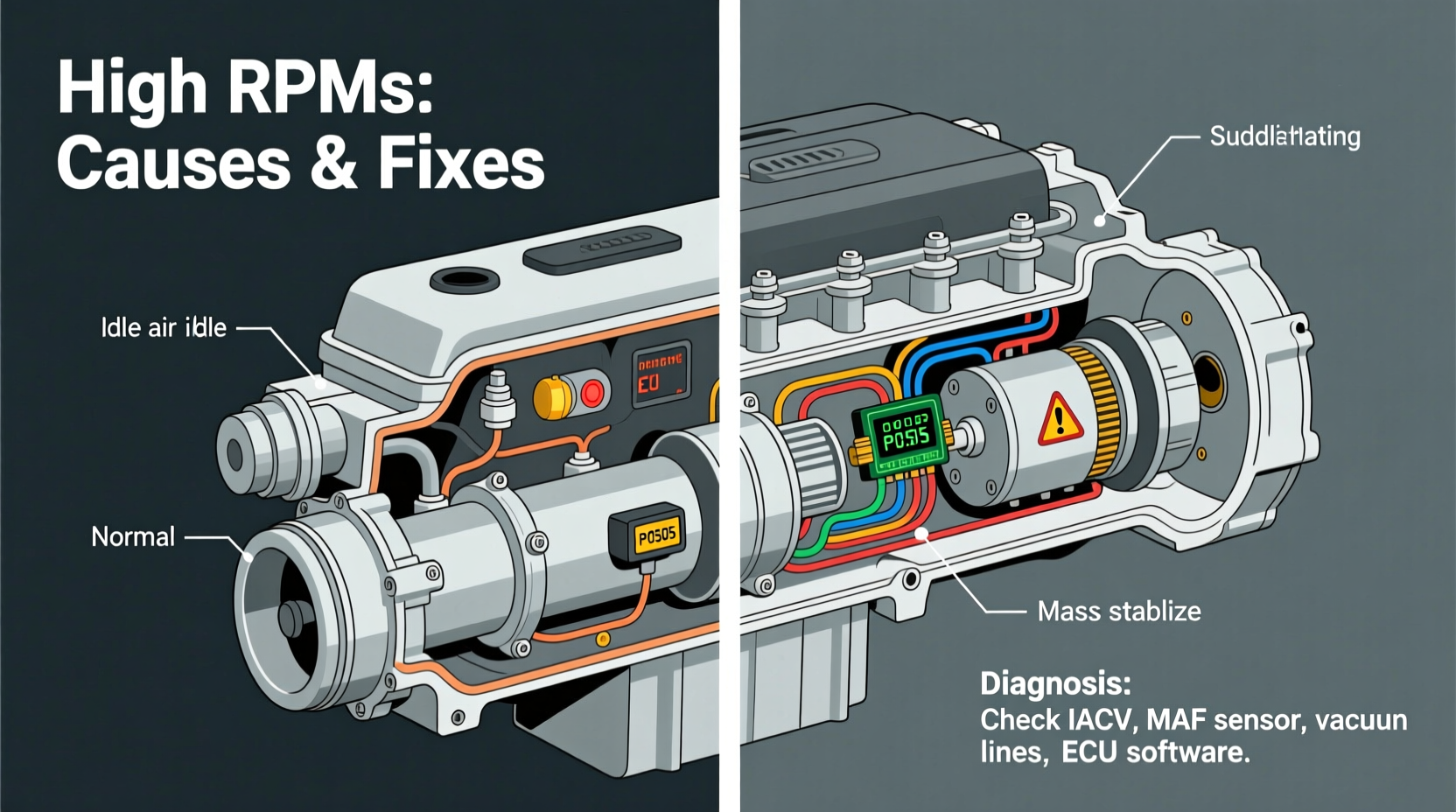
RPM measures how many times the engine’s crankshaft rotates per minute. Most passenger vehicles idle between 600 and 1,000 RPM when warmed up. Under acceleration, RPMs naturally rise—typically peaking around 5,000 to 7,000 depending on the engine—but should return to normal when you release the throttle.
Abnormal high RPMs occur when:
- The engine idles above 1,200 RPM without cause
- RPMs remain elevated after releasing the accelerator
- The tachometer spikes unexpectedly during gear shifts
- The engine races while in neutral or park
Persistent high RPMs waste fuel, increase emissions, and stress internal engine parts such as valves, pistons, and bearings.
Common Causes of High RPMs
Several mechanical, electrical, and vacuum-related issues can cause elevated engine speed. Identifying the culprit requires understanding each system involved.
1. Faulty Idle Air Control Valve (IACV)
In modern fuel-injected engines, the IACV regulates airflow when the throttle is closed. If it becomes clogged with carbon deposits or fails electronically, it may allow too much air into the intake, causing the engine control unit (ECU) to raise RPMs to compensate.
2. Vacuum Leaks
Cracked or disconnected vacuum hoses introduce unmetered air into the intake manifold. This disrupts the air-fuel ratio, prompting the ECU to increase idle speed. Common sources include brake booster lines, PCV hoses, and intake gaskets.
3. Stuck or Malfunctioning Throttle Body
A dirty or gummed-up throttle plate may not close fully, tricking the engine into thinking the driver is still accelerating. Electronic throttle bodies (drive-by-wire) can also suffer from sensor faults or motor binding.
4. Transmission Issues (Automatic Gearboxes)
If the transmission isn’t shifting properly—due to low fluid, solenoid failure, or torque converter problems—the engine may stay in a lower gear longer than necessary, causing RPMs to climb unnecessarily at highway speeds.
5. Cruise Control or Accelerator Pedal Sensor Failure
A malfunctioning accelerator pedal position sensor (APP) can send incorrect signals to the ECU, making it think the gas pedal is depressed when it’s not. Similarly, cruise control system glitches can artificially maintain throttle input.
6. Engine Management System Errors
Faulty sensors such as the Mass Air Flow (MAF), Manifold Absolute Pressure (MAP), or oxygen sensors can mislead the ECU, resulting in improper fuel delivery and erratic idle behavior.
“Modern engines rely on precise sensor data. A single faulty input can throw off the entire combustion cycle, leading to symptoms like high idle or surging.” — Carlos Mendez, ASE-Certified Master Technician
Troubleshooting High RPMs: A Step-by-Step Guide
Follow this logical diagnostic process to identify and resolve high RPM issues efficiently.
- Check for Diagnostic Trouble Codes (DTCs): Use an OBD-II scanner to retrieve stored codes. Look for P0505 (Idle Control System Malfunction), P0171/P0174 (Lean Condition), or throttle-related codes.
- Inspect Vacuum Hoses Visually: Trace all vacuum lines under the hood. Look for cracks, disconnections, or softened rubber. Perform a smoke test if leaks are suspected but not visible.
- Clean the Throttle Body: Remove the air intake tube and clean the throttle bore and plate with throttle body cleaner. Avoid using abrasive materials.
- Test the Idle Air Control Valve: On older vehicles, unplug the IACV—if the engine stalls or idle drops significantly, it was likely active. Clean or replace if necessary.
- Verify Throttle Position Sensor (TPS) Readings: Using a multimeter or scan tool, check TPS voltage at closed throttle (should be near 0.5V) and wide open throttle (~4.5–5V).
- Examine Accelerator Pedal Sensor: Ensure smooth voltage transition as the pedal is pressed. Sudden jumps or flatlines indicate failure.
- Check Transmission Fluid Level and Condition: Low or burnt fluid can impair shift timing, keeping engine RPMs high during cruising.
- Monitor Live Data: Use a scan tool to observe real-time parameters like RPM, MAF g/s, STFT/LTFT, and throttle position while idling.
Do’s and Don’ts When Dealing With High RPMs
| Action | Do | Don't |
|---|---|---|
| Diagnosing | Use an OBD-II scanner to read error codes first | Guess the problem without checking data |
| Cleaning Components | Use approved cleaners and soft brushes | Use carb cleaner on plastic or rubber parts |
| Driving with Symptoms | Limp mode: drive gently to a repair shop | Continue long-distance driving with racing idle |
| After Repairs | Clear codes and test drive under various conditions | Assume the problem is fixed without verification |
Real-World Example: Diagnosing a Surging Idle
Consider Sarah, who drives a 2014 Honda Accord. She noticed her engine idling at 1,800 RPM every morning, dropping only after several minutes. No warning lights appeared.
She visited a mechanic who began by scanning the ECU—no codes present. A visual inspection revealed a cracked vacuum hose near the brake booster. Replacing the hose immediately normalized idle speed. The extra air from the leak had caused the ECU to increase fuel delivery and RPMs to maintain stoichiometric balance.
This case highlights that even minor vacuum leaks can create noticeable symptoms—and underscores the importance of thorough inspection beyond code reading.
Frequently Asked Questions
Can high RPMs damage my engine?
Yes. Sustained high RPMs, especially without load (e.g., revving in neutral), increase heat, friction, and wear on pistons, rods, and bearings. Over time, this accelerates oil breakdown and risks mechanical failure.
Why do my RPMs spike when I start the car?
It’s normal for RPMs to briefly rise to 1,500–2,000 during cold starts as the engine warms up. However, if they don’t drop within 30–60 seconds, suspect an IACV issue, vacuum leak, or thermostat problem delaying warm-up.
Is it safe to drive with high idle RPMs?
Short distances at moderate speeds may be acceptable, but prolonged driving with abnormally high RPMs increases stress on the drivetrain and reduces fuel economy. It's best to diagnose and repair the issue promptly.
Preventive Maintenance Checklist
- Inspect vacuum hoses annually for brittleness or cracks
- Clean the throttle body every 30,000 miles
- Replace air filter as scheduled
- Use quality fuel with detergent additives to reduce carbon buildup
- Scan for hidden trouble codes every 6 months, even if no light is on
- Check engine mounts—loose mounting can mimic vibration from high RPMs
Conclusion: Take Action Before Small Issues Become Big Repairs
High RPMs are rarely random. They’re the engine’s way of communicating imbalance—whether through air, fuel, sensors, or mechanical resistance. By approaching the issue systematically, using available tools, and applying practical knowledge, most causes can be diagnosed and corrected without major expense.
Waiting too long to address abnormal engine behavior can turn a $50 vacuum hose replacement into a $2,000 transmission or engine rebuild. Stay attentive to your vehicle’s feedback, perform regular maintenance, and act decisively when something feels off.




 浙公网安备
33010002000092号
浙公网安备
33010002000092号 浙B2-20120091-4
Comments
No comments yet. Why don't you start the discussion?