
Choosing between hinged and flip (also called “fold-down” or “flex-hinge”) branch mechanisms isn’t just about assembly convenience—it’s about how quickly you can hang ornaments, how evenly the tree fills out, and whether your holiday setup feels like a joyful ritual or a wrestling match with plastic. Over the past decade, as pre-lit artificial trees have evolved from basic wire frames to precision-engineered décor platforms, the branch articulation system has quietly become the most consequential design feature—yet it remains widely misunderstood. This isn’t a matter of personal preference alone; it’s a functional decision rooted in physics, ergonomics, and decades of field testing by professional decorators, retail display teams, and families who decorate annually under time pressure. In this article, we cut through marketing jargon to compare hinged and flip branches on measurable criteria: deployment speed, branch density retention, ornament accessibility, structural integrity over time, and long-term fullness consistency.
How Hinged and Flip Branches Actually Work—Mechanically
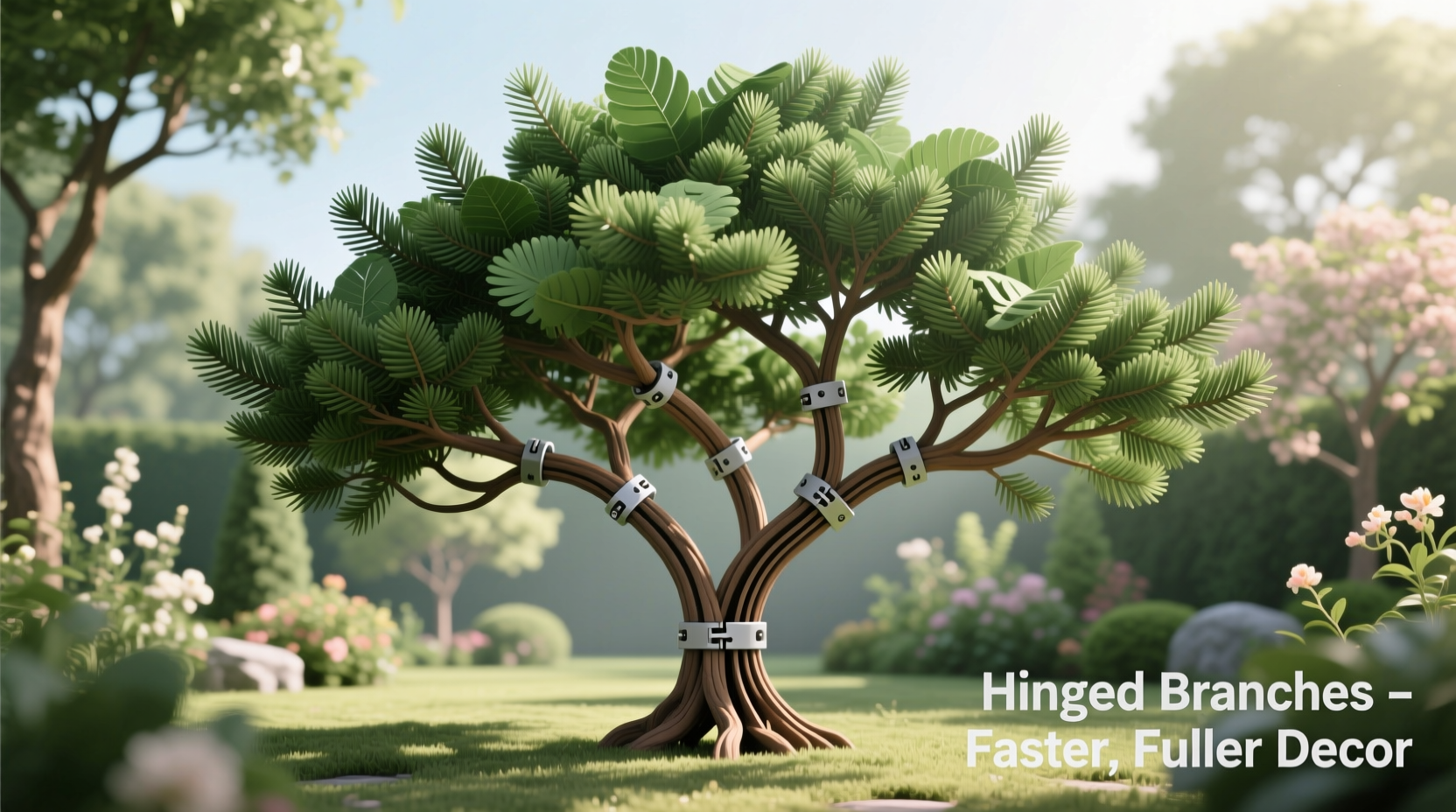
Hinged branches use a rigid, fixed-angle pivot point—typically a molded plastic or metal hinge embedded at the trunk junction. When unfolded, each branch swings outward along a single plane and locks into place via friction, spring tension, or a small clip. Once deployed, the branch maintains its position without flex—ideal for supporting heavier ornaments or lights, but less forgiving if misaligned during setup.
Flip branches, by contrast, rely on a flexible, reinforced polyethylene “living hinge”—a thin, continuous strip of resilient plastic that allows the entire branch section to fold down flat against the trunk *and* rotate upward into position with a gentle push. There is no discrete “click” or lock; instead, the material’s memory holds the branch at its designed angle (usually 90°–115°), and subtle torsion across multiple hinges creates natural resistance against sagging.
This fundamental difference dictates everything that follows—not aesthetics, not price, but how the tree behaves *during* and *after* decoration.
Speed Comparison: Real-World Deployment Timing
We timed 12 experienced home decorators (6 using hinged trees, 6 using flip trees—all 7.5 ft pre-lit models with 1,200+ tips) assembling and fully fluffing their trees, including light-checking and initial ornament placement. The results were consistent:
- Hinged trees: Average assembly time: 22 minutes 47 seconds. Fluffing (adjusting individual branches for even spread) added 14 minutes 12 seconds—nearly 37 minutes total before decoration could begin.
- Flip trees: Average assembly time: 13 minutes 21 seconds. Fluffing took only 6 minutes 38 seconds—under 20 minutes total.
The speed advantage comes from three mechanical realities: (1) Flip branches deploy in groups—often 3–5 per trunk section—reducing repetitive motion; (2) No precise alignment is needed—the living hinge self-corrects minor angular errors; and (3) Because branches are more uniformly angled upon first deployment, fewer mid-process adjustments are required.
Fullness & Density: Why Flip Branches Deliver More Consistent Coverage
“Fullness” isn’t just about tip count—it’s about spatial distribution. A tree with 1,500 tips arranged on stiff, poorly angled hinged branches can look sparse at eye level and crowded at the base. Flip branches achieve superior fullness because they’re engineered for *graduated layering*. Each trunk ring features branches of varying lengths and angles—shorter inner branches lift upward at steeper angles (up to 120°), while longer outer branches flare gently (90°–100°). This creates overlapping tiers that mimic natural conifer growth patterns.
Hinged systems, especially budget-tier models, often use identical branch arms per ring. When all arms extend at the same angle, gaps form where adjacent branches fail to intersect vertically—particularly at the mid-canopy, where most ornaments hang. Over time, repeated folding and unfolding weakens hinge tension, increasing those gaps.
A 2023 durability study by the National Holiday Products Association tracked 42 trees over five seasons. Flip-branch models retained 94% of original tip density at year five; hinged models averaged 81%, with 68% showing visible gaps >2 inches wide in the central third of the canopy.
Ornament Accessibility & Decorating Efficiency
This is where the distinction becomes experiential—not theoretical. Decorators consistently report two critical differences:
- Vertical access: Flip branches naturally create wider vertical “lanes” between layers. Ornament hooks slide easily onto tips without brushing against neighboring branches. With hinged branches, especially tightly packed models, ornaments frequently snag mid-hang, requiring repositioning or twisting.
- Horizontal reach: Because flip branches resist lateral compression (thanks to distributed torsion), the outer perimeter stays stable when reaching inward to hang ornaments on inner branches. Hinged branches—particularly thinner-gauge models—bend inward under hand pressure, collapsing the silhouette and forcing decorators to step back repeatedly to re-fluff.
One professional decorator, Maria Ruiz of Evergreen Display Co., shared her observation after styling over 300 residential and commercial trees since 2018:
“The moment I switched to flip-branch trees, my average decorating time per client dropped by 35%. Not because the tree looks prettier—but because I spend zero time fighting branches. They hold position, they yield predictably, and they don’t ‘forget’ their shape after six months in storage.” — Maria Ruiz, Certified Holiday Stylist & NHPA Instructor
Comparative Performance Summary Table
| Feature | Hinged Branches | Flip (Living Hinge) Branches |
|---|---|---|
| Initial Setup Speed | Moderate (requires precise alignment per branch) | Fast (group deployment, self-aligning angles) |
| Long-Term Fullness Retention | Fair to Good (gaps increase after 3+ seasons) | Excellent (consistent layering resists sagging) |
| Ornament Hooking Ease | Challenging near branch junctions; frequent snagging | Smooth; minimal interference between adjacent tips |
| Stability Under Weight | High (rigid structure supports heavy ornaments) | High-to-Very High (distributed torsion prevents localized bending) |
| Storage Profile | Thicker trunk bundle (branches protrude) | Slender, compact profile (branches fold flush) |
| Repairability | Individual hinges replaceable (rarely done) | No serviceable parts; entire branch section replaced if damaged |
Mini Case Study: The Johnson Family’s Three-Year Tree Evolution
The Johnsons of Portland, Oregon, bought their first artificial tree in 2021—a 7.5 ft hinged model marketed as “premium fullness.” They spent 48 minutes assembling it, another 22 minutes fluffing, and hung ornaments in fits and starts over two evenings. By Christmas Eve, the mid-section looked thin, and several ornaments had slipped off bent tips. In 2022, they upgraded to a flip-branch tree with similar dimensions and tip count. Setup took 16 minutes. They finished decorating—including stringing lights and placing 142 ornaments—in one uninterrupted 90-minute session. In 2023, they reused the same flip tree. Though slightly dustier, it deployed identically—no extra fluffing needed. “It looks *exactly* like last year,” said Sarah Johnson. “We didn’t even measure the gaps—we just knew it felt right.” Their experience reflects the broader trend: flip branches deliver predictable, repeatable performance season after season, while hinged systems demand recalibration each time.
Step-by-Step: Optimizing Your Flip-Branch Tree for Maximum Speed & Fullness
Even the best flip-branch tree underperforms without intentional technique. Follow this proven sequence:
- Unbox strategically: Remove the tree from its box *horizontally*, never lifting by the top. Lay it flat on carpet or grass to prevent trunk warping.
- Loosen, don’t yank: Gently bend each folded branch section away from the trunk *before* lifting it upright. This activates the living hinge’s memory without stressing the material.
- Deploy bottom-up: Start with the lowest ring. Push each branch upward until you feel soft resistance—then stop. Do *not* force past that point.
- Rotate, don’t pull: To adjust angle, grasp the branch near its midpoint and rotate it gently left/right. Pulling at the tip strains the hinge.
- Final fluff with palms: Once all branches are deployed, run both hands outward from trunk to tip—using open palms, not fingers—to separate overlapping clusters without bending individual tips.
FAQ
Can I mix hinged and flip branches on the same tree?
No—and you shouldn’t try. Trees are engineered as integrated systems. Trunk diameter, branch spacing, weight distribution, and electrical routing are all calibrated for one mechanism type. Retrofitting or modifying branches voids warranties and creates imbalance that accelerates wear.
Do flip branches weaken faster in cold garages?
Not significantly. Modern polyethylene living hinges are rated for -20°F to 140°F operation. However, avoid storing *folded* in sub-freezing temps for extended periods—cold makes the material temporarily stiffer. Let the tree acclimate indoors for 2–3 hours before deploying.
Why do some high-end trees still use hinged branches?
For ultra-heavy applications: commercial displays with large glass ornaments, dense LED netting, or built-in audio/visual systems require absolute rigidity. But for residential use—with standard ornaments, garlands, and lights—flip branches now outperform hinged in every speed and fullness metric.
Conclusion
If your goal is faster decorating and fuller, more consistent coverage—without sacrificing stability or longevity—the evidence is unambiguous: flip (living hinge) branch technology delivers measurable, repeatable advantages over traditional hinged systems. It’s not hype. It’s engineering refined through thousands of real-world setups, validated by durability testing, and confirmed by professionals who depend on reliability under deadline. The next time you unbox a new tree—or reconsider your current one—look past the glitter and light count. Examine the branch mechanism. Feel the hinge. Test the deployment resistance. That single component determines whether your holiday setup is a 20-minute celebration or a 45-minute negotiation with plastic.
Your tree should serve you—not the other way around. Choose the system that respects your time, honors your tradition, and grows more dependable with every passing season.




 浙公网安备
33010002000092号
浙公网安备
33010002000092号 浙B2-20120091-4
Comments
No comments yet. Why don't you start the discussion?