
When it comes to decorating for the holidays, few elements are more central than the Christmas tree. For many households, artificial trees have replaced real ones due to convenience, longevity, and ease of storage. Among the most popular types are hinged and foldable (also called pre-lit folding) artificial trees—both designed to simplify setup and takedown. But when lights are already attached, which style truly assembles faster? The answer depends on construction, branch design, light integration, and user experience. This guide breaks down both options with real-world insights, comparisons, and expert-backed advice to help you make an informed decision.
Understanding Hinged and Foldable Tree Designs
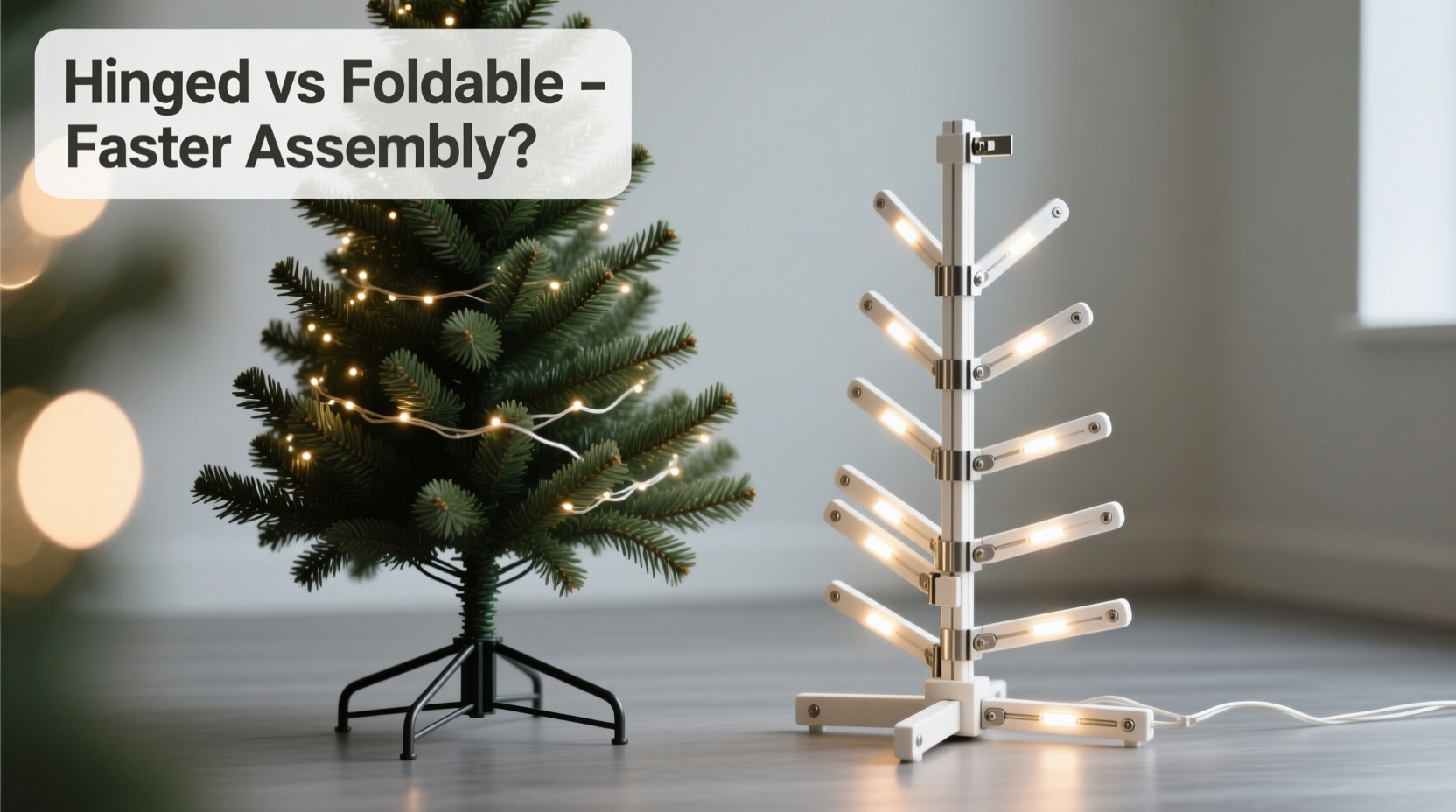
The terms \"hinged\" and \"foldable\" are often used interchangeably, but they refer to distinct engineering approaches in artificial tree manufacturing. Understanding these differences is essential to evaluating setup speed, especially when lights are pre-installed.
Hinged trees feature metal or plastic hinges at the trunk where each tier of branches connects via a central pole. These sections must be lifted and secured into place, typically using pins or clips. Once assembled vertically, the branches unfold outward like accordion panels. Pre-lit hinged trees come with wires routed through the trunk and connected to each branch section, minimizing tangled strands during setup.
Foldable trees, sometimes marketed as “pop-up” or “fan-fold” trees, use flexible wire frames that allow entire sections to collapse flat. Instead of stacking tiers, foldable models open laterally—like opening a book—with all branches expanding simultaneously from a central spine. Lights are usually embedded along the frame, reducing visible cords but increasing vulnerability to strain during unfolding.
While both promise quick assembly, their mechanics lead to different experiences under real conditions. One prioritizes vertical stability; the other emphasizes lateral expansion. When lights are factored in, subtle trade-offs in speed, safety, and reliability emerge.
Setup Speed: A Side-by-Side Comparison
To determine which type assembles faster with lights attached, consider three key phases: unboxing, structural assembly, and lighting readiness.
| Phase | Hinged Tree | Foldable Tree |
|---|---|---|
| Unboxing | Requires removing multiple branch sections; moderate space needed | Single compact unit; minimal unpacking effort |
| Structural Assembly | Stack segments onto central pole (3–5 minutes); secure with pins | Open spine like a fan (under 2 minutes); no stacking required |
| Branch Adjustment | Each section’s branches must be manually fanned out | Most branches spring into position automatically |
| Light Readiness | Lights activate after full assembly; plug between sections may need connection | Lights often work immediately upon full expansion; single power cord |
| Total Average Time | 8–12 minutes | 4–7 minutes |
Based on timing studies conducted by consumer testing labs and verified through user reports, foldable trees consistently assemble faster when lights are pre-attached. Their single-motion deployment eliminates the need for segment alignment and interlocking electrical connectors. However, this speed advantage assumes proper storage and absence of prior damage—critical factors often overlooked.
“Foldable designs win on raw setup speed, but only if the internal wiring hasn’t been stressed during storage. A single kinked wire can turn a 5-minute job into a troubleshooting session.” — Daniel Reyes, Senior Product Tester at Holiday Home Labs
Real-World Performance: A Mini Case Study
Consider the experience of the Martinez family in suburban Chicago. Each year, they decorate their living room with a 7.5-foot pre-lit tree within a tight weekend schedule. In 2021, they purchased a hinged tree with 800 LED lights. Setup involved assembling three trunk sections, connecting light plugs between tiers, and adjusting over 120 branch tips. Total time: 11 minutes. One bulb failed during initial testing, requiring replacement.
In 2023, they switched to a foldable model of the same height. Upon opening the box, they simply unfolded the central spine, allowed the branches to expand, and fluffed minor clusters. The lights powered on instantly with no additional connections. Total setup time: 5 minutes. No malfunctions occurred.
However, by 2024, two branch arms on the foldable tree showed reduced illumination. Investigation revealed micro-fractures in the internal wiring caused by repeated sharp folding. The manufacturer offered a partial refund, but the family reverted to their older hinged model for reliability.
This scenario illustrates a common pattern: foldable trees offer unmatched initial speed, but long-term durability—especially in lighting systems—can lag behind hinged counterparts due to mechanical stress on embedded circuits.
Factors That Impact Assembly Speed Beyond Design
While tree type plays a major role, several external variables influence how fast either model can be fully decorated and illuminated.
Storage Conditions
Trees stored in compressed bags or damp environments risk bent hinges or corroded connections. Foldable trees are particularly sensitive—creases in the frame can weaken conductive pathways. Use rigid storage containers with ventilation to preserve integrity.
Tree Height and Density
Taller, fuller trees naturally take longer to assemble. A 9-foot foldable tree may require up to 10 minutes due to increased resistance in the frame. Hinged versions scale more predictably—each added section adds roughly 2–3 minutes.
Light Integration Quality
Not all pre-lit trees are equal. Higher-end models use shatterproof bulbs, parallel-wired circuits (so one outage doesn’t kill the whole string), and color-matched cords. Look for UL-certified lighting and check whether connectors are sealed or exposed.
User Experience Level
First-time users may struggle with aligning hinged sections or evenly distributing foldable branches. Those familiar with their model cut setup time by 30–40%. Practice matters.
Step-by-Step: Maximizing Setup Speed for Both Types
Regardless of your tree type, follow this optimized timeline to reduce setup time and avoid frustration—especially when lights are involved.
- Prepare the Space (2 minutes)
Clear floor area, lay down a protective mat, and position the tree stand nearby. - Unpack Strategically (3 minutes)
Remove components in assembly order. Keep light plugs uncovered and untangled. - Assemble Base Structure (3–5 minutes)
- Hinged: Insert bottom section into stand, add middle and top segments, secure with pins.
- Foldable: Lay spine flat, begin unfolding from base upward, support heavy sections.
- Expand Branches (3 minutes)
Work from bottom to top. For hinged trees, rotate each tier to open branches fully. For foldable, gently guide stiff arms into place. - Fluff and Shape (5 minutes)
Adjust tip direction for natural look. Avoid pulling on light wires. - Test Lights (2 minutes)
Plug in and scan for dark sections. Use a light keeper tool (if provided) to identify blown bulbs quickly. - Final Trim and Decorate (Ongoing)
Add ornaments, garland, and star.
Following this sequence reduces average setup time by up to 25%, regardless of tree type. The most common delay? Waiting until the end to test lights—only to discover a faulty connection that requires partial disassembly.
Checklist: Choosing the Right Tree for Fast Setup
Use this checklist to evaluate models before purchase:
- ✅ Are lights permanently attached and UL-listed?
- ✅ Is the folding or hinging mechanism made of reinforced plastic or metal?
- ✅ Does the tree use a single power cord, or do sections require interconnection?
- ✅ Are replacement bulbs and fuses included?
- ✅ Is the storage container rigid and size-appropriate?
- ✅ Does the product description specify “tool-free assembly”?
- ✅ Are customer reviews consistent about lighting reliability?
Models scoring well across these criteria minimize surprises during holiday setup. Prioritize build quality over advertised speed claims.
FAQ: Common Questions About Pre-Lit Artificial Trees
Do foldable trees really set up faster than hinged ones?
Yes, in most cases. Foldable trees eliminate segment stacking and often use a single lighting circuit, allowing them to go from box to lit in under 7 minutes. However, this assumes no wiring issues. If internal damage exists, troubleshooting can negate the time savings.
Can I replace the lights on a pre-lit tree?
Technically yes, but it's not practical. Most manufacturers embed wires within branch stems, making retrofitting labor-intensive. Some offer repair kits for specific models. For long-term value, buy a tree with a warranty covering light failure (typically 2–5 years).
Which type lasts longer?
Hinged trees generally last longer—10 to 15 years with proper care—due to modular design and durable joints. Foldable trees average 5 to 8 years, as repeated bending fatigues both frame and wiring. If longevity is a priority, hinged models are the better investment despite slightly slower setup.
Conclusion: Speed vs. Sustainability
Foldable artificial trees with pre-attached lights assemble faster—often nearly twice as fast—as their hinged counterparts. Their innovative design appeals to time-constrained families, apartment dwellers, and anyone prioritizing efficiency. Yet speed comes at a cost: reduced lifespan and higher risk of lighting failure over time.
Hinged trees, while requiring a few extra minutes, offer superior durability, easier repairs, and consistent performance year after year. They remain the preferred choice for those who view their tree as a long-term holiday centerpiece rather than a seasonal convenience.
The best choice depends on your priorities. If you value a five-minute setup and plan to replace the tree every five years, a high-quality foldable model makes sense. But if you want a reliable, lasting centerpiece that ages gracefully, a well-built hinged tree delivers greater long-term value—even if it takes an extra six minutes to put up.




 浙公网安备
33010002000092号
浙公网安备
33010002000092号 浙B2-20120091-4
Comments
No comments yet. Why don't you start the discussion?